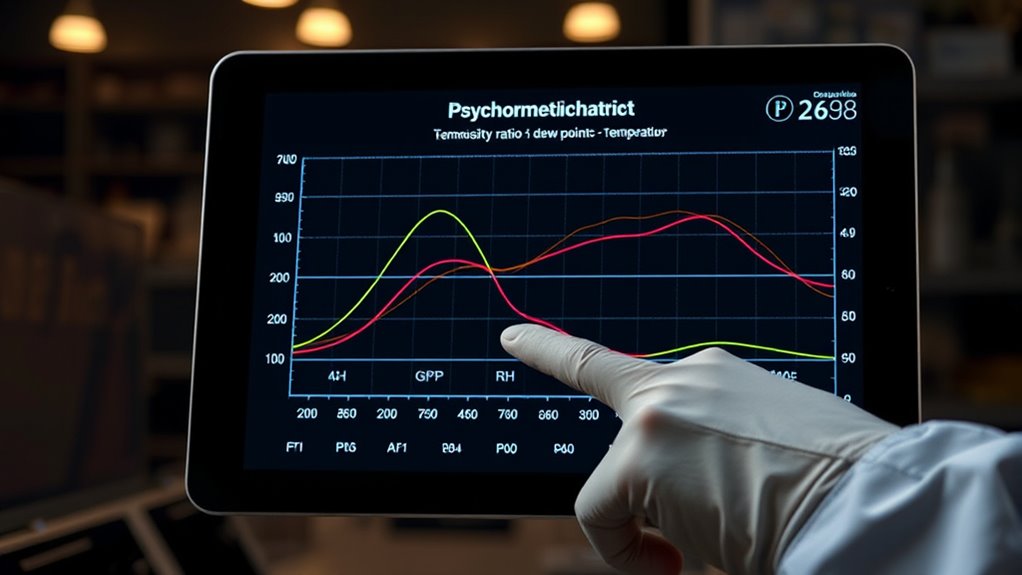
In dehumidification, understanding psychrometrics helps you control moisture effectively by focusing on GPP, RH, and dew point. GPP measures the actual moisture in the air, giving you a precise moisture level, while RH shows how humid the air is relative to its capacity. The dew point indicates when condensation occurs. Combining these factors with psychrometric charts allows you to optimize systems for energy efficiency and comfort. Keep exploring to master how these elements interplay in moisture control.
Get ready for Prime Big Deal Days — try Prime free
Exclusive member deals on October 6–7, plus fast free delivery. Cancel anytime.
As an affiliate, we earn on qualifying purchases.
Key Takeaways
- GPP measures absolute moisture content in grains per pound of dry air, aiding precise humidity control during dehumidification.
- RH indicates vapor ratio relative to maximum capacity; nearing 100% increases condensation risk at the dew point.
- Dew point signifies temperature at which air reaches saturation, crucial for effective moisture removal and preventing condensation.
- Psychrometric charts visualize relationships among temperature, RH, GPP, and dew point, optimizing dehumidification processes.
- Monitoring GPP, RH, and dew point together ensures efficient moisture removal and energy-efficient dehumidification system operation.
As an affiliate, we earn on qualifying purchases.
Understanding Psychrometric Principles in Dehumidification
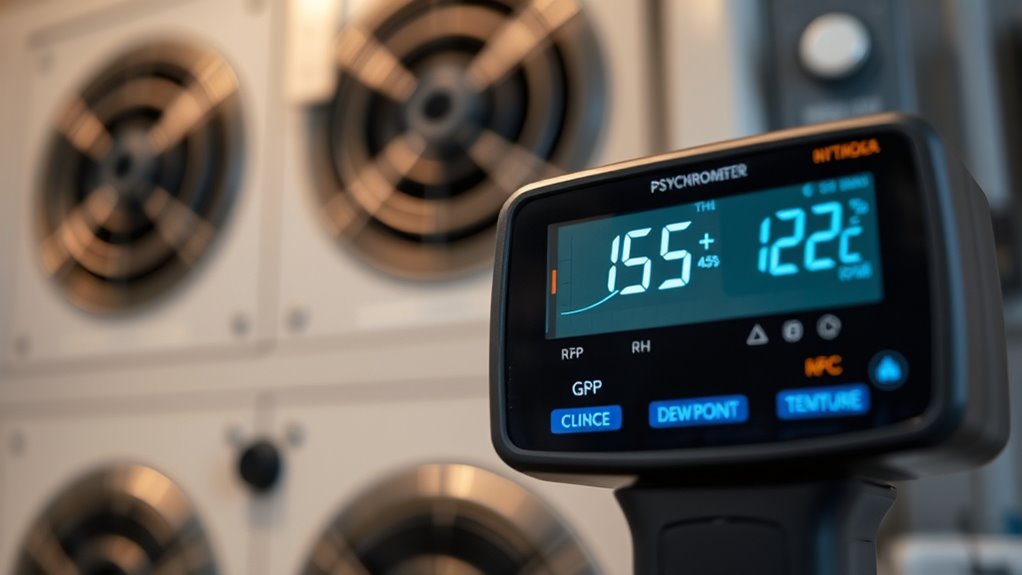
Understanding psychrometric principles is essential for effective dehumidification because they explain how air properties interact during moisture removal. You need to know the dry bulb temperature (DB), which is the air’s measurable temperature unaffected by moisture, and remains constant during latent dehumidification. The wet bulb temperature (WB) shows evaporative cooling effects, while the dew point (DP) indicates when air becomes saturated, leading to condensation. Relative humidity (RH) tells you how much moisture the air holds relative to its capacity at a given temperature. Humidity ratio quantifies the actual moisture content in grains per pound of dry air. Using psychrometric charts, you can visualize how these parameters change during dehumidification, guiding your process to optimize moisture removal while maintaining comfort. Psychrometric data is vital for designing and controlling dehumidification systems effectively, ensuring they operate efficiently and maintain desired indoor climates. Additionally, understanding air property interactions helps in adjusting system parameters for optimal performance.
Grains Per Pound (GPP): Quantifying Moisture Content
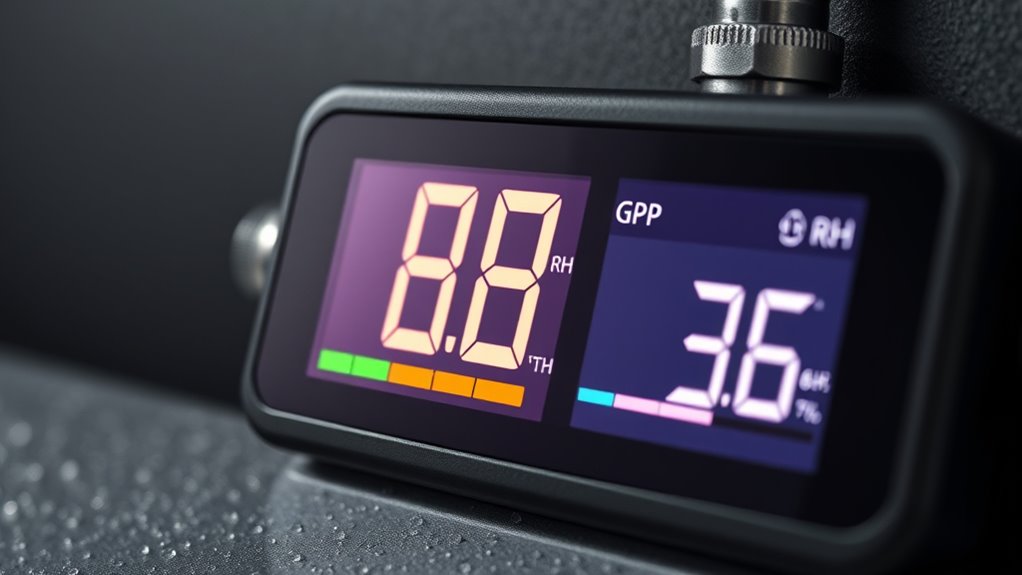
Grains Per Pound (GPP) provides a precise way to measure moisture content in the air or materials. It helps you compare moisture levels directly to humidity and assess how much moisture is being removed during dehumidification. By understanding GPP, you can better evaluate the effectiveness of your drying process and make informed adjustments. GPP is particularly useful because it quantifies moisture in terms of the actual grains present, allowing for more accurate control over moisture levels in various applications. Additionally, understanding the types of headphone jacks can assist in setting up audio equipment for monitoring or educational purposes related to psychrometrics. Recognizing the importance of a well-optimized workspace can also contribute to more precise measurements and better environmental control during dehumidification processes.
Moisture Content Measurement
Measuring moisture content in air often involves quantifying the amount of water vapor relative to dry air, and grains per pound (GPP) serves as a straightforward unit for this purpose. GPP indicates how many grains of moisture are present in one pound of dry air, with one grain equaling 1/7000th of a pound. To determine GPP, technicians use psychrometric charts or digital tools that convert temperature and relative humidity data into grains per pound. This measurement reflects the absolute moisture content, making it essential for accurate humidity control. GPP varies with temperature, even at constant RH, since warmer air can hold more moisture. By measuring GPP, you can precisely evaluate moisture loads, optimize dehumidification systems, and ensure indoor air quality without relying solely on relative humidity percentages. Understanding the relationship between temperature and moisture capacity helps in better managing indoor humidity levels effectively. Additionally, accurate moisture measurement can aid in diagnosing issues related to excess humidity or dryness, ensuring optimal indoor comfort.
GPP vs. Humidity
GPP offers a direct way to quantify moisture content in the air, providing a level of detail that complements relative humidity and dew point measurements. Unlike RH, which expresses the ratio of vapor compared to maximum capacity, GPP measures the actual weight of moisture per pound of dry air. This absolute measurement makes it easier to compare moisture levels across different environments, regardless of temperature changes. GPP directly relates to vapor pressure and dew point, increasing as moisture content rises. While RH and dew point are useful for understanding moisture in relation to temperature, GPP provides precise, mass-based data critical for controlling and monitoring dehumidification processes. Using GPP alongside other metrics ensures a more thorough assessment of the air’s moisture content in various applications. Additionally, understanding the relationship between GPP and dehumidification systems helps optimize environmental control strategies.
Calculating Moisture Removal
To accurately determine how much moisture needs to be removed from the air, you must calculate the difference in moisture content between incoming and outgoing air streams. This involves measuring the GPP of both air samples. The moisture removal rate is then found by multiplying the airflow rate (in CFM) by the GPP difference and dividing by 7,000, converting grains to pounds of water. For example, if incoming air has 150 GPP and outgoing air has 50 GPP, with a flow of 500 CFM, the moisture load is (500 × (150 – 50)) ÷ 7000, equaling about 7.14 pounds per hour. Accurate calculations help size dehumidifiers properly, optimize performance, and ensure the environment maintains desired humidity levels. Understanding GPP differences is key to effective moisture control.
The Role of Relative Humidity in Moisture Control

Understanding how relative humidity relates to dew point helps you prevent condensation issues. When you cool air, RH increases, which can lead to moisture problems if not managed properly. Reheating the air afterward allows you to maintain comfortable humidity levels without risking excess moisture. Additionally, implementing humidity control devices can optimize moisture levels for enhanced comfort and safety. Properly managing ventilation is also crucial, as it helps regulate indoor moisture and prevent buildup that could lead to mold or structural damage.
RH and Dew Point
Relative humidity (RH) plays a crucial role in moisture control because it directly influences when and where condensation occurs in the air. As RH approaches 100%, the air reaches its dew point, causing water vapor to condense into liquid. The dew point is the temperature at which this saturation happens. When the air cools to this point, moisture shifts from vapor to liquid, leading to potential surface or material condensation. The closer the ambient temperature is to the dew point, the higher the RH; a larger gap indicates lower RH. By monitoring both RH and dew point, you can predict condensation risks and adjust dehumidification strategies accordingly. Using psychrometric charts, you can visualize the relationship between RH, dew point, and moisture content to optimize moisture control. Understanding psychrometrics is essential for effectively managing humidity levels in various environments. Additionally, controlling air temperature can influence both RH and dew point, further aiding in moisture management.
Cooling Effects on RH
Cooling systems directly influence indoor humidity levels by removing heat and moisture from the air. When you cool the air, you reduce its capacity to hold water vapor, which leads to dehumidification. This process helps maintain ideal RH levels, typically between 30% and 50%, preventing issues like mold and musty odors. To understand this better: 1. Lowering temperature causes moisture to condense, removing water vapor from the air. 2. Properly sized systems ensure effective dehumidification without overcooling. 3. High humidity levels decrease cooling efficiency and increase energy use, making moisture control essential. Additionally, understanding French Press Operation techniques can aid in better managing indoor humidity through brewing methods that influence moisture levels. Proper air circulation also plays a vital role in preventing stagnant areas where humidity can accumulate.
Reheating and RH Control
Reheating plays a crucial role in controlling indoor humidity levels by adjusting the moisture content of the air after dehumidification. Using modulating hot gas reheat, you can warm cooled, dehumidified air without extra energy sources, maintaining a stable supply air temperature. A 3-way valve precisely controls the reheat coil, preventing temperature swings and improving occupant comfort. Reheating reduces zone RH by reheating air cooled below dew point, allowing more moisture removal—sometimes lowering RH from 64% to 50%. Continuous, modulating reheat minimizes RH fluctuations and prevents moisture damage. This system recycles waste heat from the refrigeration cycle, improving energy efficiency. Sensors and feedback loops help maintain target temperatures, ensuring long-term, stable humidity control without compromising comfort or system performance. Understanding relationships helps optimize system performance and enhances occupant satisfaction. Additionally, selecting the appropriate planters and pots can further improve indoor environments by maintaining optimal humidity levels and supporting healthy plant growth.
Dew Point: The Key to Effective Moisture Removal

Dew point plays a vital role in effective moisture removal because it determines the temperature at which air becomes saturated and water vapor begins to condense. When you cool air to its dew point, moisture condenses out, making dehumidification efficient. To optimize this process, keep these points in mind:
- Dew point sets the moisture removal limit—any temperature below it causes condensation.
- Cooling air to dew point ensures maximum moisture extraction without unnecessary energy use.
- Monitoring dew point helps prevent excess cooling or moisture buildup, protecting against water damage.
Utilizing Psychrometric Charts for System Design
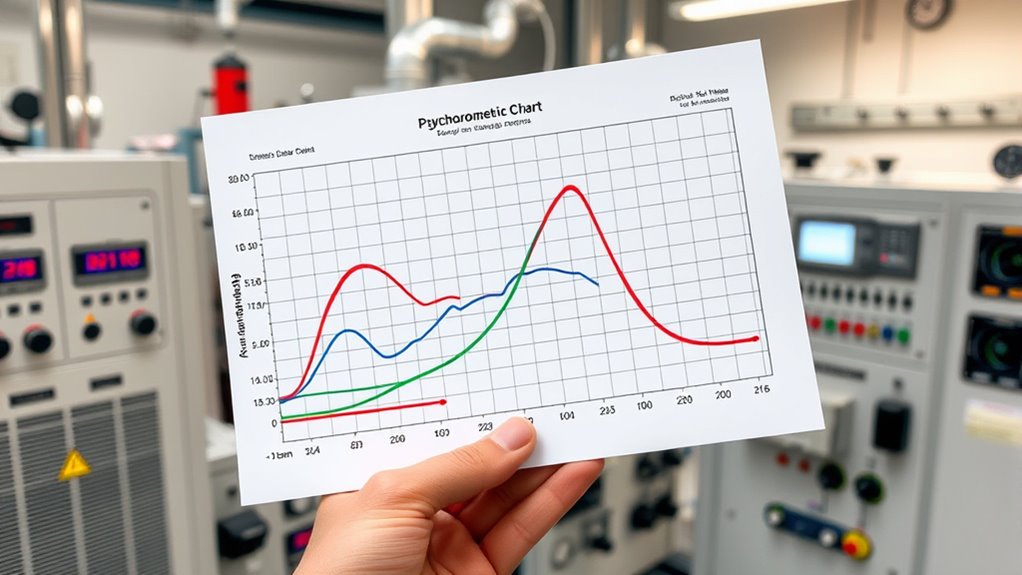
Psychrometric charts serve as essential tools in designing and optimizing HVAC systems by providing a visual representation of the relationships between air temperature, humidity, and other properties. They help you assess system performance, manage moisture, and evaluate energy transfer. By plotting air conditions, you can optimize dehumidification or humidification processes, ensuring comfort and efficiency. Use the chart to analyze cooling coil performance, verify cooling capacity, or troubleshoot environmental issues. Here’s a quick overview:
| Property | Application |
|---|---|
| Dry-bulb & Wet-bulb | Determine cooling and dehumidification needs |
| Humidity Ratio | Manage moisture levels effectively |
| Enthalpy | Assess energy transfer in processes |
| Dew Point | Prevent condensation and surface moisture |
This approach streamlines system design, saving time and improving performance. Incorporating psychrometric data can further enhance control strategies for air conditioning systems to achieve optimal indoor air quality and energy efficiency.
Energy Dynamics in Dehumidification Processes
Understanding how energy moves within dehumidification processes is key to optimizing system performance. You should recognize that energy transfer occurs mainly through latent heat removal via condensation or sorption. During desiccant-based dehumidification, heat transfer causes transient temperature changes as moisture is absorbed or released. After moisture removal, residual heat in the desiccant raises the dry air temperature. Consider these points:
Energy transfer in dehumidification involves latent heat during moisture absorption and release.
- Vapor compression systems consume substantial energy, often between 972–3000 kJ/kg of water removed.
- Liquid and solid desiccant systems improve efficiency by 30–50%, reducing energy costs.
- Regeneration requires significant heat to break sorption bonds, making it a critical factor in overall energy use.
Additionally, understanding the relationships involved in moisture removal can help you identify opportunities to reduce energy consumption and improve system efficiency. Recognizing the energy transfer mechanisms involved allows for better system design and operation adjustments to enhance performance.
Practical Considerations for Dehumidifier Sizing
Selecting the right dehumidifier size requires more than just matching it to your room’s square footage. You need to take into account the humidity levels, moisture sources, and air infiltration. Larger or damper spaces demand higher pint capacities, especially if the environment is tightly sealed or experiences high moisture loads. Temperature also influences sizing; compressor models work best around 20°C, while cooler areas may require desiccant units. Proper air circulation, ideally three times the room volume per hour, ensures efficiency. Don’t rely solely on manufacturer charts; real conditions such as airflow, temperature fluctuations, and humidity spikes impact performance. Evaluating psychrometric properties can help determine the optimal moisture removal rate for your space. Oversizing isn’t problematic but requires adjustments in operation. Evaluate these factors carefully to select a unit that meets your moisture removal needs without unnecessary energy consumption. Additionally, understanding psychrometrics can help optimize dehumidifier performance by analyzing moisture content and air temperature to achieve the desired humidity level.
Optimizing Comfort and Efficiency Through Psychrometrics

Have you ever wondered how indoor air conditions can be precisely controlled for maximum comfort and efficiency? Psychrometrics helps you do just that by analyzing key parameters like dry-bulb temperature, RH, dew point, humidity ratio, and enthalpy. To enhance comfort and energy use, consider these steps: 1. Use psychrometric charts to visualize air process paths, balancing temperature and humidity for occupant comfort. 2. Adjust dehumidification processes to target specific humidity ratios, reducing latent heat and energy consumption. 3. Monitor dew point temperatures to prevent condensation and mold while maintaining ideal moisture levels. Understanding HEPA filtration and other technologies can further improve indoor air quality and system performance. Additionally, grasping the principles of psychrometric properties can optimize your dehumidification strategies for better results.
Frequently Asked Questions
How Does Humidity Ratio Influence Dehumidification System Efficiency?
You influence dehumidification efficiency through the humidity ratio because higher ratios provide more moisture to remove, boosting potential performance. However, this also means your system consumes more energy. To optimize, you need to balance the humidity ratio, ensuring enough moisture removal without excessive energy use. Monitoring and adjusting this ratio helps you achieve better system efficiency, comfort, and indoor air quality.
Can Psychrometric Analysis Predict Mold Growth Risks in Indoor Environments?
Think of psychrometric analysis as your indoor environment’s weather forecast. It helps you predict mold growth risks by showing how temperature, humidity, and dew point interact. By analyzing these factors, you can identify when conditions are ripe for mold, especially if surface temperatures reach or fall below the dew point. This allows you to take proactive steps, like adjusting humidity or temperature, to keep mold at bay and protect your space.
What Are the Limitations of Psychrometric Charts in Real-World Applications?
You should know that psychrometric charts have limitations in real-world use. They often assume standard atmospheric pressure, which can lead to errors at higher elevations. Accurate readings depend on proper measurements like wet-bulb temperature, which can be affected by contamination or environmental factors. Also, charts don’t cover extreme temperatures or rapid changes well, making them less reliable for dynamic or specialized environments. Specialized software can help address some of these issues.
How Does Air Pressure Affect Dew Point and Moisture Removal Calculations?
Pressure pushes, pulls, and perturbs your perceptions of dew point and moisture removal. When air pressure rises, it raises the dew point, meaning less water vapor is needed to reach saturation. Conversely, at lower pressures, like high altitudes, the dew point drops, and moisture becomes more challenging to condense. You must adjust calculations and system settings accordingly, ensuring your dehumidification devices operate efficiently amid shifting atmospheric pressures.
What Role Do External Environmental Conditions Play in System Performance?
External environmental conditions substantially impact your dehumidification system’s performance. Warm, humid outdoor air increases moisture load, making it harder to maintain indoor humidity levels. Seasonal changes alter dew point and wet bulb temperatures, requiring adjustments in your system’s operation. You need to monitor outdoor conditions closely and adapt ventilation rates and dehumidification strategies to guarantee efficient moisture removal and consistent indoor air quality.
Conclusion
Think of psychrometrics as your map through a foggy landscape. By understanding GPP, RH, and dew point, you can navigate moisture control with confidence, ensuring comfort and efficiency. Master these principles, and you’ll steer your dehumidification system like a skilled captain guiding a ship through changing weather. With this knowledge, you’ll clear the air and keep humidity just right, making every environment a safe, comfortable harbor.
NFL season / tailgating Picks
team gear
As an affiliate, we earn on qualifying purchases.