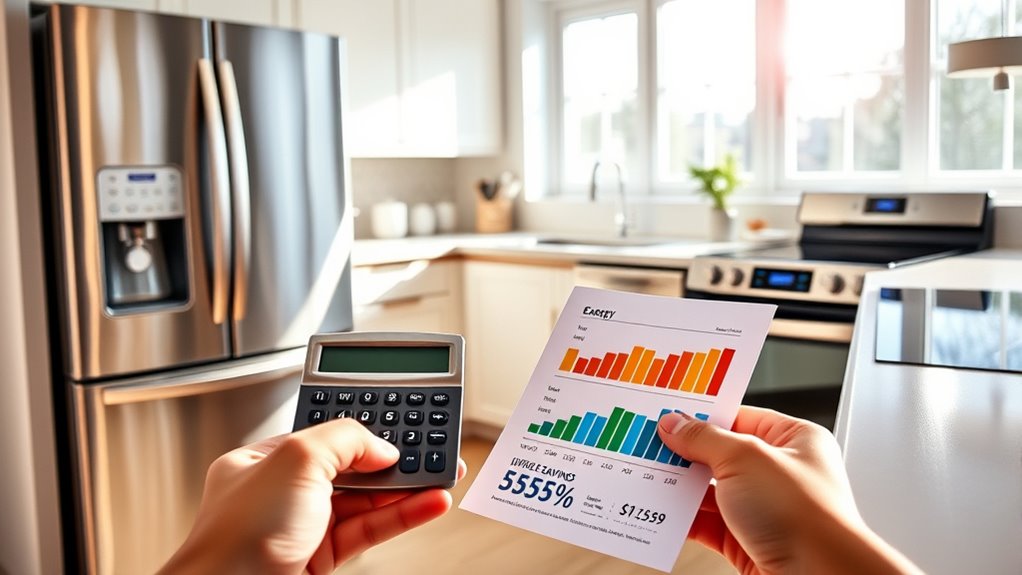

To calculate your lifetime savings from replacing old appliances, first gather their annual energy consumption and compare it to newer, more efficient models. Consider the initial purchase and installation costs, then project your annual energy savings by multiplying energy reductions by your local utility rate. Include the appliance’s lifespan to understand total benefits and account for future energy price increases. Keep exploring—there’s more to uncover about making smart, cost-effective upgrades.

Get home appliances delivered free — and shop member deals
- Fast, free delivery on millions of items
- Access to Prime Big Deal Days deals on October 6–7
- Prime Video, Amazon Music and more included
Key Takeaways
- Determine current and new appliance energy consumption in kWh annually from labels or manuals.
- Calculate annual energy cost savings by multiplying energy reductions by local utility rates.
- Incorporate purchase, installation, and maintenance costs to assess initial investment versus ongoing savings.
- Project total savings over the appliance’s lifespan, considering efficiency retention and energy price fluctuations.
- Compare the total long-term savings to initial costs to evaluate the financial viability of the upgrade.

Replacing old appliances can lead to significant savings, but understanding exactly how much you’ll save requires some calculations. This is where a thorough cost analysis comes into play. To start, you need to compare the energy efficiency of your current appliances with that of new models. Energy efficiency determines how well an appliance uses power to perform its function, and more efficient appliances consume less electricity, which translates into lower utility bills over time. When evaluating new appliances, look for those with high energy efficiency ratings, such as ENERGY STAR certifications, which can provide a clear indication of their performance and energy savings potential.
Next, gather data on your current appliances’ energy consumption. Most appliances have energy labels or specifications that list their average annual energy use, usually in kilowatt-hours (kWh). If this information isn’t readily available, you can often find it in the user manual or manufacturer’s website. Once you have this data, compare it with the energy consumption figures for the new appliances you’re considering. This comparison will give you an idea of how much energy you can save each year by upgrading.
However, energy efficiency isn’t the only factor in your cost analysis. You should also factor in the purchase price of the new appliances, installation costs, and any maintenance or operational costs that might differ from your current appliances. While newer models might have a higher upfront cost, their improved energy efficiency usually results in lower ongoing expenses. Calculate the difference in annual energy costs—by multiplying the energy savings (in kWh) by your local utility rate—and then project these savings over the appliance’s expected lifetime. This will give you a clear picture of your total potential savings.
Don’t forget to consider the lifespan of the appliances. Some appliances last longer and maintain efficiency over many years, increasing the total savings. Also, keep in mind that energy prices can fluctuate, so it’s wise to incorporate a conservative estimate of future energy costs into your analysis. Additionally, understanding the role of long-term savings in your decision helps you weigh initial costs against future benefits. Once you’ve done the math, you’ll be able to determine whether the initial investment in a new, more efficient appliance makes sense financially in the long run.
In short, a careful cost analysis rooted in understanding energy efficiency helps you see the bigger picture. It transforms vague ideas of savings into concrete numbers, empowering you to make informed decisions about replacing your old appliances and maximizing your long-term savings.
As an affiliate, we earn on qualifying purchases.
Frequently Asked Questions
How Do Energy Efficiency Ratings Impact Savings Calculations?
Energy efficiency ratings directly impact your savings calculations by indicating how much energy your new appliance will save over its lifespan. Higher ratings mean lower energy consumption, boosting your savings and reducing renovation costs. By comparing ratings, you can estimate how long it’ll take to recoup your investment, considering appliance lifespan and initial costs. This helps you make smarter choices, maximizing savings while minimizing long-term expenses.
What Role Do Utility Rate Changes Play in Long-Term Savings?
Imagine your utility bill as a rollercoaster—today’s savings could vanish with tomorrow’s rate hikes. Utility rate trends and regional rate variations play a huge role in long-term savings, making your initial energy-efficient investment sometimes feel like buying a ticket for a wild ride. Staying aware of these shifts helps you gauge true savings, ensuring you’re not caught off guard when rates spike, erasing your appliance upgrade gains.
How Can I Account for Maintenance Costs of New Appliances?
You should estimate the maintenance costs of your new appliances based on their appliance lifespan and typical repair expenses. To do this, consider the average maintenance costs over the expected lifespan and factor in how often you’ll need replacements or repairs. This approach helps you determine the best replacement timing, ensuring you balance upfront costs with ongoing maintenance to maximize savings over time.
Do Tax Incentives Significantly Affect Overall Savings?
Did you know that homeowners who utilize tax incentives and rebate programs save an average of 20% on appliance costs? These incentives can considerably boost your overall savings by reducing upfront expenses and increasing the return on investment. Tax incentives often lower the initial purchase price, making new appliances more affordable. Rebate programs can add extra cash back, further improving your financial benefits and accelerating your savings timeline.
How Accurate Are Online Savings Calculators for Appliance Replacements?
Online savings calculators for appliance replacements can be fairly accurate if they consider appliance lifespan and environmental impact. They often use your input data and current energy rates to estimate savings over time. However, your actual savings depend on factors like usage habits and local energy costs. While useful, these tools provide estimates rather than precise figures, so it’s wise to review assumptions and compare multiple sources for better accuracy.
Conclusion
By crunching the numbers, you’ll see that upgrading your appliances saves you more than just energy — it saves your wallet in the long run. Remember, the initial investment might seem steep, but it’s like planting a seed that grows into a fruitful tree over time. Don’t let old, inefficient appliances drain your resources; instead, make the switch and watch your savings blossom, proving that sometimes, the best things come to those who wait and plan wisely.
Fall yard work Picks
leaf blowers
As an affiliate, we earn on qualifying purchases.