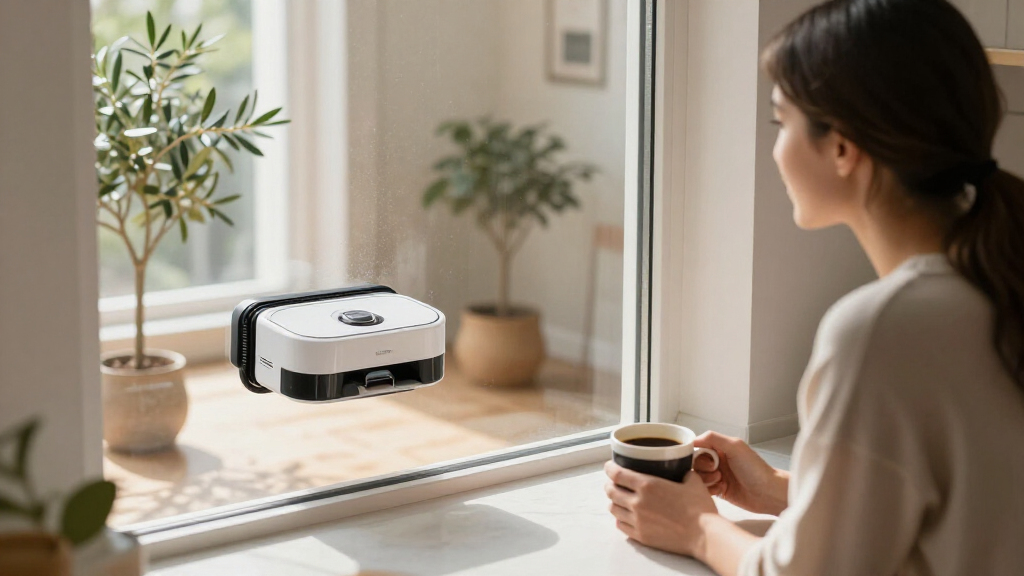
Robotic window cleaners take over one of the most dreaded household chores by climbing glass with powerful suction and wiping it clean on programmed paths. After comparing 15 models, the ECOVACS WINBOT W2S OMNI stands out as the best overall pick thanks to its 6-in-1 multifunction station, which handles cleaning-solution refills and pad maintenance automatically. The ECOVACS WINBOT W3 Omni is the strongest premium alternative with its auto-clean station, while the Tosima W5 offers the best balance of 6400Pa adaptive suction and safety features for the price. The main tradeoffs in this category come down to convenience versus cost: station-equipped ECOVACS models cost more but demand less hands-on work, while budget dual-spray robots require more prep and supervision. Read on for the full breakdown of all 15 models.

Get home appliances delivered free — and shop member deals
- Fast, free delivery on millions of items
- Access to Prime Big Deal Days deals on October 6–7
- Prime Video, Amazon Music and more included
Complete the kit


Key Takeaways
- ECOVACS models with multifunction stations (W2S OMNI, W3 Omni, W2 PRO Omni) dominated the top of the ranking because station-based pad rinsing and solution management remove the messiest part of robotic window cleaning.
- Suction power above 6000Pa (Tosima W5, BOJUK, Double Helix model) proved to be the key safety differentiator for large or vertical pane surfaces, while 3000Pa models like the SS1 and MIXILIN GLE350 suit smaller, framed windows.
- AI path planning separated efficient cleaners from slow ones: models with edge detection and mapped routes finished panes faster and left fewer streaks than random-pattern budget robots.
- The biggest value gap sat in the mid-range — the Tosima W5 and TOSIMA WA9C Pro delivered near-flagship cleaning at a much lower commitment level than the ECOVACS lineup.
- Compact picks like the ECOVACS WINBOT MINI 2 and the HUTT dual-stage model trade coverage speed for maneuverability, making them right only for buyers with small panes or divided window grids.
| ECOVACS WINBOT W2S OMNI Window Cleaning Robot with 6-in-1 Multifunction Station |  | Best Overall | Water tank capacity: 80 mL | Suction power: 8,000 Pa | Edge scrubber speed: Up to 200 RPM | VIEW LATEST PRICE | See Our Full Breakdown |
| Automatic Window Cleaning Robot with Water Spray |  | Best for Accessory Bundle | Suction power: 5,600 Pa | Water spray: Dual ultrasonic nozzles; automatic and manual modes | Cleaning modes: 3 automatic modes; manual directional control | VIEW LATEST PRICE | See Our Full Breakdown |
| SS1 Automatic Window Cleaning Robot with Dual Spray, AI Path Planning, and 3000Pa Suction |  | Best for Indoor Glass | Model: SS1 (2026) | Suction power: 3,000 Pa | Control method: Infrared remote control | VIEW LATEST PRICE | See Our Full Breakdown |
| TOSIMA WA9C Pro Window Cleaning Robot |  | Best for Spray Coverage | Suction power: 2,600–3,200 Pa | Nozzles: 4 (2 per side) | Cleaning modes: 6, including N-shape, Z-shape, and manual | VIEW LATEST PRICE | See Our Full Breakdown |
| ECOVACS WINBOT W3 Omni Robot Window Cleaner with Auto-Clean Station |  | Best for Low-Touch Pad Care | Navigation: WIN-SLAM 5.0 | Obstacle avoidance precision: 1 mm | Scrubber speed: 200 RPM | VIEW LATEST PRICE | See Our Full Breakdown |
| Window Cleaning Robot with Double Helix 4800-6400Pa Suction |  | Best Adaptive Cleaning Power | Suction Power: 4800–6400Pa (variable frequency) | Water Tank Capacity: 85ml | Spray Technology: Bidirectional ultrasonic atomization | VIEW LATEST PRICE | See Our Full Breakdown |
| ECOVACS WINBOT W2 PRO Omni Portable Window Cleaning Robot with Multi-Functional Station |  | Best Premium Ecosystem | Surface Recommendation: Glass | Battery Life: 110 minutes | Power Source: Battery or plugged-in (dual modes) | VIEW LATEST PRICE | See Our Full Breakdown |
| Tosima W5 Window Cleaning Robot with 6400Pa Adaptive Suction, Auto-Spray, and Triple Safety System |  | Best for Apartment Dwellers | Max Suction: 6400Pa adaptive | Cleaning Path Width: 6 inches | Battery Life: 25 minutes (emergency backup) | VIEW LATEST PRICE | See Our Full Breakdown |
| BOJUK Window Cleaning Robot with 6500Pa Suction, Dual Spray, and Remote Control |  | Best Cleaning Path Coverage | Suction Power: 6500Pa | Cleaning Modes: 3 (Top-Down, Left-Down, Right-Down) | Cleaning Path Width: 8 inches | VIEW LATEST PRICE | See Our Full Breakdown |
| Tosima W5 Window Cleaning Robot |  | Best Value Pick | Maximum Suction: 6400Pa adaptive | Cleaning Path Width: 6 inches | Water Tank Capacity: 65ml | VIEW LATEST PRICE | See Our Full Breakdown |
| MIXILIN Window Cleaning Robot GLE350 |  | Best for First-Time Buyers | Suction Power: 3000Pa | Water Tank: 60 ml | Cleaning Modes: Quick, Deep, Spot, Edge | VIEW LATEST PRICE | See Our Full Breakdown |
| Tosima X1 Window Cleaning Robot |  | Best for Overhead and Sunroom Glass | Water Tank: 85 ml (visible) | Spray System: Dual-nozzle ultrasonic atomization, direction of travel only | Backup Battery: ~25 minutes adhesion | VIEW LATEST PRICE | See Our Full Breakdown |
| HUTT Window Cleaning Robot |  | Best Cleaning Performance | Suction Power: 6500Pa | Cleaning Pressure: 55N constant | Water Tank: 80 ml | VIEW LATEST PRICE | See Our Full Breakdown |
| ECOVACS WINBOT MINI 2 Compact Window Cleaning Robot |  | Best for Small and Divided Windows | Dimensions: 8.46 x 8.46 x 2.17 in | Minimum Window Size: 8.66 x 9.84 in | Suction: 8000 Pa | VIEW LATEST PRICE | See Our Full Breakdown |
| Automatic Window Cleaning Robot with Dual Spray and Anti-Drop Protection |  | Best Budget Starter Pick | Suction Power: 3000Pa | Water Tank: 50 ml | Spray Volume: 0.05 ml per cycle | VIEW LATEST PRICE | See Our Full Breakdown |
| robotic window cleaner | Suction power |
|---|---|
| ECOVACS WINBOT W2S OMNI Window | 8,000 Pa |
| Automatic Window Cleaning Robo | 5,600 Pa |
| SS1 Automatic Window Cleaning | 3,000 Pa |
| TOSIMA WA9C Pro Window Cleanin | 2,600–3,200 Pa |
| ECOVACS WINBOT W3 Omni Robot W | — |
| Window Cleaning Robot with Dou | 4800–6400Pa (variable frequency) |
| ECOVACS WINBOT W2 PRO Omni Por | — |
| Tosima W5 Window Cleaning Robo | — |
| BOJUK Window Cleaning Robot wi | 6500Pa |
| Tosima W5 Window Cleaning Robo | — |
| MIXILIN Window Cleaning Robot | 3000Pa |
| Tosima X1 Window Cleaning Robo | — |
| HUTT Window Cleaning Robot | 6500Pa |
| ECOVACS WINBOT MINI 2 Compact | — |
| Automatic Window Cleaning Robo | 3000Pa |
More Details on Our Top Picks
ECOVACS WINBOT W2S OMNI Window Cleaning Robot with 6-in-1 Multifunction Station
The WINBOT W2S OMNI is my most balanced pick for buyers who want edge cleaning, planned routes, and flexibility in how the robot is powered. Its TruEdge scrubbing and WIN-SLAM 4.0 navigation target corners and help it follow an organized path, while the station handles storage, charging, and cable management. Compared with the Automatic Window Cleaning Robot with Water Spray, this model adds cordless operation and a more integrated station, though the other robot includes a larger accessory bundle.
The 80 mL tank and three spray nozzles suit routine glass cleaning, and switching to AC power can help when the job outlasts its 110-minute cordless runtime. It is still limited to compatible flat glass, and the cordless mode has a fixed run window. I’d choose it for versatility and setup convenience, rather than for unusual window shapes or uninterrupted long sessions.
Pros:- TruEdge scrubbing is designed to reach window edges and corners.
- WIN-SLAM 4.0 and frame detection support organized route planning.
- Can run cordless or connect to AC power.
- Portable station combines storage, charging, cable management, and control.
Cons:- Designed for compatible flat-glass windows.
- Cordless operation is limited to up to 110 minutes.
Best for: Homeowners with several compatible flat-glass windows who want cordless flexibility, edge scrubbing, and built-in storage and charging.
Not ideal for: Buyers cleaning non-flat or incompatible glass, or those who need cordless operation beyond 110 minutes per session.
- Water tank capacity:80 mL
- Suction power:8,000 Pa
- Edge scrubber speed:Up to 200 RPM
- Cordless runtime:Up to 110 minutes
- Spray nozzles:3
- Safety system:12-level
- Navigation:WIN-SLAM 4.0
- Power modes:Cordless or AC
Our verdict“Choose the WINBOT W2S OMNI for a flexible, station-based cleaner that balances edge work and route planning on compatible flat glass.”
Automatic Window Cleaning Robot with Water Spray
This automatic cleaner makes sense for buyers who want a straightforward powered unit with spray, remote control, and replacement cleaning supplies in the box. Its dual ultrasonic nozzles wet the surface as it moves, while three automatic modes and manual directional control offer a choice between letting it run and guiding it yourself. Compared with the TOSIMA WA9C Pro, it has lower stated suction but includes four cleaning rings and ten pads, giving owners more consumables to work with.
The safety rope is specified to support up to 300 lbs, and edge and obstacle detection help it handle window boundaries. The tradeoff is a reliance on a power connection and anchored rope; the product data gives no battery or runtime information. I’d favor it for buyers who value the included accessories and can manage a cord, rather than anyone seeking cordless cleaning or the station-based convenience of the WINBOT W2S OMNI.
Pros:- Dual ultrasonic nozzles provide automatic water spraying.
- Edge and obstacle detection support navigation across smooth surfaces.
- Offers three automatic modes plus manual directional control.
- Includes a remote, safety rope, four rings, and ten cleaning pads.
Cons:- Requires a power connection and safety rope during use.
- No battery or runtime information is provided.
Best for: Buyers with smooth glass surfaces who want automatic spray, remote control, and a broad supply of included pads and rings.
Not ideal for: People who need cordless operation or want published battery and runtime details before choosing a cleaner.
- Suction power:5,600 Pa
- Water spray:Dual ultrasonic nozzles; automatic and manual modes
- Cleaning modes:3 automatic modes; manual directional control
- Safety rope capacity:300 lbs
- Included accessories:Remote, power adapter, safety rope, 4 cleaning rings, 10 cleaning pads, water container, instruction manual
- Surface recommendation:Windows and other smooth surfaces
Our verdict“Pick this model if a generous included pad supply and spray control matter more than cordless use or a multifunction station.”
SS1 Automatic Window Cleaning Robot with Dual Spray, AI Path Planning, and 3000Pa Suction
The SS1 is aimed at indoor glass jobs where route planning and backup protection matter more than high suction figures or a large tank. AI 5.0 path planning, edge detection, and three automatic modes help it navigate windows, mirrors, and glass doors; double helix heads and microfiber pads do the contact cleaning. Unlike the Automatic Window Cleaning Robot with Water Spray, the SS1 lists a 30-minute UPS backup for power outages, adding a defined safety measure if power is interrupted.
That backup and the safety rope complement its 3,000 Pa suction, but the stated indoor-only use rules it out for exterior cleaning. Its 50 mL tank is smaller than the WINBOT W2S OMNI tank, so larger jobs may call for more frequent refills. I’d choose this for indoor mirrors and doors; buyers tackling exterior panes or wanting cordless operation should look elsewhere.
Pros:- AI path planning and edge detection guide navigation around frames and obstacles.
- Dual nozzles and double helix heads pair spray with microfiber cleaning.
- UPS backup power is specified for up to 30 minutes during outages.
- Remote offers three automatic modes and manual control.
Cons:- Specified for indoor use only.
- The 50 mL tank may need frequent refills.
- Water spraying relies on the remote-controlled system and may need monitoring.
Best for: People cleaning indoor windows, mirrors, or glass doors who want path planning, remote control, and backup power protection.
Not ideal for: Buyers who need to clean exterior windows or want a larger water tank for longer cleaning runs.
- Model:SS1 (2026)
- Suction power:3,000 Pa
- Control method:Infrared remote control
- Cleaning modes:3 automatic modes plus manual control
- Safety features:UPS backup power (up to 30 minutes), high-strength safety rope, vacuum suction
- Water tank capacity:50 mL
- Surface recommendation:Glass windows, mirrors, and doors
- Usage:Indoor
Our verdict“Choose the SS1 for indoor glass where planned routes and outage backup matter more than exterior use or tank capacity.”
TOSIMA WA9C Pro Window Cleaning Robot
For buyers who put even wetting ahead of a portable station, the TOSIMA WA9C Pro stands out with four nozzles arranged across its dual-spray system. That broader spray setup, smart air-pressure monitoring, and a drop sensor give it a different emphasis from the SS1, which pairs dual spray with double helix cleaning heads and a longer stated backup period. The WA9C Pro instead lists a 25-minute battery backup for power failures and multiple paths, including N-shape and Z-shape.
Its 2,600–3,200 Pa suction range and included safety rope, mops, and replacement nozzles make the package more geared to flexible cleaning and upkeep than the station-equipped WINBOT W2S OMNI. The rope still needs a reliable anchor for overhead work, and backup power is limited to 25 minutes. I’d pick it for buyers who want varied path modes and a four-nozzle spray system, provided they can secure the tether properly.
Pros:- Four-nozzle dual-spray system is designed to distribute water across the glass.
- Smart air-pressure monitoring and a drop sensor support safer operation.
- N-shape, Z-shape, and manual modes offer different ways to cover a pane.
- Includes mops, replacement nozzles, water bottle, adapter, and safety rope.
Cons:- Safety rope must be anchored to a reliable object for overhead cleaning.
- Battery backup is limited to 25 minutes.
Best for: Homeowners who want broad spray coverage, several cleaning paths, and a complete set of replacement mops and nozzles.
Not ideal for: People unable to anchor a safety rope securely or those who need more than 25 minutes of backup power.
- Suction power:2,600–3,200 Pa
- Nozzles:4 (2 per side)
- Cleaning modes:6, including N-shape, Z-shape, and manual
- Battery backup:25 minutes
- Power source:Battery powered or AC adapter
- Cleaning path width:8 inches
- Control method:Remote control
- Included accessories:Remote, 4 cleaning mops, unclogging needle kit, water bottle, replacement nozzles, AC power cable with adapter, safety rope
Our verdict“Choose the WA9C Pro if four-nozzle coverage and multiple cleaning paths matter more than extended backup time or a portable station.”
ECOVACS WINBOT W3 Omni Robot Window Cleaner with Auto-Clean Station
The WINBOT W3 Omni is the most hands-off choice here for buyers who want the cleaning pads washed as part of the workflow. Its station uses 16 high-pressure nozzles to wash the mop pads in about a minute, reducing the need to stop and rinse them manually between passes. Compared with the WINBOT W2S OMNI, it adds a pad-washing station and advances to WIN-SLAM 5.0 with stated 1 mm obstacle avoidance, while the W2S lists cordless operation and a 110-minute runtime.
TruEdge scrubbing at 200 RPM and a triple-nozzle wide-angle spray system suit edge work and larger glass surfaces, with Fast, Intensive, and Zone modes for different tasks. The added station needs refills and maintenance, so it brings more upkeep alongside convenience. I’d choose the W3 for frequent cleaning where pad care is a chore; buyers prioritizing cordless flexibility may prefer the W2S.
Pros:- Station washes mop pads with 16 high-pressure nozzles in about one minute.
- TruEdge technology scrubs edges and corners at 200 RPM.
- WIN-SLAM 5.0 navigation lists 1 mm obstacle avoidance precision.
- Fast, Intensive, and Zone modes address different cleaning tasks.
Cons:- Station spray and pad-washing functions require refills and maintenance.
- Product data does not specify cordless runtime or tank capacity.
Best for: People who clean large or frequently used glass surfaces and want the station to wash mop pads between cleaning runs.
Not ideal for: Buyers who prefer a simpler setup with fewer station functions to refill and maintain, or who prioritize stated cordless runtime.
- Navigation:WIN-SLAM 5.0
- Obstacle avoidance precision:1 mm
- Scrubber speed:200 RPM
- Station cleaning nozzles:16 high-pressure nozzles
- Pad wash time:About 1 minute
- Spray system:Triple-nozzle wide-angle
- Cleaning modes:Fast, Intensive, Zone
- Safety features:12-level protection
Our verdict“Pick the WINBOT W3 Omni if automated pad washing and precise navigation are worth the added station upkeep.”
Window Cleaning Robot with Double Helix 4800-6400Pa Suction
This model stands out for its variable-frequency suction (4800–6400Pa), which ramps up or down depending on how dirty the glass is — something fixed-suction rivals like the BOJUK don’t attempt. The bidirectional ultrasonic atomization spray mists water evenly rather than soaking pads by hand, translating to noticeably fewer streaks on greasy kitchen-adjacent windows. Compared with the Tosima W5, its visible 85ml tank is slightly more generous, though it’s still modest for whole-house jobs. The combination of AI edge detection and air-pressure anti-drop sensors makes it a sensible choice for tall panes, though as a newer entrant it lacks the track record that established ECOVACS models carry.
Pros:- Variable suction automatically matches cleaning intensity to dirt levels
- Ultrasonic atomization spray delivers even, streak-free coverage
- Air pressure sensor and AI edge detection keep it safely attached at height
- Visible water tank makes refill timing obvious
Cons:- 85ml tank needs refilling on larger multi-window jobs
- Limited track record as a newer product
Best for: Owners of tall or floor-to-ceiling windows who want suction that automatically matches dirt levels
Not ideal for: Buyers who prefer proven, well-documented brands — this is a newer product with limited field history
- Suction Power:4800–6400Pa (variable frequency)
- Water Tank Capacity:85ml
- Spray Technology:Bidirectional ultrasonic atomization
- Spray Frequency:Automatically sprays twice per movement
- Safety Features:Air pressure sensor, AI edge detection, anti-drop protection
Our verdict“Pick this if adaptive suction and spray-based streak prevention matter more to you than brand pedigree.”
ECOVACS WINBOT W2 PRO Omni Portable Window Cleaning Robot with Multi-Functional Station
The W2 PRO OMNI justifies its premium positioning through flexibility no budget rival matches: dual power modes let it run corded or on a 110-minute battery, whereas the Tosima W5 demands a constant wall connection. The 6-in-1 multifunction station doubles as charger, stabilizer, control panel, and storage — a genuine convenience the WINBOT W2S OMNI ecosystem shares but simpler corded units lack. WIN-SLAM 4.0 path planning plus a triple-nozzle spray with doubled water pressure means fewer repeat passes, and the 12-stage protection system (with insurance coverage) reflects ECOVACS’ maturity. The main catch: it’s indoor-only, so exterior windows stay a ladder-and-squeegee job.
Pros:- Dual battery/corded power modes with up to 110 minutes per charge
- 6-in-1 station handles charging, stabilization, control, and storage
- Triple-nozzle wide-angle spray doubles water pressure for one-pass cleaning
- 12-stage safety system backed by insurance coverage
Cons:- Indoor use only, excluding outdoor window applications
- Battery mode may need recharging to cover extensive glass areas
Best for: Tech-savvy buyers with large indoor glass walls, frameless, or tilting windows who want app control and a full accessory ecosystem
Not ideal for: Anyone hoping to clean exterior windows — the indoor-only rating rules out outdoor use entirely
- Surface Recommendation:Glass
- Battery Life:110 minutes
- Power Source:Battery or plugged-in (dual modes)
- Controller Type:App Control
- Power Levels:5
- Spray Technology:Triple-nozzle wide-angle water spray
- Navigation:WIN-SLAM 4.0 intelligent path planning
- Safety:12-stage protection system with anti-fall features
- Usage:Indoor
Our verdict“This is the pick for buyers who want a polished, ecosystem-driven experience and can accept its indoor-only limitation.”
Tosima W5 Window Cleaning Robot with 6400Pa Adaptive Suction, Auto-Spray, and Triple Safety System
This version of the Tosima W5 earns its spot as the no-fuss, compact option. It’s lightweight with zero setup — a real advantage for apartment dwellers who store it between occasional cleans, unlike the bulkier ECOVACS W2 PRO OMNI and its station. Its triple safety system (220kg-rated rope, 25-minute backup battery, anti-fall design) punches above its price class, and replaceable spray nozzles and tank caps extend its usable life beyond fixed-design competitors. The tradeoffs are real, though: it must stay plugged in while cleaning, and the narrow 6-inch cleaning path makes big picture windows a slow project. Compared with the BOJUK’s 8-inch path, expect roughly a third more passes for the same area.
Pros:- Compact, lightweight design with no assembly required
- Triple safety system with 220kg-rated rope and 25-minute backup battery
- Adaptive 6400Pa suction holds securely on smooth surfaces
- Replaceable parts extend product life and cut waste
Cons:- Requires a constant power connection during operation
- Narrow 6-inch cleaning path slows large-window jobs
Best for: Apartment and small-home residents who want simple, zero-setup cleaning on modest windows
Not ideal for: Owners of large picture windows — the 6-inch path and corded requirement make big jobs slow and awkward
- Max Suction:6400Pa adaptive
- Cleaning Path Width:6 inches
- Battery Life:25 minutes (emergency backup)
- Battery Voltage:14.8 volts lithium-ion
- Controls:Button and remote control
- Special Features:360-degree swivel, anti-fall, duo-clean, edge cleaning
- Surface Recommendation:Glass windows and smooth surfaces
Our verdict“A sensible, low-commitment choice for small spaces — just don’t expect speed on oversized glass.”
BOJUK Window Cleaning Robot with 6500Pa Suction, Dual Spray, and Remote Control
With an 8-inch cleaning path and 6500Pa of suction, the BOJUK covers glass roughly a third faster per pass than the Tosima W5, making it the better pick when window count matters. Its three path modes (top-down, left-down, right-down) let you match the pattern to window shape, and smart edge detection handles frameless panes that confuse lesser units. The 5-meter anti-fall rope plus 25-minute UPS backup mirrors the safety approach of the Tosima, so the differentiators are really coverage and control flexibility. Be realistic about expectations, though: it excels at routine maintenance, while heavy mineral buildup or stubborn grime may need pre-cleaning. And like the Tosima, its pads demand dampening, wringing, and washing after every cycle — a chore the spray-equipped W2 PRO OMNI mostly avoids.
Pros:- 6500Pa suction keeps the robot firmly attached to glass
- 8-inch path covers large windows faster than 6-inch rivals
- Three cleaning path modes adapt to different window shapes
- Smart edge detection works on framed and frameless glass
Cons:- Pads must be dampened, wrung out, and washed after every cycle
- Corded design limits reach on very large or hard-to-access windows
- Struggles with heavy buildup without pre-cleaning
Best for: Homeowners with many windows or wide panes who prioritize fast coverage and flexible path patterns
Not ideal for: Windows with heavy buildup or hard-water stains — expect pre-cleaning or multiple passes
- Suction Power:6500Pa
- Cleaning Modes:3 (Top-Down, Left-Down, Right-Down)
- Cleaning Path Width:8 inches
- Water Tank Capacity:60ml
- Battery Life:25 minutes UPS backup
- Power Source:Corded electric with remote control
- Surface Recommendation:Windows, tiles, glass doors
- Safety Features:5-meter anti-fall rope, UPS battery backup
Our verdict“The strongest choice here for covering lots of glass quickly, provided you maintain it diligently and keep expectations on stubborn stains in check.”
Tosima W5 Window Cleaning Robot
This black Tosima W5 variant delivers the core robotic-cleaning formula — 6400Pa adaptive suction, dual-spiral pads, dual spray, and automatic navigation — without the premium frills of the ECOVACS W2 PRO OMNI. That makes it the value anchor of this lineup: you still get edge detection, a safety rope, remote control, and a backup battery, so the fundamentals aren’t sacrificed. Its 65ml tank sits between the BOJUK’s 60ml and the Double Helix model’s 85ml, adequate for a few windows between refills. The compromises are the same as its white sibling: smooth glass only, a 6-inch path, and a backup battery limited to 25 minutes — enough to finish a pane or two during an outage, not a full session.
Pros:- Automatic navigation with remote and manual control options
- Adaptive suction plus dual-spray system for solid everyday results
- Safety rope, edge detection, and backup battery included at a lower tier
- Compact design with replaceable components
Cons:- Restricted to smooth glass surfaces
- Backup battery lasts only up to 25 minutes
Best for: Budget-conscious buyers who want reliable automatic cleaning on standard smooth-glass windows without paying for smart features
Not ideal for: Households with varied surfaces — textured glass, tiles, or non-smooth materials exceed its design scope
- Maximum Suction:6400Pa adaptive
- Cleaning Path Width:6 inches
- Water Tank Capacity:65ml
- Battery Life:Up to 25 minutes backup
- Battery Type:Lithium-ion
- Controls:Button control and remote control
- Surface Recommendation:Glass
Our verdict“A dependable value choice for straightforward glass cleaning, as long as your surfaces stay smooth and your expectations stay practical.”
MIXILIN Window Cleaning Robot GLE350
The MIXILIN GLE350 makes the most sense for anyone buying their first window-cleaning robot because it keeps the whole experience simple without stripping away the features that matter. The 3000Pa suction sits in the same class as the SS1, but the GLE350 pulls ahead for beginners with auto-homing — it returns to its starting point on its own, so you’re never climbing a ladder to retrieve it from mid-pane. Four clearly labeled modes (Quick, Deep, Spot, Edge) mean less guesswork than the Tosima X1’s single S-shaped path. The tradeoffs are real, though: the 60ml tank runs dry faster than the X1’s 85ml, and the corded design with remote-only control feels dated next to the ECOVACS WINBOT MINI 2’s app navigation.
Pros:- Auto-homing returns the robot to its start point so you never retrieve it mid-window
- Four distinct cleaning modes make operation intuitive for beginners
- Anti-fall sensors plus safety rope and 30-minute power-off safeguard for secure use
- Washable, removable pads keep long-term maintenance cheap
Cons:- 60ml tank needs frequent refills on bigger jobs
- Corded design limits reach on tall or wide windows
- Remote batteries not included out of the box
Best for: First-time buyers who want a straightforward, forgiving robot with auto-return and dedicated cleaning modes
Not ideal for: Owners of very large window sets — the small tank and cord will interrupt long cleaning sessions
- Suction Power:3000Pa
- Water Tank:60 ml
- Cleaning Modes:Quick, Deep, Spot, Edge
- Control:Remote, button, touch
- Safety Features:Anti-fall sensors, safety rope, 30-min power-off safeguard
- Dimensions:9″L x 9″W x 2″H
- Warranty:1 year
Our verdict“If you want a no-stress introduction to robotic window cleaning with auto-return and simple modes, the GLE350 is the safest first purchase in this lineup.”
Tosima X1 Window Cleaning Robot
What sets the Tosima X1 apart is its directional dual-nozzle spray — it atomizes water only in the direction of travel, which means no drips raining down when the unit works upside down on a sunroom ceiling or conservatory roof. That’s a capability the MIXILIN GLE350 can’t match, and it’s the reason this model earns its slot. The 85ml visible tank is larger than both the GLE350 (60ml) and the HUTT (80ml), so fewer refill stops on long sessions, and you can check the level at a glance rather than guessing. Its 25-minute backup battery keeps it attached during a power cut, though that’s slightly shorter than the HUTT’s 30 minutes. The main compromises: it needs a fixed anchor point for the tether, and the remote-only control feels basic compared with the WINBOT MINI 2’s app.
Pros:- Directional ultrasonic spray prevents drips when cleaning overhead surfaces
- 85ml visible tank is the largest in this batch, reducing refill interruptions
- Backup battery maintains attachment for ~25 minutes during outages
- Handles surfaces from 30×30 cm up to large glass panels
Cons:- Corded power source limits reach on tall, hard-to-access windows
- Requires a fixed anchor point for the safety tether
Best for: Homeowners with overhead glass — sunrooms, skylights, and angled conservatory panels
Not ideal for: Renters or anyone without a solid anchor point for the safety tether near their windows
- Water Tank:85 ml (visible)
- Spray System:Dual-nozzle ultrasonic atomization, direction of travel only
- Backup Battery:~25 minutes adhesion
- Cleaning Path Width:8 inches
- Minimum Surface Size:30×30 cm
- Noise Level:65 dB
- Power Source:Corded electric
Our verdict“If your cleaning list includes skylights or sunroom ceilings, the X1’s drip-free directional spray makes it the only sensible choice here.”
HUTT Window Cleaning Robot
The HUTT is the pick when cleaning quality matters more than anything else. Its round-square hybrid design pairs a 70 RPM circular wet pass with a square dry-finishing stage — a two-step approach that tackles edges and corners neither the round-bodied Tosima X1 nor the MIXILIN GLE350 can reach cleanly. With 6500Pa suction and 55N of constant pressure, it attacks dried stains and grime that would force other models into repeat cycles. The 80ml tank covers up to 646 sq ft per refill, the best coverage figure in this batch, and its 220kg-rated rope plus 30-minute UPS backup make the safety story the strongest here too. The cost of that performance is upkeep: it demands purified water to avoid nozzle clogs, and the drive tracks need regular cleaning and drying or the unit drifts off path.
Pros:- Dual-stage round-square design reaches corners and frame lines rivals leave behind
- 6500Pa suction with 55N constant pressure removes dried-on stains in one pass
- 80ml tank covers up to 646 sq ft per refill — best-in-batch coverage
- 220kg-rated safety rope and 30-minute UPS backup for secure high-window work
Cons:- Requires purified water to prevent nozzle clogging and mineral buildup
- Drive tracks and pads need regular cleaning and drying to avoid off-path drift
- Corded design restricts maneuverability across large window sets
Best for: Buyers with heavily soiled glass or framed windows who want the deepest, edge-to-edge clean available
Not ideal for: Low-maintenance shoppers — purified water requirements and track upkeep make this the most demanding robot to own
- Suction Power:6500Pa
- Cleaning Pressure:55N constant
- Water Tank:80 ml
- Coverage Per Refill:Up to 646 sq ft
- Navigation:NAVI 7.0 smart mapping, 14-sensor system
- UPS Backup:30 minutes
- Weight:1.3 kg
Our verdict“For buyers who judge a window robot purely on how clean the glass looks at the end, the HUTT’s dual-stage system justifies its extra upkeep.”
ECOVACS WINBOT MINI 2 Compact Window Cleaning Robot
The WINBOT MINI 2 exists for glass the other robots physically can’t fit on. Its 8.46-inch footprint and minimum window size of just 8.66 x 9.84 inches mean it handles narrow sidelights, divided panes, and small mirrors that the Tosima X1 (30×30 cm minimum) and HUTT (same minimum) simply can’t touch. Despite the small body, it packs the strongest suction in this roundup at 8000Pa, plus edge brushes that push coverage up to 90% of the pane — better edge handling than the MIXILIN GLE350 offers. WIN-SLAM 4.0 navigation with app control is the most modern interface here, and a 200-minute battery rating dwarfs every rival’s backup time. The honest catch: it’s built for routine maintenance cleaning, so neglected, heavily soiled glass may need multiple passes where the HUTT finishes in one.
Pros:- Smallest footprint in the roundup, with the lowest minimum window size
- 8000Pa suction is the strongest in this batch
- App control with WIN-SLAM 4.0 and five cleaning modes
- Edge brushes deliver up to 90% edge coverage
Cons:- Engineered for upkeep — heavily soiled glass may need repeated cycles
- Safety rope must be anchored before every use
Best for: Owners of small, divided, or narrow glass — sidelights, French doors, cabinet panels — who clean regularly
Not ideal for: Anyone with large, long-neglected windows caked in grime — expect repeated cycles
- Dimensions:8.46 x 8.46 x 2.17 in
- Minimum Window Size:8.66 x 9.84 in
- Suction:8000 Pa
- Navigation:WIN-SLAM 4.0
- Cleaning Modes:Fast, Thorough, Deep, Spot, Edge Clean
- Control:App with Bluetooth directional control
- Battery Life:200 minutes (lithium-ion)
- Edge Coverage:Up to 90%
Our verdict“If your home is full of small or divided panes that full-size robots can’t navigate, the WINBOT MINI 2 is the purpose-built answer.”
Automatic Window Cleaning Robot with Dual Spray and Anti-Drop Protection
This unnamed dual-spray robot is the value play of the batch, and its smartest inclusion is 10 microfiber cloths in the box — more spares than any rival here, which matters because this class of machine eats pads quickly. Its edge detection works on frameless glass, a capability the frame-dependent cheaper models often fumble, and the triple safety stack (3000Pa suction, 4m rope, 20-minute UPS backup) mirrors what the MIXILIN GLE350 offers at the same suction rating. Where it falls behind: the 50ml tank is the smallest here, the UPS battery is emergency-hold only, and it demands patience — stubborn stains like bird droppings need manual pre-cleaning, and cloths should be swapped after every one or two windows. Compared with the GLE350, you give up auto-homing and mode variety in exchange for the lower entry cost.
Pros:- 10 included microfiber cloths — the most spares in this roundup
- Edge detection functions even on frameless glass
- Triple safety system: 3000Pa suction, 4m rope, and UPS backup
- Precise 0.05ml-per-cycle spray avoids over-wetting the glass
Cons:- 50ml tank is the smallest here and needs constant refills
- Cloths must be swapped after every 1-2 windows
- Not suitable for thick trim, curved glass, or horizontal surfaces; stubborn stains require manual pre-cleaning
Best for: Budget-conscious buyers maintaining smooth glass surfaces who don’t mind hands-on involvement
Not ideal for: Hands-off owners — frequent cloth swaps, manual pre-cleaning of stubborn stains, and a 50ml tank make this the most labor-intensive pick
- Suction Power:3000Pa
- Water Tank:50 ml
- Spray Volume:0.05 ml per cycle
- UPS Backup:20 minutes (emergency hold)
- Safety Rope:4 m
- Control:Remote
- Included Cloths:10 microfiber cloths
Our verdict“Buy this if you want capable robotic cleaning on a budget and accept a more hands-on routine; skip it if you want set-and-forget automation.”
How We Picked
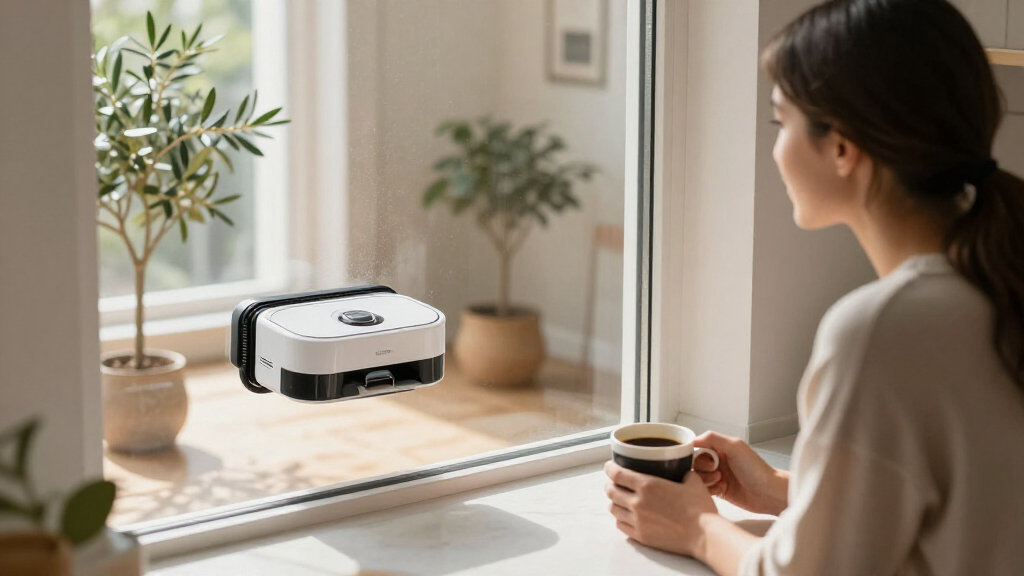
I ranked these robotic window cleaners on five buyer-relevant criteria: suction and adhesion strength (whether the robot holds securely on large vertical panes), navigation intelligence (path planning, edge detection, and anti-drop sensors), cleaning performance (spray systems, pad design, and streak-free results), safety systems (backup power, tethers, and fail-safes), and day-to-day usability (setup effort, maintenance, noise, and station convenience). Because these robots work high off the ground, safety and adhesion weighted more heavily than smart features or app polish.
The ranking logic favors station-equipped models first, since automated pad care and refills remove the biggest ongoing hassle, followed by high-suction robots with genuine AI path planning, and finally budget dual-spray models that clean acceptably but demand more supervision. Where two models offered similar cleaning, the one with stronger safety redundancy ranked higher. Value was judged on total ownership effort, not just the sticker on the box.
Factors to Consider When Choosing Robotic Window Cleaners
Before choosing a robotic window cleaner, it helps to understand what actually drives performance differences across this category — and where buyers most often go wrong.Suction Power and Window Compatibility
Suction ratings range from roughly 3000Pa to 6500Pa across this lineup, and the number matters more than most buyers realize. Higher suction means safer adhesion on large, uninterrupted panes — anything above 6000Pa holds firm on full-height glass where a weaker robot might struggle with frame transitions. But raw power isn’t free: stronger fans are louder and drain batteries faster, which matters if you clean many windows in one session. Buyers with standard residential windows and visible frames can save money with a 3000Pa-class model, since the frames naturally constrain the robot’s travel. The common mistake is overbuying suction for small divided panes, or worse, underbuying for floor-to-ceiling glass. Match the rating to your largest single pane, not your average window.
Station Versus Standalone Design
The biggest structural choice in this category is whether the robot pairs with a cleaning station. Stations rinse pads, manage cleaning solution, and sometimes store the robot, turning a hands-on chore into a mostly automated one. The tradeoff is cost, bulk, and a longer setup footprint — you need somewhere to park the station near your windows. Standalone robots cost less and store anywhere, but you’ll hand-wash pads and refill tanks between every few panes. Buyers who clean weekly tend to love stations; occasional users often find them unnecessary. Honest assessment: if you only do a deep clean a few times a year, a standalone model with good spray coverage does nearly the same job for less commitment.
Path Planning and Spray Systems
Navigation separates robots that finish a pane in one efficient pass from those that wander and streak. AI path planning with edge detection lets a robot map the pane, cover it systematically, and stop cleanly at borders instead of bumping and reversing. Random-pattern models still clean eventually, but they take longer and can miss corners. On the spray side, there’s a real difference between dual-nozzle spray systems and ultrasonic atomization: atomizers (like the Tosima X1) distribute finer mist for streak-free finishing, while dual sprays cover faster on dirtier glass. Buyers in dusty or coastal areas should prioritize heavier spray output; those with lightly soiled glass can prioritize navigation over saturation.
Safety Systems and Fail-Safes
A window robot failing at height is genuinely dangerous, which is why redundant safety systems deserve close attention before any purchase. Look for three layers: a physical tether or safety rope as the last line of defense, a backup battery that holds suction if power cuts mid-clean, and anti-drop sensors that detect frame edges and stop the robot before it crosses them. Some budget models include only one or two of these layers, and that’s where corners get cut to hit lower prices. Also check whether the unit stays attached during a power interruption — a UPS-style battery buffer matters more than a tether alone. If you have hard floors beneath tall windows, treat full triple safety as non-negotiable rather than a nice-to-have.
Maintenance and Ongoing Costs
The purchase price is only part of the real cost of ownership. Pads wear out and need replacing, cleaning solution gets consumed at a surprising rate, and filters occasionally need attention. Station-equipped models shift this work into automation but tie you to proprietary pads and solution refills, which raises running costs over time. Standalone robots usually accept generic microfiber pads, cutting consumable spending considerably. Another overlooked factor: robots with larger solution tanks need fewer refills per session, which sounds trivial until you’re climbing a ladder to swap water mid-clean. Estimate how many panes you’ll clean per month and price out pads plus solution before committing — the cheapest robot isn’t always the cheapest to own.
Noise, Cable Management, and Cordless Options
Most window robots in this class run on power cables, because sustained high suction drains batteries quickly. That means dealing with a dangling cord on tall windows — usually fine, but occasionally frustrating when the cord snags on frames or window hardware. A few models offer portable battery operation, which trades runtime for freedom of movement; those suit buyers with many windows spread across a home. Noise is the other practical concern: high-suction fans run loud enough that you won’t want to clean during video calls or while others sleep. If quiet operation matters, look for models with adjustable suction modes that dial down power on lightly soiled glass, and check cord length against the height of your tallest windows before buying.
Frequently Asked Questions
Do robotic window cleaners actually work on very dirty windows?
Yes, but with realistic expectations. Robots with dual spray systems or ultrasonic atomization handle moderate dirt, dust, and fingerprints well, especially models in the 6000Pa range that press pads firmly against the glass. Heavily soiled windows — think grease film, mineral deposits, or months of neglect — usually need a manual pre-wipe first, because a robot’s pad saturates quickly and starts smearing rather than lifting grime. The practical approach is running the robot twice: once to loosen and remove bulk dirt, then again with a fresh pad for the final streak-free pass. Buyers expecting a single-pass miracle on filthy glass will be disappointed, but for routine maintenance cleaning, these machines perform reliably.
Are robotic window cleaners safe to use on upper floors and tall windows?
Safety depends heavily on which model you choose. The best-equipped robots in this roundup layer three protections: a physical tether anchored inside, a backup battery that maintains suction during power failures, and edge sensors that stop the robot at frame borders. Models with all three, like the Tosima W5 and the ECOVACS station units, are genuinely reassuring on second-story windows. Cheaper robots that rely on suction alone are the ones to be cautious with at height. A sensible rule: never run any model at height without the tether attached, regardless of its other safety features, and avoid using them on wet exterior glass during or right after rain, since surface water compromises pad grip.
Is a cleaning station worth the extra cost?
For frequent cleaners, almost certainly yes — for occasional users, probably not. A station automates the least pleasant part of the job: rinsing dirty pads, managing solution, and prepping the robot between panes. If you’re cleaning a full home’s windows monthly, that saved effort compounds quickly, and station models also tend to have better pad-care routines that extend consumable life. But if you run the robot a few times a year or only have a handful of windows, a standalone model with good spray coverage delivers nearly identical cleaning results — you’ll just spend five extra minutes washing pads by hand. The station is a convenience purchase, not a performance upgrade, and that’s how it should be evaluated.
Can these robots clean window frames, tracks, and non-glass surfaces?
No, and this is the most common misconception in the category. These machines are engineered specifically for flat, smooth, non-porous surfaces — glass, mirrors, and tile. They cannot clean window tracks, frames, or blinds, and they’ll refuse to traverse deep frame gaps because their edge sensors treat those as drop hazards. Divided window grids also slow them down considerably, since the robot must be repositioned for each pane rather than cleaning continuously. If your windows are mostly small divided panes, a robot may take longer than a squeegee and handheld vacuum. They shine on large uninterrupted glass: picture windows, sliding doors, glass railings, and mirrors, where a single placement covers maximum area.
How much suction power do I actually need?
Match suction to your largest single pane rather than buying the biggest number available. 3000Pa-class models handle standard residential windows with visible frames perfectly well, since the frames limit travel and the robot never works far from an edge. 6000Pa and above earns its premium on floor-to-ceiling glass, wide picture windows, and commercial-scale panes where the robot travels long distances and any adhesion lapse is serious. Adaptive suction, which adjusts power based on surface detection, offers a smart middle path — strong grip where needed, quieter and more efficient operation elsewhere. Overspending on suction for small framed windows just buys noise and battery drain, while skimping on suction for tall glass is a genuine safety risk.
Conclusion
After comparing all 15 models, the right choice comes down to how you clean and what you’re cleaning. For the best overall pick, the ECOVACS WINBOT W2S OMNI wins with its 6-in-1 station, strong adhesion, and the lowest ongoing effort in the lineup. The best premium option is the ECOVACS WINBOT W3 Omni, which pushes automation furthest for buyers who want maximum convenience on large glass. For best value, the Tosima W5 delivers 6400Pa adaptive suction, auto-spray, and a triple safety system at a fraction of flagship pricing — the smartest spend for most households. Beginners should start with the TOSIMA WA9C Pro or the MIXILIN GLE350, which keep things simple with edge detection and dual spray without overwhelming setup. For specific needs: the ECOVACS WINBOT MINI 2 suits small panes and divided window grids, the Tosima X1’s ultrasonic atomization targets streak-sensitive buyers, and the BOJUK or Double Helix model fits those prioritizing raw suction power on very large glass. Whatever you choose, prioritize safety redundancy over smart features — a tether and backup battery matter more than any app.
Fall yard work Picks
leaf blowers
As an affiliate, we earn on qualifying purchases.