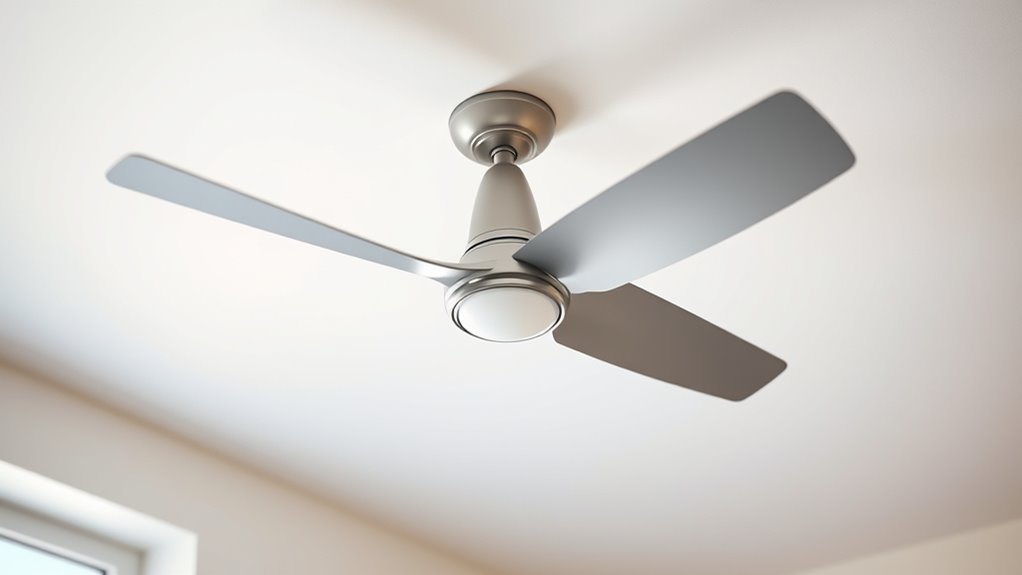

When considering ceiling fan efficiency, CFM per watt shows how much airflow you get for each watt of power used. A higher CFM/W means the fan moves more air while consuming less energy, saving you money on energy bills. Larger, well-maintained fans tend to have better efficiency ratings. To choose the right fan, you need to match the size and airflow needs of your space. If you want to learn how to pick the best, keep exploring these key points.
Key Takeaways
- CFM per Watt measures a ceiling fan’s airflow efficiency, indicating how much air it moves relative to power consumed.
- Higher CFM/W ratios mean better energy efficiency, saving on electricity costs while maintaining airflow.
- Fans with low CFM/W (<155) are less efficient, leading to higher energy use for the same airflow.
- Proper maintenance and selecting high-quality fans help sustain optimal CFM per Watt performance.
- Matching fan size and CFM per Watt to room size ensures effective airflow and energy savings.
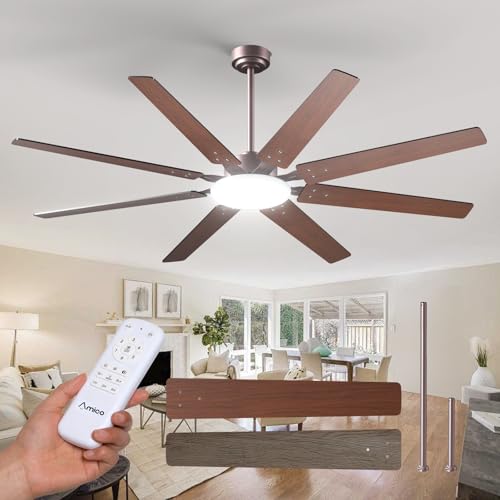
Amico 72 inch Farmhouse Bronze Ceiling Fan with Light, Large Energy Efficient Ceiling Fans with Remote, Reversible DC Motor, Dimmable 3CCT LED, Quiet Indoor/Outdoor for Living Room, Bedroom, Patio
Ceiling Fan with Light: Decorate your home with Amico ceiling fan! While bringing you coolness and comfort, it…
As an affiliate, we earn on qualifying purchases.
As an affiliate, we earn on qualifying purchases.
Understanding CFM and Its Role in Fan Performance
Understanding CFM is essential when evaluating ceiling fan performance because it directly measures the amount of air a fan moves per minute. CFM, or Cubic Feet per Minute, quantifies airflow volume, typically measured at the fan’s highest speed. This metric appears in product specs and helps you compare models. A higher CFM means the fan moves more air, improving cooling efficiency and air circulation. It’s important to match the CFM to your space size; standard rooms need about 4,000-5,000 CFM, while larger areas require more. Remember, CFM reflects volume, not airflow speed, so a high CFM indicates better air movement but doesn’t guarantee a breeze or cooling sensation. Blade design and size also influence effective CFM, impacting overall fan performance. CFM varies from 1,000 to 10,000 across different models, providing options suitable for different needs and room sizes. Additionally, understanding airflow efficiency can help you select a fan that balances power consumption with performance.

72 Inch Ceiling Fans with Lights and Remote, Dual-Sided Reversible Blades for Versatile Décor, Quiet DC Motor, 120° Wide-Angle Customized Brightness & 3CCT, Damp Rated for Indoor/Outdoor Use
SMART MEMORY & STEPLESS DIMMING Tired of cycling through light settings every time you flip the switch? Our…
As an affiliate, we earn on qualifying purchases.
As an affiliate, we earn on qualifying purchases.
What Does CFM per Watt Tell Us About Energy Efficiency?

While CFM measures how much air a ceiling fan moves, it doesn’t tell you how effectively it does so. CFM per Watt (CFM/W) shows this, indicating how many cubic feet of air a fan moves per watt of energy used. A higher CFM/W means better efficiency—you get more airflow for less power. Keep in mind:
- Fans with high CFM but also high wattage aren’t energy-efficient.
- DC motors often provide higher CFM/W ratings than traditional AC motors.
- Blade design, size, and speed settings influence the effectiveness.
- Regular maintenance helps keep fans operating near their optimal CFM/W levels.
CFM/W ratings can vary depending on the fan’s design and operating conditions, including motor efficiency and blade aerodynamics. Additionally, energy-efficient motor technology plays a significant role in enhancing overall fan performance and efficiency.
72 Inch Ceiling Fans with Lights and Remote, Dual-Sided Reversible Blades for Versatile Décor, Quiet DC Motor, 120° Wide-Angle Customized Brightness & 3CCT, Damp Rated for Indoor/Outdoor Use
SMART MEMORY & STEPLESS DIMMING Tired of cycling through light settings every time you flip the switch? Our…
As an affiliate, we earn on qualifying purchases.
As an affiliate, we earn on qualifying purchases.
Typical CFM and CFM/W Values for Different Fan Sizes and Types

Understanding how fan size affects airflow and efficiency helps you choose the right ceiling fan for your space. Larger fans generally move more air and tend to be more efficient, but their ratings vary based on design and standards. Comparing typical CFM and CFM/W values across sizes lets you find models that balance performance and energy use effectively. Additionally, advances in AI-driven solutions are increasingly influencing the development of more energy-efficient fan technologies. Being aware of lifestyle trends, such as remote work, can also impact how you optimize your space for comfort and productivity, including choosing energy-efficient appliances like ceiling fans.
Fan Size and Airflow
Choosing the right ceiling fan size is essential for efficient airflow and energy use in your space. Larger fans generally move more air, making them suitable for bigger rooms, while smaller fans work better in compact areas. Here’s what to consider:
- Small fans (up to 42 inches) produce 1,000–3,000 CFM, ideal for bathrooms or small bedrooms.
- Medium fans (44–55 inches) generate 1,600–4,500 CFM, perfect for kitchens and dining rooms.
- Large fans (over 50 inches) move 2,300–6,500 CFM, suited for master bedrooms or family rooms.
- Extra-large fans (over 62 inches) deliver up to 13,500+ CFM, best for expansive spaces like great rooms. Matching fan size to room size ensures efficient airflow and helps optimize energy consumption. The airflow efficiency of a fan can vary based on design and motor quality, impacting overall performance and energy use. Additionally, choosing a fan with a higher CFM per watt ratio can further improve energy efficiency.
Efficiency Standards and Ratings
Efficiency standards and ratings help you evaluate how well a ceiling fan converts electricity into airflow. The DOE sets minimum CFM/W thresholds based on fan type and size, ensuring energy-efficient performance. Large fans over 53 inches are measured using CFEI, with targets of 1.00 or higher at high speed. Typical residential fans range from 35 to 176 CFM/W depending on size and speed, with HVLS fans exceeding industry standards. Here’s a quick overview:
| Fan Size/Type | Typical CFM/W | Efficiency Standard | Notes |
|---|---|---|---|
| Small (~24″) | 35-155 | ~75 CFM/W | Lower efficiency |
| Medium (~49″-60″) | 51-176 | 60-75 CFM/W | Most common residential |
| Large (over 53″) | N/A | CFEI ≥ 1.00 | Uses CFEI measurement |
| HVLS (Commercial) | Exceeds 176 | High efficiency | Designed for large spaces |
| High-efficiency DC fans | Varies | Above minimum | Motor tech improves ratings |
Additionally, advancements in energy efficiency technologies continue to drive improvements in fan performance and ratings.
Amico 72 inch Farmhouse Bronze Ceiling Fan with Light, Large Energy Efficient Ceiling Fans with Remote, Reversible DC Motor, Dimmable 3CCT LED, Quiet Indoor/Outdoor for Living Room, Bedroom, Patio
Ceiling Fan with Light: Decorate your home with Amico ceiling fan! While bringing you coolness and comfort, it…
As an affiliate, we earn on qualifying purchases.
As an affiliate, we earn on qualifying purchases.
How Power Consumption Affects Ceiling Fan Efficiency
Power consumption plays a crucial role in determining how well a ceiling fan performs relative to the energy it uses. When you choose a fan, higher wattage at a given speed means more energy is consumed for the airflow produced. To improve efficiency, consider these factors:
Choosing fans with lower wattage at the same speed enhances energy efficiency and airflow performance.
- Fan size and design: Larger fans often deliver more airflow per watt, boosting efficiency.
- Motor type: Brushless DC motors use less power while maintaining airflow, enhancing CFM/W.
- Speed settings: Running fans at lower speeds consumes less power, making them more efficient for background airflow.
- Operational wattage: Fans with lower wattage on high speed or standby use save energy without sacrificing airflow. Additionally, selecting fans with optimized motor efficiency can further improve overall energy performance.
- Material and construction: The sound vibrations generated by the fan’s components can influence energy efficiency and operational smoothness.
Understanding this relationship helps you select fans that balance airflow needs with energy savings.
The Impact of Efficiency on Energy Costs and Savings
Efficient ceiling fans can considerably lower your energy bills by consuming less electricity while still providing effective airflow. By choosing models with higher CFM per watt, you maximize airflow for less power, translating to savings. For example, a fan with 287.8 CFM/W moves more air effectively than one meeting only the minimum standards. Using less energy per hour means lower monthly costs, especially when compared to air conditioning units. Durability and quality also ensure consistent performance, reducing repair and replacement costs over time.
| Fan Efficiency Level | Energy Savings Potential |
|---|---|
| High (above 287 CFM/W) | Maximum cost reduction |
| Standard (around 155–287 CFM/W) | Moderate savings |
| Low (below 155 CFM/W) | Limited savings |
| Poorly maintained | Increased costs |
Choosing the Right Fan Size and CFM for Your Room
To select the right ceiling fan, you need to take into account your room size and match it with the appropriate fan diameter and CFM rating. Keep in mind that ceiling height affects how well air circulates, so you might need downrods or multiple fans for larger or high-ceiling spaces. Choosing a fan with the right size and efficiency ensures comfortable airflow without wasting energy or creating drafts. Additionally, selecting a fan with an optimal CFM per Watt ratio can maximize energy savings and performance. For those interested in performance enhancements, considering Kia Tuning options like ECU remapping and suspension upgrades can also improve vehicle efficiency, similar to how selecting a high-efficiency ceiling fan optimizes air circulation while conserving energy.
Room Size Guidelines
Choosing the right ceiling fan depends on matching its size and airflow capacity to your room’s dimensions. To do this effectively, consider these guidelines:
- Small rooms (up to 75 sq ft) need fans with blade spans of 29-36 inches and CFM under 1,500. Proper sizing prevents underperformance and energy waste.
- Medium rooms (76-144 sq ft) are best served by fans 36-42 inches, with CFM between 1,500 and 3,000.
- Larger rooms (144-225 sq ft) require 44-50-inch fans with CFM from 1,600 to 4,500.
- Rooms over 225 sq ft (up to 400 sq ft) benefit from fans 50-54 inches, with CFM ratings between 2,300 and 6,500. Understanding CFM per watt can help optimize energy efficiency while maintaining effective airflow.
Additionally, matching the fan’s energy consumption to its airflow capacity can lead to significant savings on electricity bills.
Ceiling Height Impact
Ceiling height considerably influences the size and airflow capacity of the fan you need. For rooms with standard 8-foot ceilings, a fan rated around 4,000 to 5,000 CFM works well. If your ceiling is higher, such as 9 to 12 feet, you’ll need fans with higher CFM ratings—over 5,000—to move air effectively. Larger spaces or vaulted ceilings require longer downrods and bigger blade spans (50 inches or more) to guarantee proper airflow. Proper mounting is vital; flush mounts suit lower ceilings, while longer downrods are necessary for taller ones. Choosing the right fan size and CFM based on ceiling height helps optimize airflow, improves efficiency, and maintains comfort without wasting energy.
Fan Efficiency Tips
How do you guarantee your ceiling fan operates efficiently and keeps your space comfortable? The key is choosing the right size and CFM for your room. Here are some tips:
- Match fan size to room dimensions—smaller fans for tiny rooms, larger fans for bigger spaces.
- Prioritize high CFM per watt ratings to maximize energy efficiency.
- Select fans with energy-efficient DC motors and aerodynamic blades for better airflow at lower power.
- Consider your daily usage—running the fan only when needed saves energy and cuts costs.
Frequently Asked Questions
How Does Blade Shape Influence a Fan’s CFM and Efficiency?
Your fan’s blade shape directly impacts its CFM and efficiency by reducing air turbulence and drag. Aerodynamically contoured, tapered blades move air more smoothly, increasing airflow while using less energy. Well-designed shapes minimize resistance and optimize airflow patterns, so you get higher CFM per watt. Choosing fans with blades shaped for efficiency guarantees you circulate air effectively, save energy, and maintain comfort without unnecessary power consumption.
Can Ceiling Fans With Higher Cfm/W Still Be Noisier?
Ever wondered if a fan with higher CFM/W can still be noisy? The answer is yes. Even highly efficient fans can produce more noise due to factors like blade design, motor type, and speed settings. Lightweight motors or aerodynamic blades might boost airflow but also generate higher-frequency noise. So, don’t assume better efficiency automatically means quieter operation; several mechanical and design elements influence the sound levels.
What Maintenance Practices Improve a Fan’s Energy Efficiency?
To improve your fan’s energy efficiency, regularly clean the blades and motor vents to prevent dust buildup that hampers airflow. Tighten loose screws, balance blades, and inspect for warping or damage to guarantee smooth operation. Lubricate bearings as needed, and check electrical connections for corrosion. Seasonal adjustments, like reversing fan direction, and using fans only when needed also help optimize performance and reduce energy consumption.
Are There Specific Brands Known for Optimal Cfm/W Performance?
You’ll love discovering brands like Big Ass Fans’ Haiku L Series, TroposAir Liberator, Minka-Aire Barn, and Vogue outdoor fans—they’re known for outstanding CFM/W performance. These fans use efficient DC motors, smart controls, and blade designs that maximize airflow while minimizing energy use. With ratios exceeding 250 CFM per watt, they deliver powerful cooling quietly and sustainably, turning your space into a haven of comfort and efficiency.
How Does Room Layout Impact the Effectiveness of a Fan’s Airflow?
Your room layout considerably impacts your fan’s airflow effectiveness. Open floor plans allow better circulation because fewer barriers direct air smoothly across space. Conversely, closed layouts and long hallways create stagnant zones where air doesn’t flow well. To improve circulation, position fans centrally, use multiple units if needed, and make sure doors and vents are open. Adjusting fan direction and placement based on layout helps maximize airflow and overall comfort.
Conclusion
By understanding CFM and CFM per watt, you can pick a ceiling fan that’s both effective and energy-efficient—saving you money and reducing your carbon footprint. Remember to weigh your room size and fan performance to find the perfect match. Don’t be a square like a medieval knight; choose wisely and enjoy cool comfort without breaking the bank. With the right fan, you’ll be the hero of your home’s energy savings!