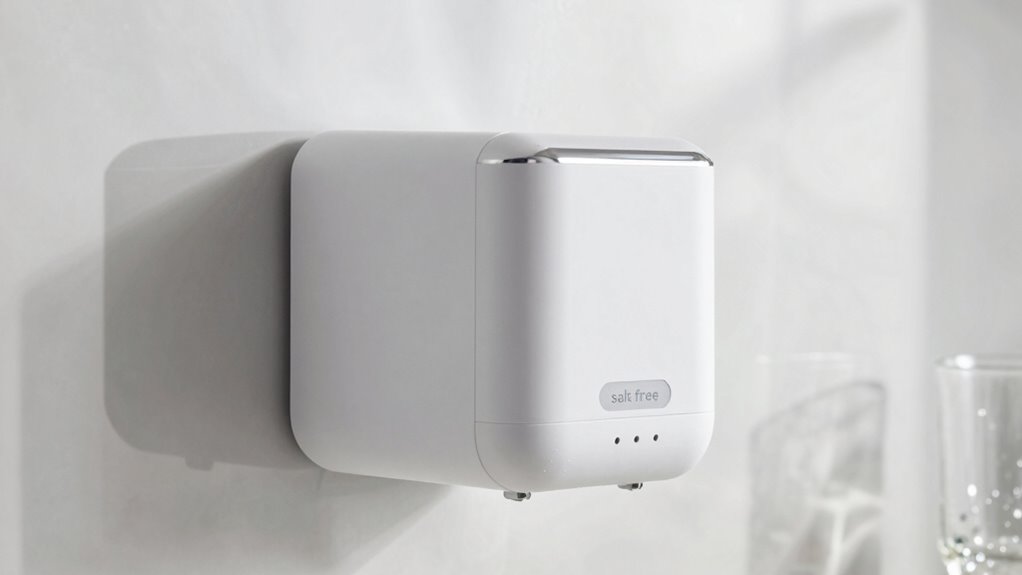

Salt-free conditioners work by transforming dissolved minerals like calcium and magnesium into tiny, stable crystals through a process called template-assisted crystallization. These crystals prevent scale buildup but don’t actually remove hardness minerals or soften your water. They help protect your plumbing and appliances from scale damage and are environmentally friendly since they don’t use salt or chemicals. To learn more about what these systems can and can’t do, keep exploring further.
Key Takeaways
- Salt-free conditioners use template-assisted crystallization to prevent scale without removing minerals.
- They do not soften water or reduce overall hardness levels.
- These systems are effective at controlling scale buildup and extending plumbing lifespan.
- They require no salt, chemicals, or regeneration, making them eco-friendly and low maintenance.
- They are not suitable if your primary goal is to remove hardness minerals from water.

Salt-free conditioners primarily work through a process called template-assisted crystallization (TAC). This water softening mechanism transforms dissolved hardness minerals like calcium and magnesium into tiny, stable crystals that don’t stick to surfaces or form scale. Instead of removing these minerals, they are altered in a way that prevents them from depositing on pipes, fixtures, or appliances. Because these conditioners don’t rely on ion exchange, they don’t actually remove hardness minerals from your water. Instead, they modify their form, which can reduce the buildup of scale and extend the lifespan of plumbing and appliances. Additionally, some systems incorporate advanced filtration methods to improve overall water quality. This approach makes salt-free conditioners an attractive choice for those looking for eco friendly alternatives. They don’t require salt, chemicals, or frequent regeneration cycles, which means less waste, lower water usage, and no brine discharge into the environment. Additionally, because they don’t add sodium to your water, they’re often recommended for people on low-sodium diets or for homes with pets and plants that could be sensitive to salt. Their simplicity also means less maintenance and fewer parts that can break down, making them a convenient and environmentally conscious option.
Salt-free conditioners transform minerals into stable crystals to prevent scale buildup without removing hardness.
However, it’s essential to realize that salt-free conditioners don’t actually soften your water in the traditional sense. They won’t reduce the overall hardness level or eliminate minerals that cause soap scum and scale. If your primary concern is removing hardness minerals to prevent scale buildup, a traditional salt-based softener might be more effective. Salt-free systems are better suited for controlling scale formation and extending the life of plumbing, rather than lowering total hardness.
Frequently Asked Questions
Do Salt-Free Conditioners Remove Existing Scale Buildup?
No, salt-free conditioners don’t remove existing scale buildup. Instead, they work by preventing new scale from forming by altering the way minerals like calcium and magnesium crystallize. If you already have significant scale, you’ll need to physically remove it through descaling or other treatment methods. Salt-free conditioners are effective for ongoing scale prevention but won’t eliminate existing buildup on pipes or appliances.
Are Salt-Free Conditioners Effective on Hard Water With High Mineral Content?
If you have hard water with high mineral content, a salt-free conditioner can help with mineral reduction and water softening, but it might not be completely effective. For example, a homeowner with very mineral-rich water saw some improvement in limescale but still experienced buildup over time. Salt-free conditioners are best for moderate mineral levels, but if your water is extremely hard, consider additional treatment options for ideal results.
How Long Does It Take to See Results With a Salt-Free Conditioner?
You can expect to see visible improvements within a few weeks of installing a salt-free conditioner. Timing expectations vary depending on your water’s mineral content and your home’s plumbing system. Usually, after about 2 to 4 weeks, you’ll notice softer skin, less soap scum, and fewer mineral deposits. Keep in mind, gradual changes mean results are often subtle at first but become more noticeable over time.
Can Salt-Free Conditioners Improve Water Taste and Odor?
Yes, salt-free conditioners can improve your water’s taste and odor by enhancing water clarity and reducing minerals that cause unpleasant smells. As they condition your water, you’ll notice fewer mineral deposits and a cleaner, fresher taste. While they don’t remove all contaminants, they effectively manage hardness and mineral buildup, resulting in better-tasting water. Expect gradual improvements, typically within a few weeks, as your water’s overall quality becomes clearer and more palatable.
Do Salt-Free Conditioners Require Any Maintenance or Replacement Parts?
Salt-free conditioners generally require minimal maintenance, so you don’t need to worry about frequent upkeep. You might occasionally need to check for any buildup or blockages but typically won’t have replacement parts to worry about. These systems are designed for longevity with little intervention, making them a convenient choice. Regularly inspecting your unit guarantees it continues to work efficiently, reducing maintenance concerns and avoiding costly replacement requirements.
Conclusion
Salt-free conditioners can be a great choice if you want to avoid added salt and still improve your water’s feel. However, they don’t work miracles and won’t completely eliminate buildup or hard water issues. Think of them as a helpful tool, but not the silver bullet. If you’re serious about tackling hard water problems, you’ll need to explore other solutions. Sometimes, it’s best to face the music instead of hoping for a quick fix.