
Smart home energy monitors help homeowners track electricity usage, identify energy leaks, and reduce bills. Among the popular choices, the Sense Energy Monitor is known for its ease of use and advanced AI analysis, while the Emporia Vue Plus appeals to budget-conscious users seeking customization and detailed data. This comparison focuses on these two options to clarify which best suits different types of homeowners, highlighting their key differences in setup, features, and value. The main tension lies in balancing user experience versus cost and customization potential, helping you decide which monitor aligns with your energy goals and technical comfort.

Emporia Vue 3 Home Energy Monitor – Real-Time Electricity Usage and Power Consumption Meter
- ✔ Certification: UL Listed
- ✔ Supported Systems: Single phase, 3-phase, 2-wire, 3-wire, Wye with earthed neutral
- ✔ Sensors: Sixteen 50A branch sensors

Emporia Energy Monitor with 16 Sensors and 4 Smart Plugs Bundle
- ✔ Sensors: 16
- ✔ Smart Plugs: 4
- ✔ Compatibility: iOS, Android, Alexa

Smart Home Energy Monitor with 16 50A Circuit Sensors, Real-Time Power Usage & Cost Tracking, Compatible with Home Assistant
- ✔ Weight: 4.09 pounds
- ✔ Dimensions: 3.1 x 1.2 x 4.18 inches
- ✔ Sensors: 16 50A, 2 200A sensors
At a Glance
| Criteria | Sense Energy Monitor | Emporia Vue Plus | Winner |
|---|---|---|---|
| Ease of installation | Simpler, plug-and-play setup | Moderate installation, some wiring needed | A |
| Data granularity | Provides broad usage categories; some device-level insights | Detailed device-level data, manual setup | B |
| AI and insights | Advanced AI with appliance detection | Basic analytics, less automation | A |
| Customization options | Limited but growing customization | Highly customizable with add-ons | B |
| Compatibility | Works with most standard homes | Compatible with various systems | A |
| Price | $299 | $150 | B |
| Customer support | Responsive, with dedicated support | Good, but less personalized | A |
| Mobile app usability | Intuitive, easy-to-navigate | Functional, but less streamlined | A |
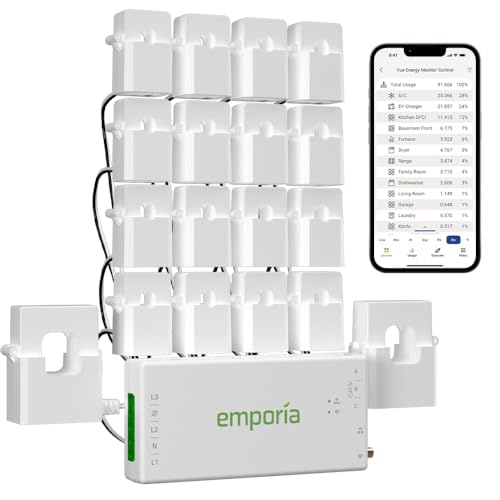
Emporia Vue 3 Home Energy Monitor - Smart Home Automation Module and Real Time Electricity Usage Monitor, Power Consumption Meter, Solar and Net Metering for UL Certified Safe Energy Monitoring
- UL Certified for Safety: Certified for electrical safety in US and Canada
- Easy Installation in Circuit Panel: Supports most home wiring systems with clamp-on sensors
- Real-Time Energy Monitoring: 24/7 management of home energy use and solar
As an affiliate, we earn on qualifying purchases.
Emporia Vue 3 Home Energy Monitor – Real-Time Electricity Usage and Power Consumption Meter
The Emporia Vue 3 stands out for its UL certification, ensuring safety and reliability—key for those concerned about home electrical safety. It supports a variety of electrical configurations, making it versatile for single-phase and three-phase systems. Its sensors monitor critical loads, providing real-time data via an intuitive app. Compared with the other options, it offers a straightforward installation with a focus on safety and trusted performance. However, it requires Wi-Fi for live updates and only retains 7 days of minute data, which might be limiting for long-term analysis.
Pros:
- UL-certified for safety and reliability
- Supports multiple electrical system configurations
- Includes sensors for critical load monitoring
- Provides real-time energy data via app
Cons:
- Requires Wi-Fi connection for live data
- Additional sensor needed for 3-phase systems with neutral
- Data retention limited to 7 days for minute data
Best for: Homeowners seeking a trusted, safety-certified energy monitor with reliable real-time data
Not ideal for: Users wanting extensive automation or local-only control without internet dependence
Bottom line: The Emporia Vue 3 offers a dependable, safety-focused monitoring solution ideal for basic real-time energy tracking in diverse electrical systems.
“The Emporia Vue 3 offers a dependable, safety-focused monitoring solution ideal for basic real-time energy tracking in diverse electrical systems.”
Emporia Energy Monitor with 16 Sensors and 4 Smart Plugs Bundle
This comprehensive bundle combines detailed energy tracking with smart plugs for remote control, making it ideal for those wanting automation and granular data. The 16 sensors monitor the entire home, while the four Wi-Fi smart plugs enable control of specific devices. It supports solar net metering and integrates seamlessly with platforms like Alexa and mobile apps for trend analysis and automation. Compared with simpler monitors, it’s more complex to set up but offers richer data and control options. The main tradeoff is the initial configuration effort required for optimal performance.
Pros:
- Provides detailed whole-home energy monitoring
- Includes smart plugs for remote control and automation
- Supports solar net metering
- Compatible with Alexa, iOS, and Android
Cons:
- Requires Wi-Fi setup and configuration
- Complex for beginners unfamiliar with energy systems
- Potentially higher cost due to additional sensors and smart plugs
Best for: Homeowners seeking detailed energy insights combined with automation features
Not ideal for: Users seeking a simple plug-and-play device or those wary of complex setup processes
Bottom line: The Emporia bundle is best suited for users who want an all-in-one system that combines detailed monitoring with automation capabilities, despite the setup complexity.
“The Emporia bundle is best suited for users who want an all-in-one system that combines detailed monitoring with automation capabilities, despite the setup complexity.”
Smart Home Energy Monitor with 16 50A Circuit Sensors, Real-Time Power Usage & Cost Tracking, Compatible with Home Assistant
This energy monitor is designed for users who value local LAN operation and customization. It installs easily with clamp-on sensors and offers detailed real-time data, suitable for rental properties, shared accommodations, or those who want to avoid cloud dependency. Its support for MQTT and LAN connectivity gives advanced users flexibility for integration with custom home automation setups like Home Assistant. The main consideration is that it requires some technical knowledge to configure MQTT and LAN features, and its advanced options might be overkill for casual users.
Pros:
- Easy clamp-on installation
- Supports local LAN operation without internet
- Provides detailed usage data for appliances
- Ideal for rental or shared spaces with customizable billing
Cons:
- Requires technical setup for MQTT and LAN
- Limited support for multi-phase configurations outside specified voltages
- Some user reviews suggest desired app improvements
Best for: Tech-savvy users looking for local control, customizable billing, and detailed appliance-level data
Not ideal for: Non-technical homeowners or those preferring plug-and-play solutions
Bottom line: This model is perfect for users who want local, customizable energy management and are comfortable with technical setup, but less suited for beginners.
“This model is perfect for users who want local, customizable energy management and are comfortable with technical setup, but less suited for beginners.”
As an Amazon Associate we earn from qualifying purchases.
Key Differences
The primary distinction between these options centers on user experience versus cost and customization. The Sense Energy Monitor prioritizes ease of installation and AI-driven insights, making it ideal for users seeking a plug-and-play solution with minimal setup. Its advanced AI can detect appliances and provide actionable insights without manual configuration, saving time and effort. Conversely, the Emporia Vue Plus offers better value for those willing to undertake some wiring and setup, providing detailed device-level data and extensive customization. This makes it suited for tech-savvy users aiming for granular control and budget-conscious households seeking comprehensive energy data at a lower price point.
In practical terms, choosing Sense means less hassle and a more automated experience, perfect for homeowners who want quick results without technical complexity. Choosing Emporia Vue Plus involves more hands-on setup but rewards users with detailed insights and flexible options, appealing to those who enjoy tinkering or need specific data for complex energy management. The decision ultimately hinges on whether ease of use or customization and price are your top priorities.
Detailed Comparison
Ease of installation (Sense Energy Monitor wins — major)
Sense is designed for straightforward, quick installation with minimal wiring, making it suitable for most users. Emporia Vue Plus requires some wiring and a slightly more involved setup process, which may be challenging for less experienced homeowners. The gap is major, with Sense offering a clear advantage for simplicity and speed.
Data granularity (Emporia Vue Plus wins — moderate)
Emporia Vue Plus provides detailed device-level energy data, allowing users to see exactly which appliances consume the most power. Sense offers broader insights, detecting appliances but not always at the device level. In terms of detailed analytics, Emporia wins, though this may be unnecessary for casual users. The gap is moderate, depending on user needs.
AI and insights (Sense Energy Monitor wins — major)
Sense features sophisticated AI capable of identifying appliances and providing proactive insights, making energy management easier. Emporia offers basic analytics without automation or appliance detection. The AI advantage gives Sense a major edge for users who rely on intelligent analysis for savings and troubleshooting.
Customization options (Emporia Vue Plus wins — moderate)
Emporia Vue Plus allows extensive customization through add-ons, manual configuration, and integrations, appealing to tech enthusiasts. Sense offers limited customization but includes pre-set features that suit most users. For those wanting control, Emporia wins; for ease of use, Sense suffices. The gap is moderate.
Compatibility (Sense Energy Monitor wins — minor)
Both monitors work with typical home electrical systems. Emporia Vue Plus may require more wiring adjustments, especially in complex setups, while Sense emphasizes compatibility and ease. In practical terms, Sense is more plug-and-play, but both are broadly compatible. The gap is minor.
Price (Emporia Vue Plus wins — major)
Emporia Vue Plus is significantly cheaper at around $150, making it attractive for budget-conscious users. Sense costs about $299, positioning it as a premium option. The price difference is major and influences affordability for most users.
Customer support (Sense Energy Monitor wins — moderate)
Sense provides dedicated support and regular updates, enhancing user experience. Emporia support is functional but less personalized. The difference favors Sense for users valuing reliable assistance, though both provide usable support channels. The gap is moderate.
Mobile app usability (Sense Energy Monitor wins — moderate)
Sense’s app is praised for its clean, intuitive interface and real-time insights, aiding ease of use. Emporia’s app is functional but less polished, which may frustrate users seeking a seamless experience. The gap is moderate, favoring Sense.
Sense Energy Monitor: Pros and Cons
Pros:
- Ease of installation and setup
- Advanced AI detection and insights
- Excellent mobile app usability
- Responsive customer support
Cons:
- Higher price point
- Limited customization options
Emporia Vue Plus: Pros and Cons
Pros:
- Lower cost significantly
- High level of customization
- Detailed device-level data
- Good value for tech-savvy users
Cons:
- More complex installation process
- Less polished app experience
- Fewer automated insights
Who Should Choose What
Choose Sense Energy Monitor if:
- You prefer quick, easy setup with minimal technical effort
- You want intelligent appliance detection and proactive insights
- You value a polished app and reliable support
Choose Emporia Vue Plus if:
- You are comfortable with wiring and setup complexity
- You want detailed, device-specific energy data
- Budget constraints are significant and customization is a priority