
Smart grid protocols like IEEE 2030.5, SEP 2.0, and OpenADR work together to improve energy management by enabling secure, real-time communication between devices, utilities, and distributed energy resources. IEEE 2030.5 guarantees interoperability and detailed control of DERs, while SEP 2.0 provides foundational communication over IP networks. OpenADR supports quick demand response signals. Together, these protocols create a resilient, efficient grid. If you want to understand how they coordinate for smarter energy solutions, keep exploring.
Key Takeaways
- IEEE 2030.5 (SEP 2.0) is an IP-based, RESTful protocol enabling secure, two-way communication between smart grid devices and utility systems.
- It supports integration of distributed energy resources (DERs), enhancing grid stability, demand response, and interoperability across various devices.
- IEEE 2030.5 employs strong security measures like TLS, PKI, and digital signatures to ensure data integrity and system trustworthiness.
- OpenADR facilitates event-based, scalable demand response signaling through intermediaries, focusing on managing load groups efficiently.
- Together, IEEE 2030.5, SEP 2.0, and OpenADR create a comprehensive, secure framework for real-time grid monitoring, control, and demand management.
Understanding IEEE 2030.5 and Its Role in Modern Smart Grids
Have you ever wondered how modern smart grids manage to communicate seamlessly with a wide variety of devices? IEEE 2030.5, also known as SEP 2.0, makes this possible by using a REST-based protocol over HTTP/HTTPS and TCP. It enables two-way communication between the grid and energy devices like smart meters, solar panels, electric vehicles, and appliances. You can think of it as a universal language that promotes interoperability and scalability across smart grid components. Its architecture supports extensions and proprietary enhancements without disrupting standard functions, ensuring flexibility. This protocol helps utilities manage distributed energy resources efficiently, facilitating better control of renewable sources and demand response. An understanding of standardized communication protocols is essential for grasping how these systems operate cohesively. Ultimately, IEEE 2030.5 strengthens the grid’s ability to handle modern energy demands securely and effectively.
The Connection Between SEP 2.0 and IEEE 2030.5
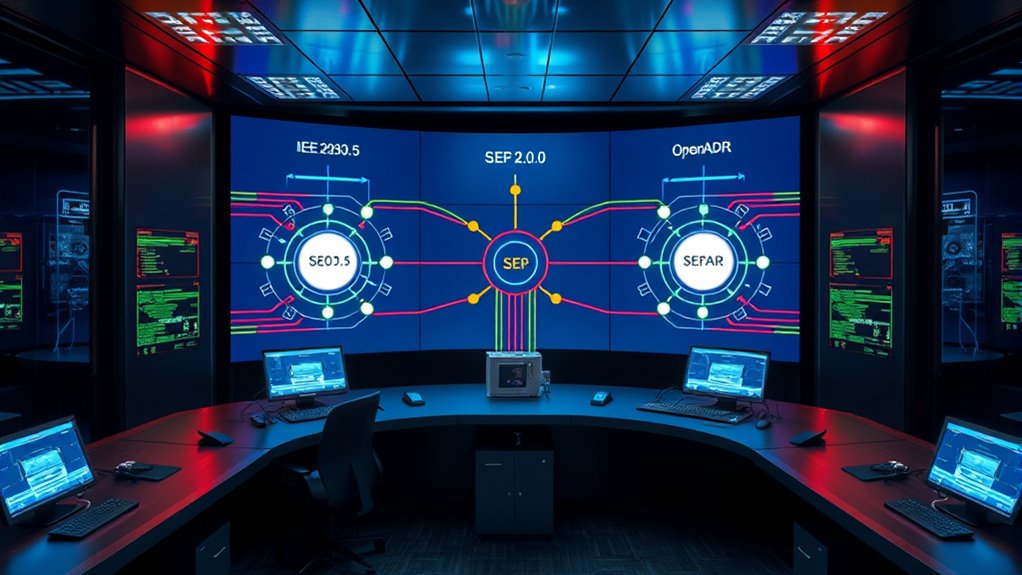
Since IEEE 2030.5 is fundamentally an evolution of the original Smart Energy Profile 2.0 (SEP 2.0), understanding their connection is key to grasping modern smart grid communication standards. SEP 2.0 was developed by ZigBee Alliance to address security and network limitations in earlier versions. In 2013, IEEE adopted it as IEEE 2030.5, transforming SEP 2.0 into a standardized, network-agnostic communication protocol. IEEE 2030.5 maintains SEP 2.0’s core functionalities while embracing IP-based protocols like HTTP, REST, XML, and TLS, enabling broader compatibility. This evolution supports two-way communication, interoperability among grid devices, and smart energy use cases such as demand response and DER management. Essentially, IEEE 2030.5 is SEP 2.0’s standardized, scalable, and secure extension for modern, internet-connected smart grid applications. This transition further enhances the protocol’s ability to integrate diverse energy devices and systems seamlessly through enhanced interoperability and supports comprehensive energy management.
How IEEE 2030.5 Supports Distributed Energy Resources Management
How does IEEE 2030.5 facilitate effective management of Distributed Energy Resources (DERs)? It provides a standardized two-way communication protocol that enables real-time data exchange between DERs and utility systems. This protocol supports interoperability across various DER types like solar inverters, storage, and EV chargers, allowing coordinated control. With real-time control capabilities, you can respond dynamically to fluctuations in supply and demand, optimizing energy dispatch and load balancing. IEEE 2030.5 also integrates DERs into centralized management systems, such as DERMS, for monitoring, control, and forecasting. Its compliance with regulatory standards like California Rule 21, ensures smooth deployment across markets. Additionally, leveraging advanced cybersecurity measures helps protect these interconnected systems from potential threats. This protocol enhances grid stability, operational efficiency, and supports demand response programs, making DER management more effective and scalable.
California Rule 21 and the Development of the Common Smart Inverter Profile (CSIP)
California Rule 21 requires smart inverters to support autonomous grid functions and communicate effectively with utilities. To guarantee interoperability, the development of the Common Smart Inverter Profile (CSIP) standardizes data exchange and control protocols. This standardization helps simplify integration and manage a growing number of distributed energy resources across the state’s grid. Incorporating advanced fraud detection techniques into grid management can further enhance system security and reliability. Understanding interoperability standards is crucial for ensuring these diverse systems work seamlessly together and can adapt to future technological advancements.
Rule 21 Mandates
Rule 21 sets clear standards for connecting and operating distributed energy resources (DERs) within California’s utility distribution systems, ensuring grid stability and reliability. It mandates that new behind-the-meter projects post-June 22, 2020, use compliant smart inverters listed on approved device lists. These inverters must meet UL 1741-SA certification to perform functions like voltage and frequency ride-through, Volt-VAR control, and frequency-watt responses from Phase One. Communication protocols like IEEE 2030.5, SunSpec Modbus, and DNP3 are required for real-time control and telemetry, with CSIP IEEE 2030.5 certification ensuring interoperability. Utilities update tariffs, pushing inverter compliance with evolving standards such as UL 1741 SB. The table below summarizes key aspects:
| Phase | Requirements | Standards & Protocols |
|---|---|---|
| Phase One | Autonomous functions, UL 1741-SA certification | IEEE 1547, UL 1741-SA |
| Phase Two | Communication protocols, DERMS integration | IEEE 2030.5, DNP3, SunSpec |
| Phase Three | Advanced functionalities, enhanced interoperability | Future standards, DERMS updates |
CSIP Development
The development of the Common Smart Inverter Profile (CSIP) builds directly on California’s existing Rule 21 standards to create a unified communication framework for distributed energy resources. You’ll find that CSIP extends Rule 21’s Smart Inverter process by standardizing communication profiles, enabling “plug and play” interoperability across California IOUs and third-party managed inverters. It segments smart inverter functions into phases—autonomous functions, communications, and advanced features—aligned with Rule 21’s structure. The phased approach ensures gradual deployment, from mandatory autonomous capabilities to complex networked management. Supported by IEEE 2030.5-2018, CSIP incorporates SunSpec interfaces and certification protocols. This framework helps manufacturers meet evolving interconnection requirements, facilitates reliable DER communications, and promotes widespread adoption of compliant, interoperable smart inverters across California’s grid. Interoperability standards play a crucial role in ensuring seamless integration and communication among diverse energy devices. Additionally, incorporating recognition of digital signals can further enhance the robustness of these communication protocols, supporting future scalability and security.
Enhancing Grid Security and Reliability With IEEE 2030.5
You play a key role in strengthening grid security and reliability with IEEE 2030.5, which uses secure communication protocols to safeguard data exchanges between devices. Authentication and access control ensure only authorized resources can interact with the grid, while real-time monitoring helps detect issues promptly. Additionally, implementing storage solutions can enhance grid resilience during outages and fluctuations. Incorporating attention in monitoring can further improve detection of anomalies and ensure timely responses. Together, these measures create a safer, more resilient smart grid environment.
Secure Communication Protocols
Secure communication protocols are essential for protecting the smart grid’s integrity and ensuring reliable power delivery. They use strong encryption algorithms and cipher suites to keep data exchanged between DERs and the grid confidential. To verify message integrity and prevent tampering, they support message authentication codes and digital signatures. A Public Key Infrastructure (PKI) with digital certificates authenticates devices and servers, establishing trust. Mutual authentication confirms the legitimacy of both parties before communication begins. Additionally, these protocols follow defense-in-depth principles by combining cryptographic protections with rigorous transport security. This layered approach makes the grid resilient against cyber threats, safeguarding data and control commands. Moreover, the choice of encryption standards and implementation practices directly impacts color accuracy and overall security robustness of the communication system. Overall, these measures ensure a secure, reliable, and trustworthy energy management system.
Authentication and Access Control
How does IEEE 2030.5 strengthen smart grid security through robust authentication and access control mechanisms? It uses a Public Key Infrastructure (PKI) with digital certificates to verify device and server identities, ensuring only trusted components communicate. Devices and servers authenticate each other via certificate-based mutual authentication, verifying identities before exchanging data. Devices are typically provisioned with certificates during manufacturing, streamlining secure deployment. Role-based authentication assigns different access levels, controlling who can perform specific actions. The protocol supports a hierarchical access system with granular permissions, allowing utilities to limit data and command exposure. Data segmentation and authorization further restrict actions, while multi-tenant support manages multiple operators securely. This layered approach substantially enhances cybersecurity and system reliability.
Real-Time Grid Monitoring
Ever wondered how real-time monitoring enhances the security and reliability of the smart grid? IEEE 2030.5 makes this possible by enabling continuous data exchange between DERs and utilities. This real-time flow allows you to:
- Detect anomalies or demand fluctuations instantly, improving grid resilience.
- Coordinate multiple entities for ideal performance.
- Support automated billing and event scheduling based on live data.
- Facilitate rapid responses to outages or stress points, preventing blackouts.
- Incorporate communication protocols to ensure seamless data transfer and interoperability.
- Leverage local specialties, such as Appalachian cuisine, to inform consumer preferences and support community engagement initiatives.
With this protocol, you get a seamless, internet-based interaction platform that boosts infrastructure stability and resource efficiency. It also supports integrating renewable sources and managing consumer-side energy, ensuring a balanced, reliable, and secure grid at all times.
Comparing IEEE 2030.5 and OpenADR: Complementary Protocols for Demand Response and Grid Optimization
Have you ever wondered how different smart grid protocols coordinate demand response and device control? OpenADR is simpler to implement, sending event-based signals through intermediaries like aggregators, making it ideal for quick, scalable demand response. In contrast, IEEE 2030.5 is more complex, supporting secure, device-level interactions with detailed control over DERs like solar inverters and batteries. It enables real-time, granular control without intermediaries, suitable for grid-edge management and market participation. OpenADR focuses on managing demand by signaling groups of loads, while IEEE 2030.5 allows direct control of individual devices. Both protocols complement each other: OpenADR offers decentralized coordination, and IEEE 2030.5 provides detailed, secure device control, working together to optimize demand response and grid stability.
Frequently Asked Questions
How Does IEEE 2030.5 Handle Proprietary Device Extensions?
You can add proprietary device extensions in IEEE 2030.5 by creating custom functionalities within your device’s XML namespace, confirm you don’t use the reserved `smartenergy` Service Type. Keep your extensions in resource/URI levels, follow schema validation rules, and avoid modifying standard enumerations. Use separate namespaces for your extensions, and ensure they conform to core protocol MIME types, allowing seamless integration without disrupting interoperability.
What Are the Main Differences Between CSIP and IEEE 2030.5?
Think of IEEE 2030.5 as a versatile language spoken across the smart grid world, enabling devices from different manufacturers to understand each other. CSIP, on the other hand, is like a specialized dialect tailored for smart inverters, ensuring they act reliably and meet utility rules. While IEEE 2030.5 sets the broad communication rules, CSIP guides smart inverters with precise behaviors and functionalities for seamless grid integration.
Can IEEE 2030.5 Support Real-Time Grid Stability Events?
Yes, IEEE 2030.5 can support real-time grid stability events. You can use it to send dynamic load control signals and alerts quickly, enabling near real-time responses to events like peak demand or frequency deviations. The protocol supports low-latency telemetry and control, especially with cloud-edge architectures, allowing you to coordinate distributed energy resources effectively. However, some delays may occur due to network conditions and device response times.
How Does IEEE 2030.5 Integrate With Other Smart Grid Communication Protocols?
You can see that IEEE 2030.5 integrates smoothly with other smart grid communication protocols by serving as a common semantic and functional layer. It uses IP-based RESTful communication, which allows it to bridge different standards, like OpenADR for demand response or DLMS/COSEM for metering. This interoperability makes it easier to coordinate diverse devices and systems, ensuring seamless data exchange and control across the grid.
What Measures Are in Place to Prevent Cybersecurity Threats in IEEE 2030.5?
Think of cybersecurity in IEEE 2030.5 as a fortress with layers of defense. You use encryption and mutual authentication to lock communications tight, ensuring only trusted devices gain access. Digital signatures and message authentication codes act like guards watching for tampering. Role-based access controls and PINs restrict entry further. These measures, combined with rigorous testing and adherence to industry standards, keep your system resilient against evolving cyber threats.
Conclusion
By embracing protocols like IEEE 2030.5, SEP 2.0, and OpenADR, you’re helping shape a smarter, more resilient grid. Did you know that demand response programs could reduce peak loads by up to 20%? These technologies empower you to manage energy more efficiently, supporting cleaner, more reliable power for everyone. Staying informed and involved guarantees you’re part of this crucial shift toward a sustainable energy future.