
TL;DR

Get home appliances delivered free with Prime
- Fast, free delivery on millions of items
- Prime Video, Amazon Music and more included
- Member-only deals all year
A Livingetc report describes renewed interest in floral epoxy resin, with preserved flowers appearing in furniture, lighting and hospitality interiors. Designers connect the material’s appeal to nostalgia and the idea of holding time still, but the report offers examples and commentary rather than sales data establishing how widespread the trend is.
Preserved flowers set in resin are appearing in a range of recent design projects, from furniture and lighting to a Paris herbal infusion house, according to a Livingetc report. The examples point to renewed creative interest in floral epoxy resin, a material with roots in the 1940s, though the report does not establish how widespread the revival is across the design market.
The report identifies projects in Paris, London and elsewhere that use resin to display or suspend botanical material. At Apoticari’s La Tisanerie, a herbal infusion house that opened in the Haut-Marais in September, a floral-enriched resin bar counter reinforces the venue’s botanical theme. The report describes the business as Paris’s first dedicated herbal infusion house.
Furniture and lighting provide other examples. The Gelo side tables, made by Paraforma for Monologue London, are hand-cast in resin, with finishes and colors ranging from glossy to frosted and amber to blush violet. Austrian designer Laurids Gallée’s Node 01 light uses resin and light in a suspended composition, according to Romain Casella, founder and director of the creative agency MAY.
Botanical artist and designer Marcin Rusak is also bringing work to Salon Art + Design in New York, scheduled for November 4–8 at the Park Avenue Armory. The report names his Flora Herbarium Clear Amber 152 among the pieces he is taking to the fair. It also notes that Sabine Marcelis’s first solo museum exhibition, “Sabine Marcelis: Light and Color,” is scheduled at Zurich’s Museum für Gestaltung from October 30, 2026, to April 4, 2027.
Why Designers Are Preserving Blooms
Resin lets makers present flowers as part of an object’s structure rather than as a temporary arrangement. In furniture and lighting, preserved botanical material can become a visible feature of a piece that is intended to remain in use. At venues such as La Tisanerie, the material also supports a design concept by making the botanical theme part of the space itself.
Casella told Livingetc that the appeal combines nostalgia with a desire to “freeze time.” That is his interpretation, not evidence of a single reason driving designers or buyers. The projects nonetheless show how the technique can carry associations with memory and nature while serving practical design functions. The report does not provide market figures, buyer research or sales data, so the scale of the renewed interest remains unmeasured.
Products Worth Considering

Ring Alarm 8-Piece Kit (2nd Gen) Home Security System

Ring Alarm 14-Piece Wireless Security System

Bose TV Speaker (2nd Gen) Compact Soundbar with Bluetooth and HDMI
As an affiliate, we earn on qualifying purchases.
A Material With Earlier Lives
Livingetc says floral epoxy resin furniture originated in the 1940s and was revived in the 1980s. The current examples therefore represent a return to a longstanding technique, rather than a newly invented material. The report places this renewed attention alongside interest in amber-toned design, but does not provide data comparing the two trends.
The article’s sense of a broader moment comes from a collection of projects the writer encountered, including venues, designers and work shown around Frieze Week. It also refers to Livingetc’s Style Pulse S/S27 report, which names “One Decorative Gesture” as a design trend forecast. These are editorial observations and a forecast, not independent measures of how many studios or consumers are adopting floral resin.
““I think it’s a mix of nostalgia, which is all around us right now, from interiors to film to fashion, and something much deeper.””
— Romain Casella, founder and director of MAY, speaking to Livingetc
How Broad Is the Revival?
The report supplies individual examples but no sales totals, production figures, search data or survey results to show whether floral resin is gaining popularity across the wider industry. It is not clear how many designers are using the technique, whether demand is increasing, or how long the current attention may last.
Some of the evidence is prospective: Salon Art + Design was scheduled for November 4–8, 2026, and the Zurich exhibition for October 30, 2026, through April 4, 2027. The source does not report how audiences responded to either event. It also does not detail the resin formulations, flower-preservation methods or environmental impacts used in the cited projects.
Upcoming Shows and Design Projects
The next listed public opportunity to see Rusak’s work is Salon Art + Design, scheduled for November 4–8 at New York’s Park Avenue Armory. Marcelis’s exhibition at Zurich’s Museum für Gestaltung is scheduled to open October 30 and run through April 4, 2027. Those events may offer further examples of how designers use resin and botanical material, but the source does not say whether either will include new floral-resin work beyond the pieces already named.
For now, the report establishes a set of projects and a design conversation, not a measured industry shift. Further evidence—such as additional commissions, exhibition records or market data—would be needed to establish how broadly the material is being adopted.
Key Questions
What is floral epoxy resin?
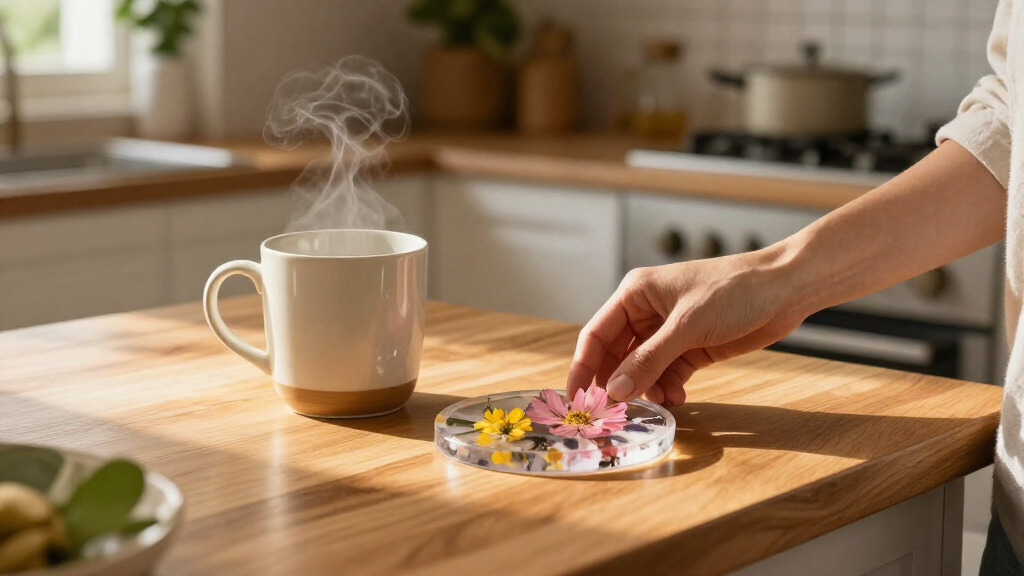
Floral epoxy resin is a design technique in which flowers or other botanical materials are set within resin, making them visible as part of an object such as a table, counter or light. The Livingetc report does not specify the exact resin formulations used in its examples.
Where is preserved-flower resin appearing?
The report cites Apoticari’s La Tisanerie in Paris, Paraforma and Monologue London’s Gelo side tables, and Laurids Gallée’s Node 01 light. It also discusses work by botanical artist Marcin Rusak.
Is floral resin a new design technique?
No. Livingetc dates the furniture genre’s origins to the 1940s and says it was revived in the 1980s. The current projects are described as a renewed interest in the technique.
Is the trend proven to be widespread?
That is not established by the report. It gives examples from several projects but includes no market figures, sales data or consumer research measuring how common floral resin has become.
Source: livingetc.com