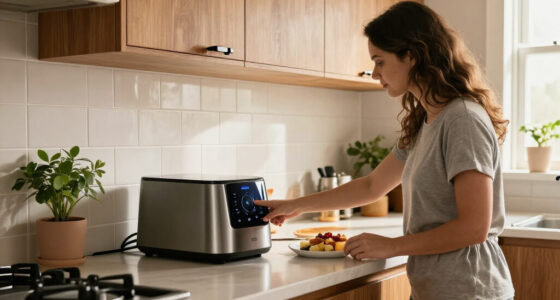
When shopping for an electric roasting pan, the real comparison is whether a separate countertop appliance earns its storage space or a conventional oven and roasting pan already meet your needs. Both can roast poultry, meat and vegetables, but they differ in capacity, temperature control, kitchen heat and what else you can cook in them. An electric roaster is appealing when you want to free the oven for side dishes or roast a large bird without heating the whole kitchen. The conventional oven is the more capable choice for crisp browning, varied roasting dishes and households that already have enough oven space. The deciding tradeoff is focused convenience versus all-around flexibility.

Get home appliances delivered free with Prime
- Fast, free delivery on millions of items
- Prime Video, Amazon Music and more included
- Member-only deals all year

28 Quart Electric Roaster Oven with Self-Basting Lid, Stainless Steel
- ✔ Brand: Kiss the Water
- ✔ Model: R0220
- ✔ Capacity: 28 quarts
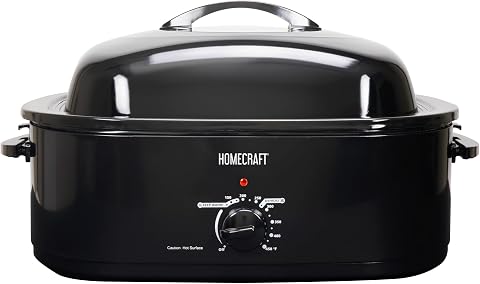
HomeCraft Electric Roaster Oven, 18-Quart, Black
- ✔ Brand: HomeCraft
- ✔ Model: HCRO18BK
- ✔ Capacity: 18 quarts

SUNVIVI 24-Quart Roaster Oven with Three Buffet Trays
- ✔ Brand: SUNVIVI
- ✔ Model: ZER01X
- ✔ Capacity: 24 quarts
At a Glance
| Criteria | Electric roasting pan | Conventional oven with a roasting pan | Winner |
|---|---|---|---|
| Roasting capacity | Usually sized for a turkey or roast; check the stated capacity and dimensions. | Depends on oven and pan dimensions; often accommodates a wider range of pan shapes. | Depends |
| Kitchen heat and oven availability | Uses a countertop outlet and can leave the main oven free; the exterior can become hot. | Heats the kitchen and occupies the oven during cooking. | A |
| Browning and cooking control | Thermostat controls cooking temperature, but performance and heat distribution vary by model. | Offers familiar oven settings and broad compatibility with roasting techniques; results depend on oven and pan. | B |
| Versatility | Best for roasting and a narrower set of slow-cooking or warming tasks. | Works for roasting, baking and many other dishes. | B |
| Cleanup and storage | Removable insert models can simplify washing; the appliance takes up storage space. | The pan needs washing, while the oven itself usually does not; no separate appliance to store. | Depends |
| Cost and value | An extra purchase that can pay off when separate roasting capacity is used often. | A roasting pan may be a modest purchase if an oven is already available. | B |
28 Quart Electric Roaster Oven with Self-Basting Lid, Stainless Steel
The Kiss the Water 28-quart roaster is our best overall pick because it combines the largest stated capacity in this group with a useful set of cooking modes. Its temperature range runs from 150°F to 450°F, and the description lists roasting, baking, slow cooking, defrosting, and warming. That range supports more than a holiday roast: we can use the same appliance to thaw food or hold a dish warm when serving runs long.The lid helps distinguish it from HomeCraft’s more basic high-dome design. Its visible self-basting lid is described as circulating moisture, while the window lets us monitor food without lifting the cover. That can help avoid unnecessary heat loss during cooking. SUNVIVI also has a self-basting dome lid, but its clearest advantage is buffet service, not the visible lid feature described here.Capacity comes at a real storage cost. Listed dimensions are 27 inches deep by 22 inches wide, making this the least convenient choice for a tight counter or cupboard. At 14.7 pounds, it also takes more effort to move than a small countertop appliance. Its knob control is simple to understand, but buyers who want digital settings or finer adjustments should look elsewhere. We rank it first for cooks who will use the extra room and flexible functions often enough to justify its footprint.
Pros:
- Largest stated capacity in this comparison at 28 quarts
- Visible self-basting lid lets us monitor food without lifting the cover
- 150–450°F range with roasting, baking, slow cooking, defrosting, and warming listed
- Removable stainless steel pan and rack support easier serving and cleanup
Cons:
- 27-inch depth and 22-inch width make storage challenging
- Knob controls offer less precision than a digital interface
- At 14.7 pounds, it can be cumbersome to move
Best for: Cooks who regularly prepare large roasts or turkey and want multiple cooking modes plus a lid they can see through.
Not ideal for: Anyone with limited counter or storage space, or buyers who prefer digital controls and a compact appliance.
Bottom line: Choose the Kiss the Water when capacity and versatile cooking functions matter more than a compact footprint.
“Choose the Kiss the Water when capacity and versatile cooking functions matter more than a compact footprint.”
HomeCraft Electric Roaster Oven, 18-Quart, Black
The HomeCraft 18-quart suits buyers who want a straightforward electric roaster without the buffet pieces included with SUNVIVI or the broader feature list of the Kiss the Water. Its removable enamel pot and stainless-steel lift-out rack keep the core tasks in focus: roasting a turkey, chicken, or pot roast, then lifting the food out for serving. A high-dome lid and cool-touch handles address heat retention and handling during use.Its capacity is the smallest of these three, so it makes more sense for a modest household meal than for someone seeking maximum room. The Kiss the Water offers ten more quarts and more explicitly listed cooking modes; SUNVIVI adds buffet service for sides. HomeCraft’s appeal is the simpler combination of a roaster, pot, and rack, with a listed maximum of 450°F.There is some ambiguity in the control description: the product information calls the dial full-range, while the listed drawback describes three temperature settings. We should not assume fine temperature increments from the supplied details. The footprint is smaller than the Kiss the Water by listed width and depth, though at 23.43 inches deep it still needs dedicated storage. Pick this model when a basic roasting setup is the priority; skip it if you need the biggest capacity or side-dish warming trays.
Pros:
- 18-quart capacity for turkey, chicken, and pot roast
- Removable enamel pot and stainless-steel lift-out rack
- High-dome lid and cool-touch handles
- Listed maximum temperature of 450°F
Cons:
- Smaller capacity than the 24- and 28-quart alternatives
- Control details are described inconsistently, with a drawback noting three settings
- Still requires substantial storage space for occasional use
Best for: Buyers who want a conventional roaster, removable enamel pot, and lift-out rack without a buffet-serving setup.
Not ideal for: Cooks who need maximum capacity, several clearly defined cooking modes, or buffet trays for sides.
Bottom line: Choose HomeCraft for a simpler roasting setup, provided its 18-quart capacity and dial control fit your cooking needs.
“Choose HomeCraft for a simpler roasting setup, provided its 18-quart capacity and dial control fit your cooking needs.”
SUNVIVI 24-Quart Roaster Oven with Three Buffet Trays
The SUNVIVI 24-quart earns its place through serving flexibility. Alongside a roaster described as fitting a turkey up to 28 pounds, it includes three buffet trays and a divider pan for keeping side dishes warm. That makes it the natural choice when a meal needs to stay organized at the counter. The Kiss the Water gives us more stated capacity and a visible lid, but SUNVIVI is the only option here whose included pieces directly address serving multiple sides.Its stated 150–450°F thermostat supports roasting, defrosting, baking, slow cooking, and warming, so it is not limited to buffet duty. The self-basting dome lid is also intended to retain moisture. Compared with HomeCraft’s 18-quart setup, SUNVIVI has six more quarts and a broader listed set of modes, but its buffet trays mean more separate pieces to handle and clean.The 25-inch width demands a sizable counter or storage spot, and the roasting pan and trays need separate cleaning. The buffet trays are dishwasher-safe according to the description, which helps, but buyers still have more components to manage than with HomeCraft. Its controls are described as button controls, though the supplied details do not specify a display or precision increments. We recommend it for households that will regularly use the warming trays; if sides are served directly from the kitchen or table, the larger Kiss the Water may be a more useful investment in capacity.
Pros:
- Three buffet trays and divider pan support serving several sides
- Stated capacity of 24 quarts and turkey capacity up to 28 pounds
- 150–450°F range with roasting, baking, slow cooking, defrosting, and warming listed
- Dishwasher-safe buffet trays simplify part of cleanup
Cons:
- 25-inch width requires substantial storage or counter space
- Pan, rack, divider, and trays create more separate cleaning tasks
- Button controls are listed without further detail on adjustment precision
Best for: Hosts who want an electric roaster that can also keep several sides warm at the counter.
Not ideal for: Buyers with tight storage or those who will rarely use buffet trays and prefer fewer parts to clean.
Bottom line: Choose SUNVIVI when warming and serving sides alongside a roast is worth the extra pieces and storage needs.
“Choose SUNVIVI when warming and serving sides alongside a roast is worth the extra pieces and storage needs.”
As an Amazon Associate we earn from qualifying purchases.
Key Differences
The electric roasting pan’s strongest advantage is a second cooking space. On a busy holiday, it can roast the turkey while the oven handles casseroles and pies. It can also be useful in a small kitchen, at a cabin or anywhere that has counter space and a suitable outlet but limited oven access. That advantage depends on the appliance being large enough for the meal and easy to store between uses.
The conventional oven wins on flexibility. It can handle more than roasting, and its space and settings suit recipes that call for a particular pan, rack position or oven technique. Electric roasters can produce good meals, but their compact format and model-specific heating behavior may call for adjustments. For crisp skin or reliably browned edges, a conventional oven is generally the safer choice.
Cost follows use. If separate roasting capacity solves a recurring problem, paying for an electric roaster can be worthwhile. If it would come out just once or twice a year, a roasting pan for an existing oven is usually better value. The key question is whether freeing the oven is worth owning, storing and cleaning another appliance.
Detailed Comparison
Roasting capacity (moderate difference)
Capacity depends on dimensions rather than the appliance label. Electric roasters are sold with stated bird or roast capacities, but an irregularly shaped turkey, lid clearance and insert size can limit what fits. A conventional oven paired with a suitable pan may offer more room and accommodates a wider selection of cookware. This is a moderate, size-dependent advantage for the oven: measure the food and cooking space before buying either setup.
Kitchen heat and oven availability (Electric roasting pan wins — major)
The electric roaster wins by operating separately from the oven. It can free the oven for other dishes and may warm the kitchen less than running a full-size oven, though the countertop unit itself gets hot and still needs room around it. The oven setup takes up the oven and heats the kitchen. This is a major advantage for holiday cooks with crowded menus, but minor for a simple meal that fits in one oven.
Browning and cooking control (Conventional oven with a roasting pan wins — moderate)
A conventional oven wins for familiar, flexible roasting conditions. Its settings and interior can accommodate different pans and techniques, which helps when recipes depend on browning or a particular rack position. Electric roasters have temperature controls and can roast effectively, but heat patterns vary across models and the covered, compact design may produce a different finish. The gap is moderate: both cook food, while the oven is the more dependable choice when crisp browning is central.
Versatility (Conventional oven with a roasting pan wins — major)
The conventional oven is a clear winner because it can bake, roast and cook a broad range of dishes with different cookware. An electric roasting pan is designed mainly for roasting; some models can also slow-cook or keep food warm, but those functions do not make it a full oven replacement. This is a major difference for households with limited storage or budgets: the roaster makes sense as a dedicated appliance, not as a substitute for an oven.
Cleanup and storage (minor difference)
There is no universal winner. A roaster with a removable insert and rack may be straightforward to wash, but the lid and bulky housing still need cleaning and storage space. With a conventional oven, the roasting pan needs washing, while the oven usually does not; the oven itself requires no extra storage. Choose based on the particular insert’s materials, your sink space and where a countertop appliance will live between meals. For small kitchens, the oven setup often wins.
Cost and value (Conventional oven with a roasting pan wins — moderate)
The conventional oven usually offers better value when one is already available: a roasting pan adds a tool to a kitchen appliance the household already owns. An electric roaster costs extra and may require counter or cabinet space. Paying more is justified when it regularly frees the oven, handles large meals or serves a location without a practical oven. For occasional roasting, the separate appliance is harder to justify.
Electric roasting pan: Pros and Cons
Pros:
- Adds roasting capacity without occupying the main oven
- Can reduce the need to heat a full-size oven
- Removable inserts on many models make the cooking vessel easier to clean
Cons:
- Costs extra and needs counter or cabinet space
- Less versatile than a conventional oven
- Capacity and browning results vary by model
Conventional oven with a roasting pan: Pros and Cons
Pros:
- More versatile for roasting, baking and other oven dishes
- Uses equipment many kitchens already have
- Offers familiar settings and broad cookware compatibility
Cons:
- Ties up the oven during a long roast
- Can heat the kitchen
- Requires a pan sized to fit both the food and oven
Who Should Choose What
Choose Electric roasting pan if:
- You regularly cook a large meal and need the main oven for sides or desserts.
- Your kitchen or second home has limited oven access but enough stable counter space and a suitable electrical outlet.
- You roast often enough to justify the purchase and have room to store the appliance.
Choose Conventional oven with a roasting pan if:
- You already have a suitable oven and roast only occasionally.
- You want one cooking appliance for roasting, baking and a wide range of dishes.
- Crisp browning, recipe flexibility or avoiding another bulky appliance matters more than freeing the oven.
Skip both if: You rarely roast large cuts or whole poultry; a smaller baking dish, sheet pan or stovetop method may suit your meals better.
Value for Money
For most households that already own an oven, a roasting pan is the better value because it adds capacity for the task without duplicating an appliance. Paying more for an electric roaster is worthwhile when its separate cooking space solves a real scheduling problem several times a year, or when a conventional oven is inconvenient or unavailable. Before buying, compare the roaster’s usable dimensions with your typical food, check that you have a safe place to operate it, and account for storage. A low purchase price is poor value if the unit is awkward to store or too small for the meals you plan to cook.
Final Verdict
Choose a conventional oven and roasting pan if you want the strongest all-around value, cook a range of dishes, or roast only now and then. Choose an electric roasting pan if you frequently need a second cooking space, especially for large shared meals that would otherwise crowd the oven. The biggest deciding factor is whether freeing the oven matters enough to justify another appliance. For most kitchens with a capable oven, start with a roasting pan; buy the electric model when its separate capacity will see regular use.
Frequently Asked Questions
Can an electric roasting pan replace a conventional oven?
No. It can roast food and may offer warming or slow-cooking functions, but its size and purpose limit what it can do compared with an oven. It is best treated as an additional cooking space.
Does an electric roasting pan cook as well as an oven?
It can roast successfully, but results depend on the model, food size and recipe. A conventional oven is generally more flexible for browning and recipes that depend on pan placement or a particular finish.
Is an electric roaster worth buying for Thanksgiving?
It can be worth it if the main oven is needed for several other dishes and the roaster fits the turkey you plan to cook. If you need it for one meal and have enough oven space, borrowing or using a roasting pan is usually better value.
What should I check before buying an electric roasting pan?
Check the interior dimensions, stated capacity, insert material, temperature range, cleaning instructions and storage footprint. Confirm you have a stable counter location and an outlet that suits the manufacturer’s instructions.