Among these robot lawn mowers, I rank the Segway Navimow i206 AWD as the best overall for its all-wheel-drive approach to uneven ground, while the Husqvarna Automower 410iQ stands out for buyers who value an established wire-free system and the DREAME A3 AWD Pro 3500 for larger or more demanding lawns. The main choice is between simpler setup and dependable boundary control, or newer wire-free navigation that can reduce installation work but depends on the yard layout and positioning conditions. Coverage, slopes, obstacles, and the amount of setup you are willing to do matter more than a long feature list. Commercial-scale and large-area models may be excessive for a modest lawn, while compact options can struggle to suit expansive or complex plots. Read on for my full comparison and the factors I’d weigh before choosing.

Get home appliances delivered free with Prime
- Fast, free delivery on millions of items
- Prime Video, Amazon Music and more included
- Member-only deals all year
Complete the kit


Key Takeaways
- AWD separates the terrain-focused picks: Segway’s Navimow i206 AWD and DREAME’s A3 AWD Pro 3500 are the clearest choices here when slopes and uneven ground matter more than a basic, flat-lawn setup.
- Wire-free does not mean setup-free: LiDAR, RTK, and vision systems can reduce boundary-wire work, but their usefulness depends on yard layout, satellite visibility, mapping, and obstacle conditions.
- Coverage claims need context: The LOPKIN L2500 NEO is listed for lawns up to 0.9 acres, while several other names and model variants suggest smaller or different use cases; match capacity to the whole mowing area, not lot size.
- Commercial duty is a separate buying decision: The Husqvarna Automower 550 is aimed at demanding upkeep, making it a poor fit for many homeowners who do not need commercial-oriented operation.
- Similar navigation labels hide different tradeoffs: The Roborock RockNeo Q110H, MOVA LiDAX Ultra 1000, HOOKII Neomow X SE, and ECOVACS GOAT models all pursue wire-free mowing, but buyers should compare coverage, mapping method, and yard compatibility rather than assume they work alike.
| Segway Navimow i206 AWD Robot Lawn Mower |  | Best for Steep, Compact Lawns | Cutting width: 7.1 inches | Cutting height: 2–3.6 inches | Coverage per charge: Up to 1,350 sq ft | VIEW LATEST PRICE | See Our Full Breakdown |
| Segway Navimow i215 LiDAR Wire-Free Robotic Lawn Mower |  | Best for Satellite-Free Navigation | Coverage: Up to 0.37 acre | Navigation: Solid-state LiDAR and vision sensors | Obstacle detection: 200+ obstacle types; 0.4-inch accuracy | VIEW LATEST PRICE | See Our Full Breakdown |
| Husqvarna Automower 410iQ Wire-Free Robotic Lawn Mower |  | Best for Established Half-Acre Lawns | Maximum lawn area: ½ acre | Maximum slope: 45% | Cutting height: 1–4 inches | VIEW LATEST PRICE | See Our Full Breakdown |
| DREAME A3 AWD Pro 3500 Wire-Free Robotic Lawn Mower with LiDAR and AI Vision |  | Best for Fast Coverage on Challenging Terrain | Drive system: 4WD hub motors | Navigation: 360° 3D LiDAR and binocular AI vision | Maximum slope: 38.7° (80%) | VIEW LATEST PRICE | See Our Full Breakdown |
| Roborock RockNeo Q110H Wire-Free Robot Lawn Mower |  | Best for Narrow Passages and Mixed Coverage | Lawn coverage: Up to ¼ acre | Navigation: Full-Band RTK and VSLAM | Mapping: AI auto-mapping and app-guided manual mapping | VIEW LATEST PRICE | See Our Full Breakdown |
| ANTHBOT M5 Robotic Lawn Mower with Dual Vision and RTK Navigation |  | Best for Zoned Small Yards | Maximum mowing area: 0.15 acre | Navigation: Dual-camera vision and RTK positioning | Maximum slope: 45% | VIEW LATEST PRICE | See Our Full Breakdown |
| LOPKIN L2500 NEO Robotic Lawn Mower for Lawns up to 0.9 Acres |  | Best for Large, Sloped Lawns | Lawn coverage: Up to 0.9 acre | Navigation: NetRTK, AI vision, and GNSS/INS fusion | Maximum slope: 57% maximum; stable performance up to 40% | VIEW LATEST PRICE | See Our Full Breakdown |
| Husqvarna Automower 550 Commercial Robotic Lawn Mower |  | Best for Large or Divided Properties | Coverage area: Up to 1.25 acres | Guide wires: 3 | Remote start points: 5 | VIEW LATEST PRICE | See Our Full Breakdown |
| MOVA LiDAX Ultra 1000 Wire-Free Robotic Lawn Mower |  | Best for Wire-Free Setup Without RTK | Coverage: Up to 1/4 acre | Mapping: 360° 3D LiDAR and AI vision; wire-free and RTK-free | Maximum slope: 45% | VIEW LATEST PRICE | See Our Full Breakdown |
| DREAME A3 AWD 1000 LiDAR Robot Lawn Mower with Cleaning Kit and Replacement Blades |  | Best for Steep, Uneven Terrain | Lawn coverage: 0.25–0.5 acre | Drive: All-wheel drive | Navigation: 360° LiDAR and binocular AI vision | VIEW LATEST PRICE | See Our Full Breakdown |
| HOOKII Neomow X SE Robotic Lawn Mower with 360° 3D LiDAR Navigation, 0.75-Acre Coverage | 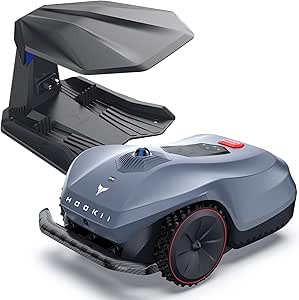 | Best for Satellite-Free Navigation | Navigation: 360° 3D LiDAR and AI vision | Maximum lawn area: 0.75 acre | Area per charge: Up to 0.17 acre | VIEW LATEST PRICE | See Our Full Breakdown |
| Lymow One Plus Wire-Free Robot Lawn Mower |  | Best for Steep, Uneven Lawns | Navigation: RTK satellite positioning and VSLAM visual mapping | Drive system: Track drive, all-wheel drive | Maximum slope: 45° | VIEW LATEST PRICE | See Our Full Breakdown |
| ECOVACS GOAT O1000 RTK CARE Robot Lawn Mower |  | Best for Compact RTK Care | Coverage: Up to 1/4 acre | Navigation: RTK, wire-free | Cutting width: 8.66 inches | VIEW LATEST PRICE | See Our Full Breakdown |
| ECOVACS GOAT A3000 LiDAR PRO Robotic Lawn Mower |  | Best for Edge Trimming | Navigation: HoloScope 360° Dual-LiDAR | Positioning accuracy: 2 cm | Lawn coverage: Up to 3/4 acre | VIEW LATEST PRICE | See Our Full Breakdown |
| LEBOSBO V3 AI Vision Robotic Lawn Mower |  | Best for Tiny, Wire-Free Lawns | Lawn coverage: Up to 1,600 sq. ft. | Navigation: AI vision | Cutting width: 6.3 inches | VIEW LATEST PRICE | See Our Full Breakdown |
| robot lawn mower | Cutting height | Navigation | Maximum slope | Cutting width |
|---|---|---|---|---|
| Segway Navimow i206 AWD Robot | 2–3.6 inches | EFLS Network RTK and Vision | 45% | 7.1 inches |
| Segway Navimow i215 LiDAR Wire | 2–4 inches | Solid-state LiDAR and vision sensors | 45% | 8.66 inches |
| Husqvarna Automower 410iQ Wire | 1–4 inches | — | 45% | — |
| DREAME A3 AWD Pro 3500 Wire-Fr | 1–4 inches | 360° 3D LiDAR and binocular AI vision | 38.7° (80%) | 15.8 inches |
| Roborock RockNeo Q110H Wire-Fr | — | Full-Band RTK and VSLAM | 45% | — |
| ANTHBOT M5 Robotic Lawn Mower | 1.2–2.7 inches | Dual-camera vision and RTK positioning | 45% | 7.9 inches |
| LOPKIN L2500 NEO Robotic Lawn | 1.18–2.76 inches | NetRTK, AI vision, and GNSS/INS fusion | 57% maximum; stable performance up to 40% | — |
| Husqvarna Automower 550 Commer | 2–3.5 inches | — | 45% | 9.45 inches |
| MOVA LiDAX Ultra 1000 Wire-Fre | 1.2–3.9 inches | — | 45% | — |
| DREAME A3 AWD 1000 LiDAR Robot | — | 360° LiDAR and binocular AI vision | 80% (38.7°) | — |
| HOOKII Neomow X SE Robotic Law | 1.18–3.35 inches | 360° 3D LiDAR and AI vision | — | 11 inches |
| Lymow One Plus Wire-Free Robot | 1.2–4 inches | RTK satellite positioning and VSLAM visual mapping | 45° | 16 inches |
| ECOVACS GOAT O1000 RTK CARE Ro | 1.2–3.2 inches | RTK, wire-free | — | 8.66 inches |
| ECOVACS GOAT A3000 LiDAR PRO R | — | HoloScope 360° Dual-LiDAR | — | 12.99 inches |
| LEBOSBO V3 AI Vision Robotic L | 0.8–2.4 inches | AI vision | — | 6.3 inches |
More Details on Our Top Picks
Segway Navimow i206 AWD Robot Lawn Mower
The Navimow i206 is the compact slope specialist in this group. Its all-wheel drive and 45% slope rating suit a small, hilly yard where traction matters more than covering ground quickly; zero-turn steering also helps limit turf scuffing. Wire-free EFLS Network RTK and Vision mapping avoids perimeter-wire installation, and the app can manage up to 20 zones. Compared with the Navimow i215 LiDAR, the i206 gives up lawn capacity and cutting width, but offers a broader cutting-height range at the upper end, reaching 3.6 inches. The main compromise is scale: coverage is limited to 1,350 square feet per charge, and its 2.5Ah battery may mean more charging interruptions. I’d choose it for a steep, modest-sized lawn, not a large property.
Pros:- All-wheel drive is rated for slopes up to 45%.
- Zero-turn steering is designed to reduce turf damage.
- EFLS Network RTK and Vision support wire-free setup and automatic mapping.
- App control supports up to 20 mowing zones.
Cons:- Coverage is limited to 1,350 square feet per charge.
- The 2.5Ah battery may require frequent recharging on demanding schedules.
Best for: Owners of compact, steep lawns who want wire-free mapping and careful turns around turf.
Not ideal for: People with large lawns or long mowing windows; its stated coverage is only 1,350 square feet per charge.
- Cutting width:7.1 inches
- Cutting height:2–3.6 inches
- Coverage per charge:Up to 1,350 sq ft
- Battery capacity:2.5Ah
- Maximum slope:45%
- Navigation:EFLS Network RTK and Vision
- Mowing zones:Up to 20
- Steering:Zero-turn
Our verdict“Choose the i206 for a small, steep yard where traction and turf-friendly turning matter more than broad coverage.”
Segway Navimow i215 LiDAR Wire-Free Robotic Lawn Mower
The Navimow i215 LiDAR stands out for lawns where satellite-dependent positioning may be inconvenient: its solid-state LiDAR and vision navigation supports mapping and obstacle detection without satellite positioning, day or night. It covers up to 0.37 acre and handles slopes up to 45%, making it a more capable all-around choice than the smaller Navimow i206. The app accommodates up to 20 zones, while Alexa and Google Home control add a convenient option for routine commands. Its 8.66-inch cutting width is narrower than the DREAME A3 AWD Pro 3500’s 15.8-inch path, so mowing may take longer on broad lawns. Cutting height runs from 2 to 4 inches, which is less flexible at the low end than the Husqvarna 410iQ’s 1-inch minimum. It makes most sense for buyers prioritizing navigation flexibility over a wide deck.
Pros:- LiDAR and vision navigation work without satellite positioning.
- Rated for slopes up to 45%.
- Supports up to 20 app-managed mowing zones and custom patterns.
- Alexa and Google Home voice control are supported.
Cons:- The 8.66-inch cutting width is narrower than the DREAME A3 AWD Pro 3500’s.
- The 2–4-inch cutting-height range excludes lower settings available on the Husqvarna 410iQ.
Best for: Owners of medium-sized or tree-shaded lawns who want wire-free mapping that does not depend on satellite positioning.
Not ideal for: Buyers seeking a wide cutting deck or the option to mow below 2 inches.
- Coverage:Up to 0.37 acre
- Navigation:Solid-state LiDAR and vision sensors
- Obstacle detection:200+ obstacle types; 0.4-inch accuracy
- Maximum slope:45%
- Cutting width:8.66 inches
- Cutting height:2–4 inches
- Mowing zones:Up to 20
- Noise level:59 dB(A)
- Voice control:Alexa and Google Home
Our verdict“Pick the i215 if satellite-free navigation and multi-zone control matter more to you than a wide cutting path.”
Husqvarna Automower 410iQ Wire-Free Robotic Lawn Mower
The Husqvarna Automower 410iQ is the measured choice for a larger lawn where virtual boundaries, scheduling, and security features matter as much as slope handling. EPOS positioning provides centimeter-accurate location data for virtual mowing areas and stay-out zones, while onboard radar supports obstacle detection. Its stated capacity of up to ½ acre exceeds the Navimow i215’s 0.37-acre coverage, and the 1–4-inch cutting range gives more flexibility at the low end. The app controls patterns from random to striped and checkerboard, but mapping requires smartphone setup; buyers wanting a simpler control experience may prefer a less feature-heavy option. It also has a separate battery warranty from the mower’s four-year coverage. I’d favor it over the compact Navimow i206 for a larger property, but not for someone avoiding app-based configuration.
Pros:- Rated for lawns up to ½ acre and slopes up to 45%.
- EPOS supports virtual boundaries and centimeter-accurate positioning.
- Offers random, striped, and checkerboard mowing patterns.
- Includes anti-theft alarm, GPS tracking, and standard installation materials.
Cons:- Mapping and setup require a smartphone app.
- The battery warranty is three years, separate from the mower’s four-year warranty.
Best for: Owners of lawns up to ½ acre who want virtual boundaries, varied mowing patterns, and GPS-backed security.
Not ideal for: Buyers who want setup without smartphone mapping or who prefer one warranty term covering both mower and battery.
- Maximum lawn area:½ acre
- Maximum slope:45%
- Cutting height:1–4 inches
- Positioning:EPOS with centimeter-accurate location data
- Obstacle detection:Onboard radar
- Mowing patterns:Random, striped, and checkerboard
- Security:Anti-theft alarm and GPS tracking
- Warranty:Four years for mower; battery covered by a separate three-year warranty
Our verdict“Choose the 410iQ for a larger, app-managed lawn where virtual boundaries and pattern choices justify setup work.”
DREAME A3 AWD Pro 3500 Wire-Free Robotic Lawn Mower with LiDAR and AI Vision
The DREAME A3 AWD Pro 3500 is the wide-deck workhorse here. Its 15.8-inch dual-disc cutting width and coverage rate of up to 8,611 square feet per hour in Rush mode are aimed at buyers who want broad ground covered quickly; by comparison, the Navimow i215’s 8.66-inch width is a narrower choice. Four-wheel drive, 360° 3D LiDAR, and binocular AI vision combine wire-free mapping with traction for steep or uneven lawns. The stated maximum slope is 38.7° (80%), though slope figures should not be compared directly with the other models’ percentage ratings without matching measurement conventions. Its app allows extensive zone and no-go-area management. The tradeoff is that runtime and charging time are not specified, making daily capacity harder to plan, and its 1–4-inch cutting range offers no setting above four inches.
Pros:- A 15.8-inch dual-disc cutting width covers a broad path.
- Four-wheel drive and off-road traction target steep, uneven lawns.
- LiDAR and binocular AI vision support wire-free navigation and obstacle detection.
- App supports up to 100 zones, 100 no-go areas, and 50 paths.
Cons:- Battery runtime and charging time are not specified in the supplied product details.
- Cutting height is limited to 1–4 inches.
Best for: Owners of large, uneven lawns who value a wide cutting path, extensive zone controls, and four-wheel drive.
Not ideal for: Buyers who need published battery runtime or charging details, or routinely keep grass above four inches.
- Drive system:4WD hub motors
- Navigation:360° 3D LiDAR and binocular AI vision
- Maximum slope:38.7° (80%)
- Cutting width:15.8 inches
- Cutting height:1–4 inches
- Maximum grass height:8 inches
- Coverage rate:Up to 8,611 sq ft per hour in Rush mode
- Obstacle detection:Over 300 obstacles; range up to 240 feet
- App capacity:100 zones, 100 no-go areas, and 50 paths
Our verdict“Choose the A3 AWD Pro 3500 if you want a wide-cutting, four-wheel-drive mower and can plan without published runtime figures.”
Roborock RockNeo Q110H Wire-Free Robot Lawn Mower
The Roborock RockNeo Q110H makes sense for a yard with narrow routes or shaded patches, where navigation can be a bigger challenge than raw cutting speed. Its Full-Band RTK and VSLAM pairing, plus automatic or app-guided manual mapping, gives owners more than one way to lay out the lawn. The product is rated for up to ¼ acre and can pass through a stated 2.3-foot-wide passage; that is a smaller coverage target than the Husqvarna 410iQ’s ½ acre, but more specific about tight access. Dual-camera vision detects and avoids people, pets, and garden objects, while the floating deck and large wheels handle slopes up to 45%. The drawbacks are modular extras: edge cutting and 4G tracking are sold separately. Its 1.57-inch obstacle clearance also limits what it can cross compared with rough-ground-focused options.
Pros:- RTK and VSLAM navigation supports mapping across shaded areas and narrow passages.
- Automatic and app-guided manual mapping give setup flexibility.
- Dual-camera AI vision is designed to avoid people, pets, and garden objects.
- Floating cutting deck and large wheels support slopes up to 45%.
Cons:- Edge-cutting module is sold separately.
- 4G tracking and anti-theft module is sold separately.
- Obstacle clearance is limited to 1.57 inches.
Best for: Owners of lawns up to ¼ acre with shaded sections, narrow passages, or several zones to manage.
Not ideal for: People who want built-in edge cutting or 4G tracking, or whose yard has obstacles taller than 1.57 inches.
- Lawn coverage:Up to ¼ acre
- Navigation:Full-Band RTK and VSLAM
- Mapping:AI auto-mapping and app-guided manual mapping
- Obstacle avoidance:Dual-camera AI vision
- Maximum slope:45%
- Obstacle clearance:1.57 inches
- Narrow passage width:2.3 feet
- Security:PIN lockout and alarm; optional 4G tracking module sold separately
- Edge cutting:Optional module sold separately; 1.2-inch edge precision
Our verdict“Pick the RockNeo Q110H for a smaller, complicated yard where narrow-passage navigation matters more than built-in premium extras.”
ANTHBOT M5 Robotic Lawn Mower with Dual Vision and RTK Navigation
The ANTHBOT M5 is a good fit for a compact, divided lawn where mapping separate areas matters more than broad coverage. Its dual cameras and RTK positioning support wire-free path planning, while app controls can organize up to 20 work zones and no-go areas. That gives it more zone flexibility than the MOVA LiDAX Ultra 1000’s stated limit of 150 managed zones only in raw count? Actually MOVA supports up to 150, so the M5 is less flexible on zone volume; its advantage is a smaller-yard package with obstacle recognition for more than 1,000 common objects. The tradeoff is its 0.15-acre coverage ceiling, which makes it a poor match for larger properties. It also needs an RTK reference station, so setup is not as station-free as the MOVA. Automatic recharging and resume, plus operation at up to 58 dB, suit frequent scheduled mowing without much disruption.
Pros:- Dual-camera vision and RTK support automatic lawn mapping and path planning.
- Recognizes more than 1,000 common garden objects.
- Supports up to 20 work zones and customizable no-go areas.
- Automatically recharges and resumes, with operating noise up to 58 dB.
Cons:- Coverage is limited to lawns up to 0.15 acre.
- Requires an RTK reference station for its navigation setup.
Best for: Owners of lawns up to 0.15 acre who want app-managed zones, automatic mowing, and obstacle recognition for a cluttered garden.
Not ideal for: Buyers with larger lawns or anyone seeking a wire-free mower that does not require an RTK reference station.
- Maximum mowing area:0.15 acre
- Navigation:Dual-camera vision and RTK positioning
- Maximum slope:45%
- Cutting height:1.2–2.7 inches
- Cutting width:7.9 inches
- Work zones:Up to 20
- Obstacle recognition:More than 1,000 common garden objects
- Operating noise:Up to 58 dB
Our verdict“Choose the M5 for a small, zone-heavy yard where obstacle recognition matters more than coverage or a station-free setup.”
LOPKIN L2500 NEO Robotic Lawn Mower for Lawns up to 0.9 Acres
For a larger property with meaningful slopes, the LOPKIN L2500 NEO offers a more ambitious coverage-and-terrain mix than the compact ANTHBOT M5. Its stated capacity reaches 0.9 acre, and NetRTK, AI vision, and GNSS/INS fusion combine for wire-free mapping and navigation. The mower is rated for slopes up to 57%, though the product description specifies stable performance on gradients up to 40%; buyers should use that distinction when judging a hilly yard. App-based multi-zone management, rain sensing, and night mowing add scheduling flexibility, while IP66-rated housing suits outdoor exposure. The tradeoffs are a connectivity setup that depends on Wi-Fi HaLow—whose real reach can shrink around obstacles—and a shorter one-year battery warranty than the two-year mower warranty. Compared with the Husqvarna Automower 550, it covers less area but avoids guide wires.
Pros:- Wire-free navigation combines NetRTK, AI vision, and GNSS/INS fusion.
- Covers up to 0.9 acre and is rated for slopes up to 57%.
- App supports mapping, scheduling, cutting modes, and multiple zones.
- Rain sensing, night mowing, and IP66-rated housing support flexible outdoor operation.
Cons:- Wi-Fi HaLow reach can vary with terrain, obstacles, and interference.
- Battery warranty is one year, compared with two years for the mower.
- Stable performance is specified only up to 40% gradients, below the stated 57% maximum.
Best for: Owners of lawns approaching 0.9 acre who want wire-free navigation, multiple zones, and help managing sloped terrain.
Not ideal for: Buyers who need predictable connectivity across obstructed property or want the battery covered for as long as the mower.
- Lawn coverage:Up to 0.9 acre
- Navigation:NetRTK, AI vision, and GNSS/INS fusion
- Maximum slope:57% maximum; stable performance up to 40%
- Cutting height:1.18–2.76 inches
- Cutting rate:Up to 2,421 sq. ft. per hour
- Battery:8 Ah; up to 200 minutes per charge
- Obstacle avoidance:AI vision identifies more than 300 common objects
- Warranty:2 years for mower; 1 year for battery
Our verdict“Pick the L2500 NEO for a large, hilly lawn if you value wire-free mapping and can account for connectivity limits and the shorter battery warranty.”
Husqvarna Automower 550 Commercial Robotic Lawn Mower
The Husqvarna Automower 550 is the lineup’s commercial-scale choice for a property where reaching separated sections reliably matters more than avoiding installation infrastructure. Its three guide wires and five remote start points help route mowing across large or divided lawns, while coverage reaches 1.25 acres—more than the LOPKIN L2500 NEO’s 0.9-acre capacity. GPS navigation, geofencing, remote control, and theft tracking add fleet-style oversight through connected apps. That setup is a different proposition from the MOVA LiDAX Ultra 1000, which maps without wires but is limited to a quarter acre. The Husqvarna’s tradeoff is the guide-wire approach and dependence on connected apps for its smart features. Its cutting-height range tops out at 3.5 inches, so buyers who keep taller grass may prefer a mower with a higher upper setting.
Pros:- Covers properties up to 1.25 acres.
- Three guide wires and five remote start points help serve divided lawns.
- GPS navigation, geofencing, remote control, and theft tracking support remote oversight.
- Handles slopes up to 45% and works with Amazon Alexa and Google Home.
Cons:- Uses guide wires rather than the wire-free mapping approach of the MOVA LiDAX Ultra 1000.
- Smart features and fleet management rely on connected apps.
- Maximum cutting height is 3.5 inches.
Best for: Managers of large, divided properties who want multiple guided routes, remote start points, and app-based tracking.
Not ideal for: Owners who want a wire-free installation, avoid connected-app dependence, or need a cutting height above 3.5 inches.
- Coverage area:Up to 1.25 acres
- Guide wires:3
- Remote start points:5
- Maximum slope:45%
- Cutting width:9.45 inches
- Cutting height:2–3.5 inches
- Weight:33 pounds
- Smart home compatibility:Amazon Alexa and Google Home
- Warranty:2-year limited warranty
Our verdict“Choose the Automower 550 for a large or divided property where guided coverage and remote oversight outweigh wire-free setup.”
MOVA LiDAX Ultra 1000 Wire-Free Robotic Lawn Mower
The MOVA LiDAX Ultra 1000 stands out for buyers who want a wire-free mower without adding an RTK reference station. Its 360° 3D LiDAR and AI vision map the lawn, while support for two maps and up to 150 managed zones gives it room to organize detailed layouts. The MOVA also cuts within two inches of edges, a useful advantage over the DREAME A3 AWD 1000’s stated edge precision of 1.97 inches only by a narrow margin; the figures are nearly identical, so neither should be treated as a substitute for trimming every edge. Its 45% slope rating matches the ANTHBOT M5, but coverage is much larger at up to a quarter acre. The main limit is still its modest coverage ceiling, and obstacle detection is specified for objects over a limited height of 1.6 inches. Automatic recharging and resume reduce the need to restart interrupted mowing.
Pros:- Maps without boundary wires or an RTK station.
- Supports two maps and up to 150 managed zones.
- Cuts within two inches of edges.
- Returns to charge and resumes mowing where it stopped.
Cons:- Coverage is limited to up to 1/4 acre.
- Maximum obstacle height is 1.6 inches.
- Edge cutting still leaves a narrow strip that may need separate trimming.
Best for: Owners of smaller lawns who want wire-free, RTK-free mapping and flexible zone management.
Not ideal for: Buyers with lawns larger than a quarter acre or yards with many obstacles taller than 1.6 inches.
- Coverage:Up to 1/4 acre
- Mapping:360° 3D LiDAR and AI vision; wire-free and RTK-free
- Maximum slope:45%
- Cutting height:1.2–3.9 inches
- Edge cutting:Within 2 inches
- Obstacle detection:More than 300 types
- Maximum obstacle height:1.6 inches
- Maps and zones:Up to 2 maps and 150 managed zones
- Manufacturer warranty:3 years
Our verdict“Choose the LiDAX Ultra 1000 for a small, mapped lawn where avoiding boundary wires and an RTK station is the priority.”
DREAME A3 AWD 1000 LiDAR Robot Lawn Mower with Cleaning Kit and Replacement Blades
If steep ground is the main obstacle, the DREAME A3 AWD 1000 makes the strongest terrain-focused case in this group. Its all-wheel drive is rated for slopes up to 80%, well above the 45% limits listed for the MOVA LiDAX Ultra 1000 and ANTHBOT M5. Wire-free 360° LiDAR and binocular AI vision map the lawn and help the mower navigate under tree cover, while obstacle clearance reaches 2.17 inches. Coverage is listed as 0.25–0.5 acre, so it can suit a mid-sized property, though the range means buyers should confirm their lawn falls within the intended capacity. Edge precision is within 1.97 inches, close to the MOVA’s two-inch figure, and still leaves a narrow strip. The optional trimmer module is sold separately; the included cleaning kit and replacement blades do not close that edge gap.
Pros:- All-wheel drive is rated for slopes up to 80%.
- Wire-free 360° LiDAR and binocular AI vision support mapping under tree cover.
- Clears obstacles up to 2.17 inches high.
- Includes a cleaning kit and replacement blades, with a three-year warranty.
Cons:- Edge precision leaves a gap of up to 1.97 inches without the optional trimmer.
- Optional trimmer module is sold separately.
- Listed coverage spans 0.25–0.5 acre rather than a single maximum figure.
Best for: Owners of mid-sized lawns with steep slopes or uneven ground who want wire-free mapping and all-wheel drive.
Not ideal for: Buyers with mostly flat lawns who prioritize close edge finishing or expect a trimmer module in the package.
- Lawn coverage:0.25–0.5 acre
- Drive:All-wheel drive
- Navigation:360° LiDAR and binocular AI vision
- Maximum slope:80% (38.7°)
- Obstacle clearance:2.17 inches
- Edge precision:Within 1.97 inches
- Included accessories:Cleaning kit and replacement blades
- Warranty:3 years
- 4G service:1 year free
Our verdict“Pick the DREAME A3 AWD 1000 when steep terrain matters more than finishing the lawn edges without a separate trimmer.”
HOOKII Neomow X SE Robotic Lawn Mower with 360° 3D LiDAR Navigation, 0.75-Acre Coverage
The HOOKII Neomow X SE is a strong fit for yards where satellite reception is unreliable: its 360° 3D LiDAR and AI vision handle navigation without boundary wires, an RTK station, or satellite signals. That makes it distinct from the LYMOW One Plus, which pairs visual mapping with RTK positioning and suits buyers prioritizing steep-terrain traction. HOOKII instead emphasizes flexible mapping, with up to 40 app-managed areas and no-go zones, plus breakpoint resume after charging. Its listed maximum lawn size is 0.75 acre, but it covers only up to 0.17 acre per charge, so a larger yard will need repeated charging cycles. The roughly 1.6-inch obstacle limit also makes it a weaker fit for lawns with raised borders or uneven transitions.
Pros:- LiDAR and AI vision navigate without boundary wires, RTK stations, or satellite signals.
- Supports up to 40 customizable mowing areas and no-go zones through the app.
- Breakpoint resume lets it continue a job after returning to charge.
- IPX5-rated chassis can be rinsed for maintenance.
Cons:- Covers up to 0.17 acre per charge, so the full listed lawn capacity may require multiple charging cycles.
- Obstacle crossing is limited to about 1.6 inches.
- Its 11-inch cutting width is narrower than the LYMOW One Plus’s 16-inch deck.
Best for: Owners of lawns up to 0.75 acre who want wire-free mowing in shaded or satellite-challenged areas and value app-defined zones.
Not ideal for: People with steep, rough yards, raised obstacles over about 1.6 inches, or large lawns who want fewer charge-and-mow cycles.
- Navigation:360° 3D LiDAR and AI vision
- Maximum lawn area:0.75 acre
- Area per charge:Up to 0.17 acre
- Battery capacity:13,000 mAh
- Runtime:Up to 2 hours per charge
- Cutting width:11 inches
- Cutting height:1.18–3.35 inches
- Obstacle crossing:About 1.6 inches
- Water resistance:IPX5
Our verdict“Choose the Neomow X SE for wire-free navigation that does not depend on satellite signals, provided your lawn has modest obstacles and you can accommodate charging breaks.”
Lymow One Plus Wire-Free Robot Lawn Mower
Where many wire-free mowers are best suited to relatively clear, level turf, the LYMOW One Plus is built around traction: its track drive and all-wheel drive are rated for slopes up to 45° and obstacles up to 2.8 inches. That gives it a different job from the HOOKII Neomow X SE, whose LiDAR navigation works without satellite signals but has a lower obstacle-crossing limit. Lymow combines RTK positioning with visual mapping, so its setup depends on satellite positioning as well as vision. The 16-inch deck and stated 0.57-acre mowing capacity per charge make it better suited to larger, demanding lawns than small-yard options such as the LEBOSBO V3. The tradeoff is a three-hour recharge, and the supplied data does not give a maximum lawn-area figure.
Pros:- Track drive and all-wheel drive are rated for slopes up to 45°.
- Crosses obstacles up to 2.8 inches, higher than the HOOKII Neomow X SE’s listed limit.
- Wide 16-inch cutting deck and dual steel blades support broad, mulching-focused coverage.
- App supports scheduling and management for up to 80 zones.
Cons:- RTK positioning relies on satellite signals, unlike the HOOKII Neomow X SE’s satellite-free navigation.
- Recharge time is listed as 3 hours.
- Its track-drive capability may be unnecessary for buyers with small, level lawns.
Best for: Owners of larger, sloped or uneven lawns who need a wire-free mower with strong traction and broad zone scheduling.
Not ideal for: Buyers with satellite-obstructed yards, small simple lawns, or a preference for a compact mower with short recharge periods.
- Navigation:RTK satellite positioning and VSLAM visual mapping
- Drive system:Track drive, all-wheel drive
- Maximum slope:45°
- Obstacle crossing:2.8 inches
- Cutting width:16 inches
- Cutting height:1.2–4 inches
- Mowing per charge:Up to 0.57 acres
- Recharge time:3 hours
- Water resistance:IPX6
Our verdict“Pick the LYMOW One Plus if steep slopes and rough ground matter more than satellite-independent navigation or a quick recharge.”
ECOVACS GOAT O1000 RTK CARE Robot Lawn Mower
The ECOVACS GOAT O1000 RTK CARE is a straightforward choice for a modest lawn where automatic mapping and RTK-based, wire-free mowing matter more than a wide cutting deck. It handles mowing and recharging automatically, while app-based multi-zone management lets owners tailor schedules across separate patches of grass. The CARE bundle adds 36 replacement blades and an RTK extension cable, a practical distinction from the ECOVACS GOAT A3000 LiDAR PRO, which instead brings dual LiDAR, faster listed charging, and a built-in edge trimmer. The O1000 is rated for up to a quarter acre and has an 8.66-inch cutting width, so it is less suited to broad lawns or buyers seeking faster coverage. Its 90-minute battery-life listing and 3.2-inch maximum cutting height also limit its appeal for longer grass.
Pros:- RTK navigation supports systematic mowing without perimeter wires.
- Automatic yard mapping and app-based multi-zone management simplify routine scheduling.
- Automatically manages mowing and recharging.
- CARE bundle includes 36 replacement blades and an RTK extension cable.
Cons:- The 8.66-inch cutting width is narrower than the ECOVACS GOAT A3000 LiDAR PRO’s 12.99-inch width.
- Listed battery life is 90 minutes.
- Maximum cutting height is 3.2 inches.
Best for: Owners of lawns up to a quarter acre who want automatic RTK mapping, app-managed zones, and spare blades included.
Not ideal for: Buyers with large lawns, tall grass, or a preference for LiDAR navigation and a built-in edge trimmer.
- Coverage:Up to 1/4 acre
- Navigation:RTK, wire-free
- Cutting width:8.66 inches
- Cutting height:1.2–3.2 inches
- Battery life:90 minutes
- Weight:44.5 pounds
- Noise level:62 dB
- Included accessories:36 replacement blades and RTK extension cable
Our verdict“Choose the GOAT O1000 RTK CARE for a smaller lawn and an included maintenance bundle, not for wide-area mowing or taller grass.”
ECOVACS GOAT A3000 LiDAR PRO Robotic Lawn Mower
The ECOVACS GOAT A3000 LiDAR PRO stands apart for its built-in TruEdge trimmer, which is designed to cut along borders and reduce the amount of manual touch-up after mowing. Its dual-LiDAR navigation and stated 2 cm positioning accuracy avoid reliance on an RTK antenna, a contrast with the ECOVACS GOAT O1000 RTK CARE and its satellite-based positioning. With coverage up to three-quarters of an acre, a 12.99-inch cutting width, and an approximately 70-minute recharge, it is the stronger ECOVACS fit for a larger yard. The tradeoff is physical: at 64.5 pounds, it is a substantial machine to move or reposition. Buyers with compact lawns may find the smaller O1000 more appropriate, while owners of yards larger than the stated coverage should look elsewhere.
Pros:- Dual LiDAR maps and navigates without a perimeter wire or RTK antenna.
- Built-in TruEdge trimmer is designed to reduce missed grass along borders.
- App controls support mowing zones, no-go areas, cutting height, speed, and travel paths.
- Approximately 70-minute recharge is quicker than the LYMOW One Plus’s listed three-hour charge.
Cons:- At 64.5 pounds, it is heavy to lift or reposition.
- Coverage is listed at up to 3/4 acre, which excludes larger lawns.
- Its advanced coverage and edge-trimming setup may be more machine than a small, simple lawn needs.
Best for: Owners of lawns up to three-quarters of an acre who want LiDAR navigation and less manual trimming along borders.
Not ideal for: People who need a lightweight mower, have a lawn beyond the stated coverage, or want a smaller machine for a compact yard.
- Navigation:HoloScope 360° Dual-LiDAR
- Positioning accuracy:2 cm
- Lawn coverage:Up to 3/4 acre
- Cutting width:12.99 inches
- Battery capacity:7500 mAh
- Recharge time:Approximately 70 minutes
- Mowing efficiency:Up to 400 m²/h
- Edge trimming:Built-in TruEdge trimmer
- Weight:64.5 pounds
Our verdict“Choose the GOAT A3000 LiDAR PRO if clean lawn edges and satellite-independent navigation justify a heavier mower for your yard.”
LEBOSBO V3 AI Vision Robotic Lawn Mower
The LEBOSBO V3 is the small-lawn outlier in this group: its coverage tops out at 1,600 square feet, far below the quarter-acre ECOVACS GOAT O1000 RTK CARE or the larger HOOKII Neomow X SE. For a compact residential patch, AI vision and app scheduling offer basic wire-free operation without asking the owner to install a perimeter wire. Its 32-foot magnetic strip provides a way to mark no-go areas, but those boundaries require physical placement rather than the app-defined zones offered by larger, more capable options such as the LYMOW One Plus. The 6.3-inch cutting width and 0.8–2.4-inch height range reinforce its limited scope. It makes sense for a small, relatively simple lawn, not for expansive, uneven, or tall-grass jobs.
Pros:- AI vision recognizes obstacles and lawn areas without boundary wires.
- App provides scheduling, operating modes, and mower status.
- Includes a 32-foot magnetic strip for defining no-go areas.
- Adjustable cutting height and a low-noise motor suit residential use.
Cons:- Coverage is limited to 1,600 square feet, much less than the HOOKII Neomow X SE’s stated 0.75-acre lawn capacity.
- No-go zones require placing the magnetic strip rather than setting them entirely in an app.
- The 6.3-inch cutting width and 2.4-inch maximum cutting height limit its use on broader lawns and taller grass.
Best for: Owners of small, flat lawns up to 1,600 square feet who want automatic scheduling without boundary-wire installation.
Not ideal for: People with larger lawns, complex no-go areas, uneven terrain, or grass that needs a taller cutting setting.
- Lawn coverage:Up to 1,600 sq. ft.
- Navigation:AI vision
- Cutting width:6.3 inches
- Cutting height:0.8–2.4 inches
- Boundary setup:No boundary wires; includes 32-foot magnetic strip
- Dimensions:17 × 14 × 8.6 inches
- Power source:Battery powered
- Included items:18V charger, magnetic strip, ground stakes, replacement blades, and user manual
Our verdict“Pick the LEBOSBO V3 only for a small lawn where simple wire-free scheduling matters more than broad coverage or app-drawn boundaries.”
How We Picked
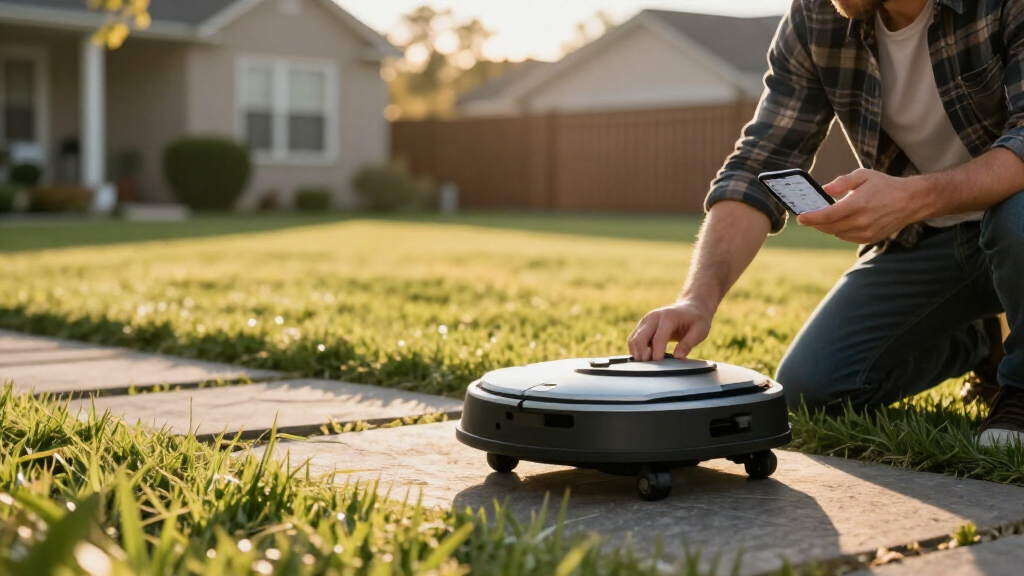
I compared these 15 robot lawn mowers on the factors that change ownership, not on feature count alone: stated lawn coverage, navigation approach, terrain capability, obstacle handling, setup demands, and the intended residential or commercial use. A mower’s cutting system matters, but a machine that cannot map or travel reliably through a particular yard is a poor fit regardless of its headline technology. I also weighed maintenance needs and the practical value of included accessories where those details were provided.
The ranking favors options with a clear use case and a stronger balance of capability and usability for the buyers most likely to need them. Models with all-wheel drive or broader stated coverage earn attention for challenging terrain and larger lawns; wire-free navigation earns credit when it can simplify installation, but not as an automatic advantage. I placed specialized commercial and highly specific coverage models lower for general buyers, since their strengths may come with unnecessary complexity or a narrower fit. Product names alone do not establish equivalent performance, so I treat stated features as selection criteria rather than guarantees for every yard.
Factors to Consider When Choosing Robot Lawn Mowers
Before choosing a mower, I’d start with the shape and conditions of the lawn rather than the navigation feature that sounds most advanced. A robot mower is a fit between the machine, its mapping method, and the work you expect it to handle.
Match Rated Coverage to the Mowing Area
Measure the grass the mower must cut, not the full property, since paths, beds, patios, and buildings do not count as mowing area. Then leave headroom for divided sections, narrow passages, and a lawn that grows quickly during peak season. A model listed for a larger area may reduce schedule pressure, but it can bring capabilities you will rarely use on a small, simple lawn. Do not assume that two mowers with similar coverage labels will finish at the same pace; battery capacity, mowing schedule, and recharge behavior can change how much area they manage day to day. If the manufacturer’s coverage figure is unclear about conditions, treat it as a planning reference rather than a promise. I’d rather size for the actual workload than buy by lot size alone.
Choose Navigation for Your Yard, Not the Feature List
Wire-free systems can avoid perimeter-wire installation, but each method has different dependencies. RTK-based navigation may need a suitable signal and well-placed reference equipment, while LiDAR and vision rely on the mower’s ability to perceive the yard and its boundaries. Trees, tall buildings, tight side yards, and irregular borders can make a system’s job harder, even if the lawn looks straightforward on a map. Before buying, check whether the mower needs clear sky access, a separate antenna, or a manual mapping pass. A boundary wire can take more initial labor but may be the more predictable choice for a yard with poor positioning conditions. The mistake is treating “wire-free” as a guarantee of easier setup in every property.
Treat Slopes and Surface Changes as a Separate Test
A lawn’s steepest section can matter more than its total area. Check the mower’s stated slope capability and whether that figure applies to the whole surface or only in specific conditions, such as dry grass. Damp turf, loose soil, roots, and sharp transitions between lawn and paving can reduce traction. All-wheel drive, as found in some of the lineup’s terrain-oriented options, is relevant when the mower must maintain movement on uneven ground, but it does not make every steep or slippery yard suitable. Walk the route and note slopes, low spots, and transitions before comparing models. If most of the lawn is flat, paying extra for terrain hardware may not improve the day-to-day result.
Map Obstacles, Narrow Routes, and Multiple Lawn Zones
List fixed obstacles such as trees, play equipment, garden edges, and steps, then identify every narrow route between lawn sections. Navigation and obstacle detection are not the same thing: avoiding an object does not necessarily mean the mower can pass through a narrow corridor or reach a separated patch. Confirm how zones are created and whether the mower can return to its charging point from each one. Very complex layouts may require more boundary adjustments or manual mapping, so an attractive feature list should not replace a practical route check. Keep movable items out of the plan too; hoses and lightweight toys can change position between mowing sessions. Buyers with a single open lawn can prioritize simple operation, while multi-zone yards should put route management first.
Plan for Setup, Maintenance, and Seasonal Care
Wire-free models can save the work of laying a perimeter cable, but they still require a clear charging location, mapping, app configuration, and occasional boundary corrections. Cutting blades are consumables, and grass buildup, leaves, and debris can affect cutting and movement if left unattended. Check how blades are replaced, whether common replacement parts are easy to source, and what cleaning the manufacturer permits. Accessories such as replacement blades or a cleaning kit can be useful, but they should not outweigh the mower’s fit for the lawn. Also plan for storage and seasonal shutdown, especially where winter conditions prevent regular mowing. A machine that is easy to maintain is often a better long-term match than one with more features but more setup work than you want.
Pay for Capability You Will Actually Use
Higher-spec navigation, stronger terrain handling, or commercial-oriented construction can make sense when the lawn creates a matching workload. Those features are harder to justify on a small, level yard with few obstacles and a straightforward mowing schedule. Conversely, choosing a basic model solely to minimize initial complexity can be a false economy if it cannot cover the lawn or cope with its slopes. Compare the cost of installation effort, recurring blade replacement, and the time needed to manage multiple zones alongside the mower’s feature set. Keep residential and commercial needs distinct: a commercial-oriented machine may suit frequent, demanding use but can be more than a household needs. My rule is to pay for a demonstrated yard problem, not a specification that merely sounds advanced.
Frequently Asked Questions
Can a wire-free robot lawn mower work in a yard with trees or tall buildings?
It can, but performance depends on the navigation system and how much of the yard has clear positioning conditions. RTK-based mowers may have trouble maintaining a strong signal near dense tree cover or tall structures, while LiDAR or vision systems rely on their own ability to read the surroundings. A yard can have open grass and still include a narrow side passage or shaded corner that complicates mapping. Check the setup requirements and coverage limits for the specific model rather than relying on the wire-free label. If your lawn has obstructed areas, look for a clear explanation of how the mower handles them and plan to map those sections carefully.
Do I need an all-wheel-drive robot mower for a sloped lawn?
Not automatically; the answer depends on the steepness, surface, and how much of the lawn is sloped. A modest, dry slope may suit a mower without AWD if its published limits match the yard, while uneven or slippery terrain makes traction more important. Compare the mower’s slope rating with the steepest section, and check whether the stated capability changes on wet grass. AWD models such as the Segway Navimow i206 AWD and DREAME A3 AWD Pro 3500 are more relevant when terrain is a central problem, but they are not a substitute for checking the manufacturer’s limits. If the lawn is mostly flat, simpler equipment may be a better use of your budget.
How much larger should the mower’s coverage rating be than my lawn?
There is no single margin that fits every yard, because layout, mowing schedule, and travel between zones affect how much work the machine can complete. Start with the actual grass area and account for separate patches, narrow routes, and the pace at which the lawn grows. A mower rated close to the area may be a sensible fit for an open, simple lawn, while a divided or obstacle-heavy yard benefits from more capacity headroom. Read how the manufacturer defines its coverage figure and whether it assumes particular operating conditions. Do not use the full property acreage if much of the land is paved, planted, or otherwise outside the mowing area.
Will a robot mower handle separate lawn sections divided by a path or driveway?
Some models support multiple zones, but their ability to reach each section depends on routes, mapping, and how the mower crosses the divider. A narrow passage may be harder to navigate than a broad paved path, and not every mower can safely cross every surface or level change. Check how many zones the system supports and whether each one needs a mapped route or manual setup. If the sections are not physically connected, ask whether the mower can be carried between them and how that affects scheduling. Map the tightest route before choosing a model, since total grass area alone will not reveal this limitation.
Is a commercial robot lawn mower a good choice for a large home lawn?
It may suit a large, demanding property, but commercial positioning alone does not make a mower the right household choice. Consider the area it can manage, how often it needs to run, its setup needs, and whether its construction or operating features address a real problem on your property. The Husqvarna Automower 550 is the lineup’s commercial-oriented option, so I would reserve it for buyers with frequent or demanding mowing needs rather than a typical small yard. A residential mower with enough coverage and terrain capability may be easier to match to household use. Compare the manufacturer’s intended application and support details before treating a commercial model as an automatic upgrade.
Conclusion
For most buyers, I’d start with the Segway Navimow i206 AWD as the best overall pick, particularly when the lawn has uneven ground and the appeal of wire-free mowing is strong. The LOPKIN L2500 NEO is the most coverage-focused value candidate in this lineup, with its stated capacity of up to 0.9 acres; verify that its navigation and layout fit your property before choosing it. For a premium, more demanding setup, compare the DREAME A3 AWD Pro 3500 with the Husqvarna Automower 550, selecting the former for a large residential lawn with terrain needs and the latter for commercial-oriented upkeep. Beginners with a straightforward yard should favor the mower whose mapping and setup requirements are easiest to meet, rather than paying for advanced features they will not use; the Husqvarna Automower 410iQ is a strong shortlist option for buyers who want a recognized wire-free system. For steep or uneven lawns, focus on AWD models, while buyers with complex boundaries should compare navigation methods and zone management first. Match the mower to the yard’s hardest section, not just its total area.