The best commercial carbon water filter systems depend on whether you need to protect an ice machine or treat water across an entire building. My best overall pick is the 3M ICE260-S for its commercial ice-machine focus; the LiquaGen Catalytic Carbon and KDF system stands out for whole-building treatment, while the Arctic Pure Plus offers a simpler single-cartridge approach. The central tradeoff is between targeted filtration designed around one piece of equipment and larger systems that serve multiple taps but call for more installation space and planning. Capacity, flow, replacement schedules, and the water contaminants you need to address can change which option makes sense. Read on for the full breakdown and a buying guide to help match a system to your site.

Get home appliances delivered free with Prime
- Fast, free delivery on millions of items
- Prime Video, Amazon Music and more included
- Member-only deals all year
Complete the kit


Key Takeaways
- Application separates the leading options: the 3M ICE260-S and ICE120-S are built for commercial ice equipment, while LiquaGen, iSpring, Aquasana, and A. O. Smith are whole-house-style systems.
- Carbon format affects service planning: cartridge systems such as the Arctic Pure Plus can be simpler to maintain, while larger treatment setups may require more room and installation work.
- Capacity figures need context: the Arctic Pure Plus lists a 15,000-gallon capacity, but actual replacement timing depends on source-water quality and equipment demand.
- More filtration stages do not automatically mean a better fit: the iSpring WGB32B uses three stages, while a single-purpose ice-machine system may better suit a site that only needs ice-water treatment.
- Commercial suitability requires verification: buyers should confirm flow, connection size, certifications, and replacement-cartridge availability for the exact model and intended use before ordering.
| LiquaGen Whole House Water Filtration System with Catalytic Carbon and KDF 55, 10 x 54 in. |  | Best for Chloramine Treatment | Filter media: Catalytic carbon and KDF 55 | Maximum flow rate: 12 GPM | Media life: Up to 10 years or 1,000,000 gallons | VIEW LATEST PRICE | See Our Full Breakdown |
| 3M ICE260-S High Flow Water Filtration System for Commercial Ice Makers |  | Best for High-Volume Ice and Beverage Service | Model: ICE260-S | Maximum flow rate: 6.68 GPM | Capacity: 70,000 gallons | VIEW LATEST PRICE | See Our Full Breakdown |
| iSpring WGB32B 3-Stage Whole House Water Filter System |  | Best DIY Whole-House Cartridge System | Stages: 3 | Filtration: 5-micron sediment filter and two coconut-shell carbon-block filters | Maximum flow rate: 15 GPM | VIEW LATEST PRICE | See Our Full Breakdown |
| Arctic Pure Plus Single-Cartridge Ice Machine Water Filtration System, 15,000-Gallon Capacity |  | Best Compact Ice Machine Filter | Model: AR-10000-P | Capacity: 15,000 gallons | Compatible ice production: Up to approximately 600 lbs/day | VIEW LATEST PRICE | See Our Full Breakdown |
| Aquasana Rhino Max Flow Whole House Water Filter, Carbon and KDF, WH-1010-CT-LM |  | Best Low-Maintenance Whole-House Pick | Model: WH-1010-CT-LM | Filtration media: Carbon, KDF, and salt-free Scale Control Media | Peak flow rate: 14.5 GPM | VIEW LATEST PRICE | See Our Full Breakdown |
| 3M High Flow Series Commercial Ice Water Filtration System ICE120-S |  | Best for Commercial Ice Machines | Model: ICE120-S | Brand: Aqua-Pure | Flow rate: Up to 1.5 gpm | VIEW LATEST PRICE | See Our Full Breakdown |
| Krowne KR-HS3-KIT HydroSift Triple Water Filter Assembly Kit | 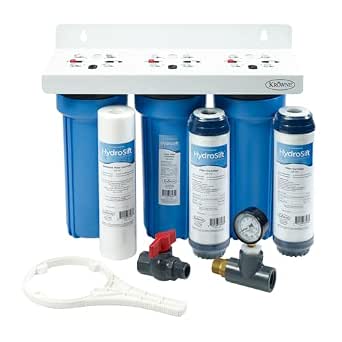 | Best for Multi-Stage Beverage Setups | Model: KR-HS3-KIT | Filtration method: Granular activated carbon and sedimentation | Installation type: Under sink | VIEW LATEST PRICE | See Our Full Breakdown |
| A. O. Smith AO-WH-Filter Whole House Water Filter System |  | Best for Whole-Home Chlorine Reduction | Model: AO-WH-Filter | Filtration method: Activated carbon | Chlorine reduction: Up to 96.9% | VIEW LATEST PRICE | See Our Full Breakdown |
| commercial carbon water filter system | Model | Maximum flow rate | Capacity |
|---|---|---|---|
| LiquaGen Whole House Water Fil | — | 12 GPM | — |
| 3M ICE260-S High Flow Water Fi | ICE260-S | 6.68 GPM | 70,000 gallons |
| iSpring WGB32B 3-Stage Whole H | — | 15 GPM | 100,000 gallons |
| Arctic Pure Plus Single-Cartri | AR-10000-P | 0.75 GPM | 15,000 gallons |
| Aquasana Rhino Max Flow Whole | WH-1010-CT-LM | 7 GPM | 1,000,000 gallons |
| 3M High Flow Series Commercial | ICE120-S | — | 9,000 gallons |
| Krowne KR-HS3-KIT HydroSift Tr | KR-HS3-KIT | — | — |
| A. O. Smith AO-WH-Filter Whole | AO-WH-Filter | — | — |
More Details on Our Top Picks
LiquaGen Whole House Water Filtration System with Catalytic Carbon and KDF 55, 10 x 54 in.
For municipal-water homes looking for point-of-entry carbon treatment, the LiquaGen pairs catalytic carbon with KDF 55 to target chlorine, chloramine, PFAS, sediment, VOCs, and unwanted tastes and odors. Its 12 GPM flow rate and automatic backwashing make it a different proposition from the iSpring WGB32B: LiquaGen treats water through a backwashing media tank, while iSpring uses replaceable carbon-block cartridges and offers a higher stated flow rate of 15 GPM. The advertised capacity of up to 10 years or 1,000,000 gallons may appeal to buyers who want fewer routine cartridge changes, but it depends on water conditions and use. This is a main-line plumbing installation, not a countertop filter, and it is designed for municipal supplies. I would skip it for well water or a renter-friendly setup.
Pros:- Treats water at the point of entry for use across taps, showers, and appliances.
- Catalytic carbon and KDF 55 target chlorine, chloramine, and other listed contaminants.
- Programmable automatic backwashing helps clear accumulated contaminants from the media bed.
- Preloaded tank and included bypass valve support installation and maintenance.
Cons:- Requires connection to the main water line and basic plumbing work.
- Designed for municipal water rather than well-water applications.
- Its 12 GPM maximum flow rate is below the iSpring WGB32B’s stated 15 GPM.
Best for: Homeowners on municipal water who want whole-house chlorine and chloramine treatment and have space for a backwashing media tank.
Not ideal for: Renters, buyers seeking a simple under-sink or countertop system, and households using well water, which this model is not designed for.
- Filter media:Catalytic carbon and KDF 55
- Maximum flow rate:12 GPM
- Media life:Up to 10 years or 1,000,000 gallons
- Tank size:10 × 54 in.
- Tank material:Fiberglass-reinforced plastic
- Bypass valve:1-inch metal
- Installation:Whole house, point of entry
Our verdict“Choose the LiquaGen if you want backwashing, whole-house carbon treatment for municipal water, and can accommodate a main-line installation.”
3M ICE260-S High Flow Water Filtration System for Commercial Ice Makers
The 3M ICE260-S is the strongest fit here for a busy ice machine or coffee brewer that needs high flow and a 70,000-gallon capacity. Its activated-carbon cartridge reduces chlorine taste and odor, while the listed filtration targets also include sediment, scale, bacteria, and cysts. Compared with the Arctic Pure Plus, this model supports a much higher maximum flow rate—6.68 GPM versus 0.75 GPM—which suits equipment with greater water demand. Its sanitary quick-change cartridge and valve-in-head design also make service less disruptive: the valve shuts off and vents air during cartridge changes. The tradeoff is its countertop footprint and its equipment-focused purpose. I would not choose it as a whole-house filter or for a small ice maker that does not need this flow capacity.
Pros:- Maximum flow rate of 6.68 GPM supports higher-demand commercial equipment.
- 70,000-gallon capacity suits sustained ice-machine or coffee-brewer use.
- Sanitary quick-change cartridge avoids contact with filter media.
- Valve-in-head design shuts off and vents air for cartridge changes.
Cons:- Designed for commercial ice machines and coffee brewers rather than whole-house treatment.
- The 18.6 × 5.5 × 24.5-inch system needs dedicated installation space.
- Its equipment-specific setup is less suitable for buyers seeking a general-purpose carbon filter.
Best for: Restaurants, cafés, and other commercial kitchens running high-demand ice makers or coffee brewers that need a service-friendly filter.
Not ideal for: Homeowners seeking whole-house filtration or small operations with limited counter space and low water demand.
- Model:ICE260-S
- Maximum flow rate:6.68 GPM
- Capacity:70,000 gallons
- Purification method:Activated carbon
- Dimensions:18.6 × 5.5 × 24.5 in.
- Operating temperature:40–100 °F
- Certifications:NSF/ANSI 42, NSF/ANSI 53, CSA B483.1
Our verdict“Pick the ICE260-S for commercial equipment with substantial flow needs; choose the Arctic Pure Plus for a lower-flow ice machine and smaller system footprint.”
iSpring WGB32B 3-Stage Whole House Water Filter System
The iSpring WGB32B suits buyers who prefer a replaceable-cartridge setup over a backwashing media tank. Its three stages combine a 5-micron sediment filter with two coconut-shell carbon-block filters to reduce chlorine, rust, sediment, tastes, odors, and herbicides while preserving minerals. The stated 15 GPM flow rate is higher than the LiquaGen’s 12 GPM, making this a compelling fit for households prioritizing flow. Unlike the LiquaGen, though, the iSpring has a stated capacity of 100,000 gallons and a one-year filter life, so buyers should plan on regular cartridge replacement. It is designed for DIY installation and includes a housing wrench, but the 20 × 4.5-inch cartridges are a specific format to maintain. This is not a dissolved-solids solution; buyers needing TDS reduction should look at reverse osmosis instead.
Pros:- Three filtration stages address sediment, chlorine, rust, tastes, odors, and herbicides.
- Stated maximum flow rate of 15 GPM exceeds the LiquaGen’s 12 GPM.
- Preserves healthy minerals rather than removing them.
- Designed for DIY installation and includes a housing wrench and manual.
Cons:- Does not remove total dissolved solids.
- Filter life is stated as one year, with a 100,000-gallon capacity.
- Requires 20 × 4.5-inch replacement cartridges.
Best for: DIY-minded homeowners who want whole-house sediment and carbon filtration, preserved minerals, and a stated flow rate up to 15 GPM.
Not ideal for: Buyers seeking TDS removal, long-life media without annual cartridge changes, or a system that avoids 20 × 4.5-inch replacement filters.
- Stages:3
- Filtration:5-micron sediment filter and two coconut-shell carbon-block filters
- Maximum flow rate:15 GPM
- Capacity:100,000 gallons
- Filter life:1 year
- Inlet/outlet:1-inch NPT
- Installation:DIY
Our verdict“Choose the iSpring for DIY whole-house carbon and sediment filtration with higher stated flow; skip it if you need TDS reduction or less frequent cartridge changes.”
Arctic Pure Plus Single-Cartridge Ice Machine Water Filtration System, 15,000-Gallon Capacity
The Arctic Pure Plus is the more focused choice for an ice machine that needs fine-particle filtration and scale control without the larger capacity of the 3M ICE260-S. Its 0.5-micron carbon block targets sediment and fine particles that can affect ice clarity, while the quick-change cartridge is designed for machines producing up to approximately 600 pounds of ice per day. That fit comes with a clear limitation: 0.75 GPM maximum flow is far below the 3M system’s 6.68 GPM, so this is not the pick for higher-throughput beverage service. Capacity is 15,000 gallons, and the cartridge needs replacement every six months or when pressure drops below 35 PSI. Its compact dimensions help where a bigger system will not fit, but buyers should check the machine’s demand and water pressure before choosing it.
Pros:- 0.5-micron carbon block helps reduce fine particles and sediment.
- Built-in scale control helps limit mineral buildup in ice equipment.
- Quick-change cartridge can be replaced without shutting off the water.
- Designed for ice machines producing up to approximately 600 pounds per day.
Cons:- Maximum flow rate of 0.75 GPM is substantially lower than the 3M ICE260-S.
- Cartridge replacement is specified every six months or when pressure drops below 35 PSI.
- The 15,000-gallon capacity is below the 3M ICE260-S’s 70,000 gallons.
Best for: Operators of compact or moderate-output commercial ice machines who want fine-particle filtration, scale control, and a quick-change cartridge.
Not ideal for: High-volume ice or coffee service that needs more than 0.75 GPM, or operators who want longer intervals between cartridge changes.
- Model:AR-10000-P
- Capacity:15,000 gallons
- Compatible ice production:Up to approximately 600 lbs/day
- Maximum flow rate:0.75 GPM
- Water pressure:35–125 PSI
- Inlet connection:3/8 inch
- Replacement interval:Every 6 months or when pressure drops below 35 PSI
Our verdict“Choose the Arctic Pure Plus for a compact, lower-flow ice machine setup; select the 3M ICE260-S when equipment demand calls for higher flow and capacity.”
Aquasana Rhino Max Flow Whole House Water Filter, Carbon and KDF, WH-1010-CT-LM
The Aquasana Rhino Max Flow is aimed at households that want carbon and KDF filtration with salt-free scale control, without the backwashing routine used by the LiquaGen. Its stated capacity reaches 1,000,000 gallons or up to 10 years, and the system is designed to preserve minerals rather than soften or demineralize water. The listed peak flow is 14.5 GPM, but its separate maximum-flow figure is 7 GPM, so I would check expected simultaneous household demand rather than relying on the peak number alone. Compared with the iSpring WGB32B, the Aquasana offers a much longer stated system life and scale-control media, while iSpring lists a higher maximum flow of 15 GPM and uses replaceable cartridges. Aquasana’s water chemistry guidance is restrictive: it is recommended for hardness under 15 gpg, alkalinity up to 250 mg/L, and pH below 8.3.
Pros:- Combines carbon and KDF media with salt-free scale-control media.
- Stated capacity of up to 1,000,000 gallons or 10 years.
- Scale control requires no salt bags, backwashing, or cleaning.
- Installation kit supports 3/4-inch or 1-inch main water lines.
Cons:- Recommended for water below 15 gpg hardness, up to 250 mg/L alkalinity, and below pH 8.3.
- Peak flow of 14.5 GPM differs from the listed maximum flow of 7 GPM.
- PEX tubing is not included.
Best for: Homeowners seeking long-life whole-house carbon and KDF filtration with salt-free scale control and water that fits the listed chemistry guidance.
Not ideal for: Homes with water outside the recommended hardness, alkalinity, or pH ranges, or buyers who need a clearly stated 14.5 GPM maximum flow.
- Model:WH-1010-CT-LM
- Filtration media:Carbon, KDF, and salt-free Scale Control Media
- Peak flow rate:14.5 GPM
- Maximum flow rate:7 GPM
- Capacity:1,000,000 gallons
- Filter life:Up to 10 years
- Chlorine reduction:Up to 97%
- Recommended water conditions:Hardness under 15 gpg; alkalinity up to 250 mg/L; pH below 8.3
Our verdict“Choose the Aquasana for long-life whole-house carbon and scale control when your water chemistry fits its guidance and you can work within the 7 GPM maximum-flow figure.”
3M High Flow Series Commercial Ice Water Filtration System ICE120-S
I’d put the ICE120-S high on the list for operators who need filtration matched to commercial ice equipment rather than a whole building. It targets sediment, chlorine taste and odor, cysts, scale, and microplastics, while its scale inhibitor is intended to help protect pumps, valves, and seals. That equipment-focused protection gives it a different job from the A. O. Smith AO-WH-Filter, which treats water throughout a home but does not target scale or microplastics in the supplied description.
The 9,000-gallon capacity and flow rate of up to 1.5 gpm are narrower than the Krowne KR-HS3-KIT’s listed 3 gpm, so I’d match capacity to the ice machine’s demand. Cartridge changes are easier with the sanitary quick-change and valve-in-head design, but replacement still means changing the cartridge, and this system is not a general-purpose whole-house pick.
Pros:- Targets sediment, chlorine taste and odor, cysts, scale, and microplastics.
- Built-in scale inhibitor is designed to help protect ice-machine components.
- Sanitary quick-change cartridge avoids contact with filter media.
- Valve-in-head design shuts off and vents air during cartridge changes.
Cons:- Designed for commercial ice-machine applications rather than broad whole-house use.
- Listed capacity is 9,000 gallons, so replacement planning depends on usage and water conditions.
- Cartridge replacement is required to maintain filtration.
Best for: Restaurants, cafés, and food-service operators seeking a dedicated filter for a commercial ice machine, especially where scale and sediment protection matter.
Not ideal for: Businesses seeking one system for multiple beverage outlets or whole-building water, or operators whose flow needs exceed the listed 1.5 gpm.
- Model:ICE120-S
- Brand:Aqua-Pure
- Flow rate:Up to 1.5 gpm
- Capacity:9,000 gallons
- Dimensions:3.75 × 3.75 × 16.38 in
- Material:Polypropylene (PP)
- Included components:Head/bracket, HF20-S cartridge, and user manual
- Certification:NSF
Our verdict“Choose the ICE120-S when a commercial ice machine needs a purpose-built filter with scale-inhibitor support and convenient cartridge changes.”
Krowne KR-HS3-KIT HydroSift Triple Water Filter Assembly Kit
The Krowne KR-HS3-KIT is the more flexible under-sink choice here for beverage equipment that needs both sediment control and activated-carbon filtration. Its triple assembly includes sediment and granular activated carbon cartridges, plus fittings, a pressure gauge, and a wrench—useful for a site that wants a bundled installation kit rather than the 3M ICE120-S’s focused ice-machine configuration. The listed 3 gpm flow rate also gives it more headroom than the 3M’s 1.5 gpm, though the source data gives conflicting flow and capacity figures, so I would verify the correct specifications before buying.
Its 10,000-gallon listed capacity is below the A. O. Smith AO-WH-Filter’s large whole-house capacity, but that system serves a different purpose and does not provide this kit’s beverage-equipment installation package. The Krowne’s sediment cartridge is limited to 100°F, and its under-sink setup is less suited to treating water at every tap.
Pros:- Combines granular activated carbon and sediment cartridges to address taste, odor, and particles.
- Includes a mounting bracket, fittings, pressure gauge, ball valve, and filter wrench.
- Listed maximum flow rate of 3 gpm is higher than the 3M ICE120-S’s 1.5 gpm.
- Designed for use with water and beverage equipment.
Cons:- Source specifications conflict on maximum flow rate and capacity, so buyers should confirm the figures.
- Sediment cartridge maximum temperature is 100°F.
- Under-sink configuration is not a whole-house treatment solution.
Best for: Food-service operators setting up under-sink filtration for ice or beverage equipment who want sediment and carbon stages with installation fittings included.
Not ideal for: Buyers who need confirmed flow and capacity figures before purchase, whole-building treatment, or operation with water above the sediment cartridge’s 100°F limit.
- Model:KR-HS3-KIT
- Filtration method:Granular activated carbon and sedimentation
- Installation type:Under sink
- Connections:3/4-inch NPT inlet and outlet
- Listed maximum flow rate:3 gpm; source data also lists 8 gpm
- Listed capacity:10,000 gallons; source data also lists 20,000 gallons
- Operating pressure:20–100 PSI, non-shock
- Included components:Triple assembly, bracket, three cartridges, fittings, ball valve, pressure gauge, and filter wrench
Our verdict“Pick the Krowne for an under-sink beverage setup that benefits from bundled fittings and staged filtration, but confirm its operating specifications first.”
A. O. Smith AO-WH-Filter Whole House Water Filter System
The A. O. Smith AO-WH-Filter is the broadest-coverage option in this group: its activated-carbon treatment serves the whole house, reaching water used for drinking, cooking, bathing, and showering. Its stated capacity of up to 600,000 gallons or six years is far beyond the commercial-equipment capacities listed for the 3M ICE120-S and Krowne KR-HS3-KIT, but that does not make it a substitute for their targeted ice and beverage filtration setups.
For a household prioritizing chlorine taste and odor reduction, the system lists up to 96.9% reduction and requires no drainage or backwashing. Its limits are equally relevant: it does not soften water or reduce TDS, sulfur, or iron. The listed flow figures also differ—7 gpm in the specifications and 14 GPM in an item highlight—so I would confirm the expected flow before sizing it for a busy home.
Pros:- Treats water throughout the home for drinking, cooking, bathing, and showering.
- Lists up to 96.9% chlorine taste and odor reduction.
- Capacity is listed up to 600,000 gallons or six years.
- Operates without drainage, backwashing, or water waste.
Cons:- Does not soften water or reduce TDS, sulfur, or iron.
- Flow rate is listed as both 7 gpm and 14 GPM in the product data.
- Installation may require additional tools, and a pre-filter is recommended.
Best for: Homeowners who want activated-carbon chlorine taste and odor reduction at multiple taps, including showers, without a backwashing system.
Not ideal for: Buyers seeking commercial ice-machine filtration, water softening, or reduction of TDS, sulfur, or iron; also a poor fit if the conflicting flow figures cannot be confirmed for the home’s demand.
- Model:AO-WH-Filter
- Filtration method:Activated carbon
- Chlorine reduction:Up to 96.9%
- Capacity and filter life:Up to 600,000 gallons or six years
- Listed maximum flow rate:7 gpm; item highlight also lists 14 GPM
- Operating pressure:20–100 psi
- Connection:3/4-inch NPT
- Certification:NSF/ANSI 42
- Not reduced:TDS, sulfur, and iron
Our verdict“Choose this system for long-life, whole-home chlorine taste and odor reduction, not for scale control or commercial ice-machine filtration.”
How We Picked
I ranked these systems by how clearly their design matches commercial use, not by assuming that every whole-house filter can serve a busy business. The main criteria were intended application, stated capacity and flow information, filtration approach, installation demands, and ongoing cartridge or media service. A system designed for commercial ice equipment earns a higher place for that job than a general whole-house unit, while whole-building models are judged on their broader coverage and the space and upkeep they can require.
The ordering reflects how useful each model is to the widest likely buyer group, with specialized picks retained for buyers whose needs are narrower. I also accounted for the limits of the supplied product details: claims about contaminant reduction, certifications, flow rates, and service life should be checked against current manufacturer documentation and local water conditions. A named carbon filter is not proof that a system treats every contaminant, so I favor options whose application and maintenance needs are easier to identify and verify.
| commercial carbon water filter system | Model |
|---|---|
| LiquaGen Whole House Water Fil | — |
| 3M ICE260-S High Flow Water Fi | ICE260-S |
| iSpring WGB32B 3-Stage Whole H | — |
| Arctic Pure Plus Single-Cartri | AR-10000-P |
| Aquasana Rhino Max Flow Whole | WH-1010-CT-LM |
| 3M High Flow Series Commercial | ICE120-S |
| Krowne KR-HS3-KIT HydroSift Tr | KR-HS3-KIT |
| A. O. Smith AO-WH-Filter Whole | AO-WH-Filter |
Factors to Consider When Choosing Best Commercial Carbon Water Filter Systems
Before choosing a model, start with the water problem and the equipment it must serve. The right commercial carbon filter is a system that fits the site’s demand, plumbing, and service routine—not simply the one with the most stages or the largest advertised capacity.
Match the system to the point of use
Decide whether you need to treat water for an ice machine, several pieces of equipment, or the building’s incoming supply. Point-of-use filters keep treatment focused and can simplify maintenance, but they do not improve water at other outlets. A whole-house unit covers more fixtures, yet it may add installation complexity and treat water that does not need the same filtration. Avoid buying a residential-style whole-house system for a commercial workload without checking its rated flow and duty conditions. Ask the manufacturer whether the specific model is intended for your equipment and daily demand. Application fit should come before stage count or brand familiarity.
Size for peak flow, not just daily volume
Daily gallons alone do not describe how a system performs when several taps or machines draw water at once. Check the stated service flow, pressure limits, connection size, and any guidance for peak demand. An undersized filter can restrict flow during busy periods, while an oversized unit may add cost and occupy more space than your site can spare. For ice equipment, confirm the machine’s required inlet flow and pressure rather than relying on a general capacity figure. Have a plumber or equipment supplier review the demand if multiple devices share the line. Peak-use compatibility helps prevent a filter from becoming a bottleneck.
Check what the carbon is meant to reduce
Carbon filtration is commonly selected for taste, odor, and certain chemical concerns, but performance varies by media, system design, and the contaminant in question. Read the exact reduction claims for the model and confirm whether they are supported by relevant testing or certification. If the concern is hardness, sediment, microorganisms, or a specific chemical, carbon alone may not address it. A water test can help distinguish a taste issue from a treatment need that calls for another technology. Do not treat KDF, multiple stages, or a product name as proof of a particular reduction claim. Choose for the documented water problem, not a broad “clean water” promise.
Estimate maintenance before installation
Replacement intervals depend on water quality and usage, so advertised gallon capacity is a guide rather than a guaranteed calendar schedule. Ask how cartridges or media are replaced, whether the unit needs a bypass or shutoff arrangement, and how much clearance is required for service. A system that is easy to maintain can be a better business choice than one with more treatment stages but complicated servicing. Confirm that replacement elements are available and identify who will handle scheduled changes. Missed maintenance can reduce performance and disrupt equipment operations. Plan filter service as part of operating costs and staff routines.
Verify plumbing, space, and installation needs
Commercial spaces often have tighter utility areas and different plumbing connections than homes. Measure the proposed installation area, including room to remove cartridges, access valves, and reach the drain or electrical connections if the system requires them. Check line size, pressure conditions, mounting method, and whether installation calls for a bypass or prefilter. Do not assume a whole-house footprint will fit near an ice machine or in an existing equipment closet. For food-service settings, confirm any applicable local plumbing and health requirements with the installer. A technically suitable filter still needs a serviceable installation location.
Compare total ownership needs, not just the initial setup
Compare replacement-element frequency, service labor, downtime during changes, and the consequences of a missed replacement. A compact cartridge unit may be straightforward to service, while a larger media system can suit broader treatment needs but require more planning. Ask suppliers for the current replacement part numbers and maintenance instructions before committing. Also check warranty terms and whether installation or routine service affects coverage. If two models address the same water issue, a clear service plan can matter more than extra features you will not use. Choose the system your team can maintain consistently.
Frequently Asked Questions
Can I use a whole-house carbon filter for a commercial ice machine?
Possibly, but a whole-house label does not establish that a system can meet an ice machine’s flow, pressure, or water-quality requirements. Check the filter’s rated flow and connection details against the machine’s specifications, and confirm that its contaminant-reduction claims fit the issue you are addressing. A dedicated ice-machine filter may be easier to size and service for that single application. If the building also needs treated water at other fixtures, compare the cost and maintenance of a whole-building system with a separate point-of-use setup. Ask the equipment maker or installer to confirm compatibility before connecting it.
How should I compare the Arctic Pure Plus capacity with another system’s capacity?
Compare capacity only alongside the stated flow conditions, replacement guidance, and the quality of your incoming water. The Arctic Pure Plus lists 15,000 gallons, but that figure does not tell you how many months it will last at your site or whether its flow suits your machine. Different manufacturers may use different test conditions, so gallon figures are not always directly comparable. Check the replacement schedule and the signs or measurements the supplier recommends for cartridge changes. A water test and a realistic usage estimate give a more useful service plan than capacity alone.
Do I need carbon filtration if my water already meets local drinking-water standards?
Meeting local standards does not necessarily address taste, odor, or every concern tied to a specific piece of equipment. Carbon may be useful for certain chlorine-related taste or odor issues, depending on the product’s documented claims. It is not a universal treatment for hardness, microbes, or all chemical contaminants. Start by identifying the issue through a water report or testing, then check whether the selected system is rated for it. If there is no defined problem, a filter may add maintenance without a clear benefit.
Should I choose a single-cartridge filter or a multi-stage system for a business?
Choose based on the water issue, flow requirement, and service routine rather than the number of stages. A single-cartridge design can be a practical fit for a defined point-of-use job, while multiple stages may address more than one treatment step if each stage has a documented purpose. More stages can also mean more components and replacement tasks. Confirm the performance claims for each stage and check whether the system can handle peak demand. For a narrow application such as one ice machine, a purpose-built unit may be simpler than a broader assembly.
What should I verify before ordering a commercial carbon filter system?
Confirm the model’s intended application, rated flow, operating pressure, connection size, and the specific reduction claims relevant to your water. Check current manufacturer documentation for certifications and make sure the system’s service interval fits your use. Verify that replacement cartridges or media are available and that the installation location allows routine access. For equipment protection, confirm compatibility with the machine maker or installer rather than relying on a general product description. These checks can prevent a mismatch that would otherwise show up as restricted flow, premature cartridge changes, or untreated water at the point of use.
Conclusion
For the best overall fit among these picks, I’d start with the 3M ICE260-S when the main job is filtering water for a commercial ice maker. For best value in a defined ice-machine setup, compare the Arctic Pure Plus with the 3M ICE120-S on service needs, flow, and replacement availability rather than choosing by capacity alone. Buyers seeking a premium whole-building approach should compare the Aquasana Rhino Max Flow and LiquaGen system against their treatment needs, footprint, and maintenance plan. For beginners, a dedicated, clearly matched point-of-use system may be easier to specify than a broad multi-stage setup; the 3M ice-focused options are natural starting points if ice equipment is the target. For specific needs, the Krowne triple-filter assembly, iSpring WGB32B, and A. O. Smith whole-house model merit a closer look only after confirming current flow, claims, and compatibility. My final choice is the one that matches your tested water issue and peak demand while remaining easy to service.