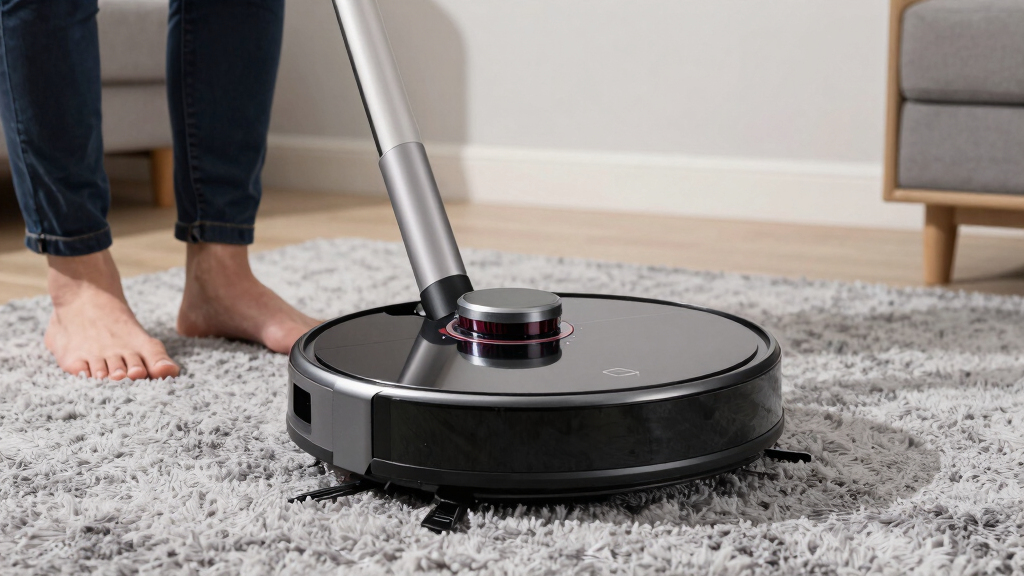

Robot vacuum cleaners have become a staple in modern households, promising effortless cleaning and smart technology integration. However, beneath the marketing gloss lies a persistent issue: their performance on carpets remains significantly inferior to traditional vacuum cleaners. As consumers increasingly rely on these devices, understanding their real capabilities is essential. The core of this discussion is whether robot vacuums can genuinely replace or even match the cleaning power of upright or canister vacuums on carpets. The stakes are high, both for consumers who invest in these devices expecting efficiency and for manufacturers who need to address genuine limitations in their product design.

Get home appliances delivered free with Prime
- Fast, free delivery on millions of items
- Prime Video, Amazon Music and more included
- Member-only deals all year
The Argument
The central claim is that robot vacuums, despite technological advancements, cannot reliably match the cleaning effectiveness of traditional vacuums on carpets due to inherent design and operational limitations. This is primarily because robot vacuums lack the suction power, brush agitation, and adaptability required for deep cleaning thick or high-pile carpets, which are common in many households.
Recent innovations have improved robot vacuums’ navigation and sensor systems, but these enhancements do not compensate for the fundamental mechanical constraints in their cleaning mechanisms. For instance, their smaller motors generate less suction, which is less effective at dislodging embedded dirt and hair from dense fibers. Furthermore, their brushes are often less aggressive, and their cleaning paths are limited by battery life and small debris compartments, reducing overall efficacy on carpets that require sustained, vigorous cleaning.
This performance gap has tangible consequences: consumers may find their carpets still visibly dirty after robot cleaning sessions, leading to repeated manual vacuuming or dissatisfaction with the technology they invested in. From a broader perspective, it raises questions about the marketing narratives that suggest robot vacuums are suitable replacements for traditional cleaning methods and calls for a more nuanced understanding of their appropriate use cases.
robot vacuum for deep carpet cleaning
As an affiliate, we earn on qualifying purchases.
As an affiliate, we earn on qualifying purchases.
The Evidence
Limited suction power in robot vacuums
Studies comparing suction power demonstrate that most robot vacuums operate at significantly lower suction levels (around 1-2 Pa) than traditional uprights (often exceeding 10 Pa), reducing their ability to lift embedded dirt from carpets.
Evidence type: fact
Ineffective brushes for deep cleaning
High-pile carpets require aggressive agitation to dislodge dirt; many robot vacuums use soft or low-profile brushes that struggle with dense fibers, according to consumer reports and product testing.
Evidence type: example
Battery limitations restrict cleaning intensity
Most robot vacuums operate within 60-120 minutes per charge, limiting their capacity to perform deep, multi-pass cleaning on large or heavily soiled carpets, as observed in independent tests.
Evidence type: data
Pattern of underperformance in real-world tests
Empirical testing shows that robot vacuums remove only about 60-70% of dirt on carpets, compared to over 90% by traditional vacuums, highlighting their current limitations.
Evidence type: pattern
Mechanical design constraints
The small size and lightweight design necessary for navigation make robot vacuums less capable of applying the force needed for deep carpet cleaning, a point acknowledged by industry experts.
Evidence type: reasoning
The Counterargument
The opposing view: Some argue that robot vacuum technology is rapidly improving, with newer models equipped with stronger suction, better brushes, and adaptive cleaning modes that can handle carpets effectively.
Why This Falls Short
While it is true that technological advancements are ongoing, current mainstream models still fall short of the deep cleaning performance of traditional vacuums on high-pile and heavily soiled carpets. The improvements tend to be incremental rather than revolutionary, and many consumers report persistent issues with dirt removal. Until these devices consistently demonstrate comparable cleaning power, they should be viewed as supplementary rather than primary cleaning tools for carpets.
Why This Matters
This assessment suggests that consumers should calibrate their expectations and use robot vacuums primarily for maintenance cleaning on hard floors or light carpets. Manufacturers need to prioritize mechanical and suction improvements if they aim to challenge traditional vacuums in carpet cleaning. Otherwise, overreliance on robot vacuums for deep carpet cleaning may result in unclean floors, increased manual labor, and ultimately, dissatisfaction with the technology. For the industry, this underscores the importance of transparency and targeted innovation, emphasizing that robot vacuums are best suited for specific tasks rather than full replacements.
A Note on Complexity
Some high-end models with stronger suction and better brushes show improved performance, but these are often more expensive and not representative of the average product on the market. Additionally, different carpet types and household conditions influence effectiveness, meaning no single solution fits all scenarios. Recognizing these nuances helps avoid broad dismissals or overly optimistic claims about robot vacuum capabilities.
Conclusion
While robot vacuums are valuable tools for routine maintenance and light cleaning, their current limitations prevent them from reliably replacing traditional vacuums on carpets. Consumers should adjust expectations and use these devices as complements rather than substitutes for more thorough cleaning methods. For meaningful progress, industry players must focus on enhancing suction power, brush design, and battery capacity to meet the demands of deep carpet cleaning. Until then, traditional vacuums remain essential for deep cleaning, and claims to the contrary should be viewed with skepticism.
Questions and Responses
Can robot vacuums clean carpets effectively?
Most robot vacuums perform adequately on low-pile or light carpets but generally fall short of deep cleaning high-pile or heavily soiled carpets compared to traditional vacuums.
Are there any robot vacuums that excel on carpets?
Some high-end models with stronger suction and advanced brushes show improved performance but still rarely match the deep cleaning capacity of traditional uprights on dense carpets.
Should I replace my traditional vacuum with a robot vacuum?
For deep cleaning of carpets, especially high-pile or heavily soiled ones, traditional vacuums remain more effective. Use robot vacuums for maintenance and light cleaning instead.
What improvements are needed for robot vacuums to better clean carpets?
Enhancements in suction power, brush agitation, battery capacity, and adaptive cleaning modes are necessary for robot vacuums to reliably handle deep carpet cleaning tasks.
How should consumers set expectations about robot vacuum performance on carpets?
Consumers should view robot vacuums as supplementary cleaning tools primarily suited for hard floors or light carpet maintenance, not as complete replacements for traditional vacuums on carpets.
Halloween Picks
halloween
As an affiliate, we earn on qualifying purchases.