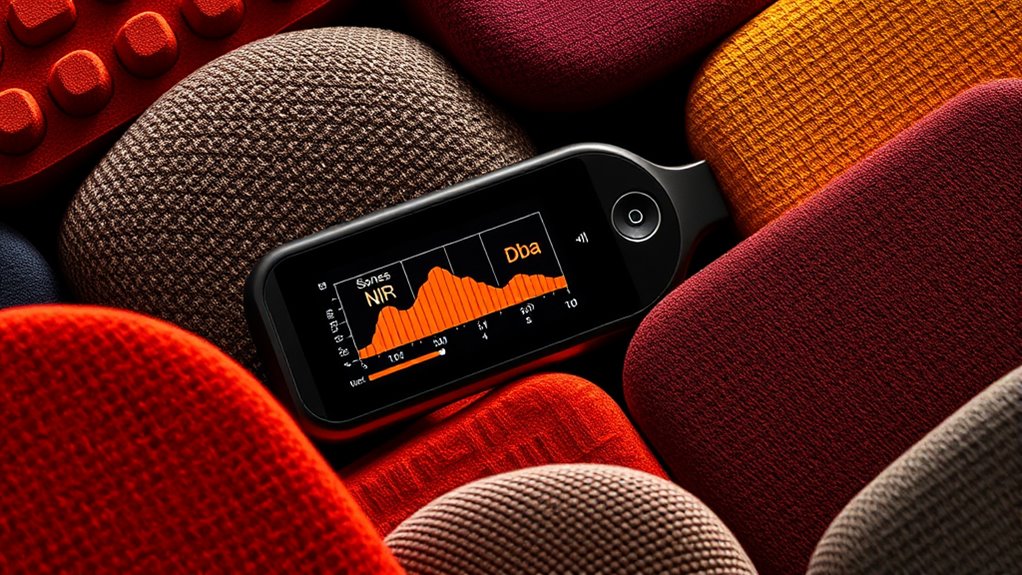

Traditional decibel measurements often miss how we actually perceive sound, so metrics like sones, Noise Rating (NR) curves, and dBA weighting help bridge this gap. Sones measure perceived loudness directly, aligning with human judgment, while NR curves evaluate spectral content for noise severity. Dba weighting adjusts sound levels based on our hearing sensitivity across frequencies. To understand how these metrics offer a more accurate picture of sound environments, explore the details they reveal.
Key Takeaways
- Sones measure perceived loudness linearly, aligning with human auditory perception, unlike the logarithmic decibel scale.
- NR (Noise Rating) curves evaluate noise severity based on spectral content and standardized frequency bands, indicating environmental noise impact.
- dBA weighting adjusts sound measurements to mimic human hearing sensitivity, emphasizing frequencies between 250 Hz and 5 kHz.
- Psychoacoustic metrics like sones and spectral analysis provide a more comprehensive understanding of sound perception than traditional dB measurements.
- Combining multiple metrics and spectral analysis enhances the assessment of sound quality, annoyance, and environmental noise beyond simple decibel levels.
The Limitations of Decibel Measurements
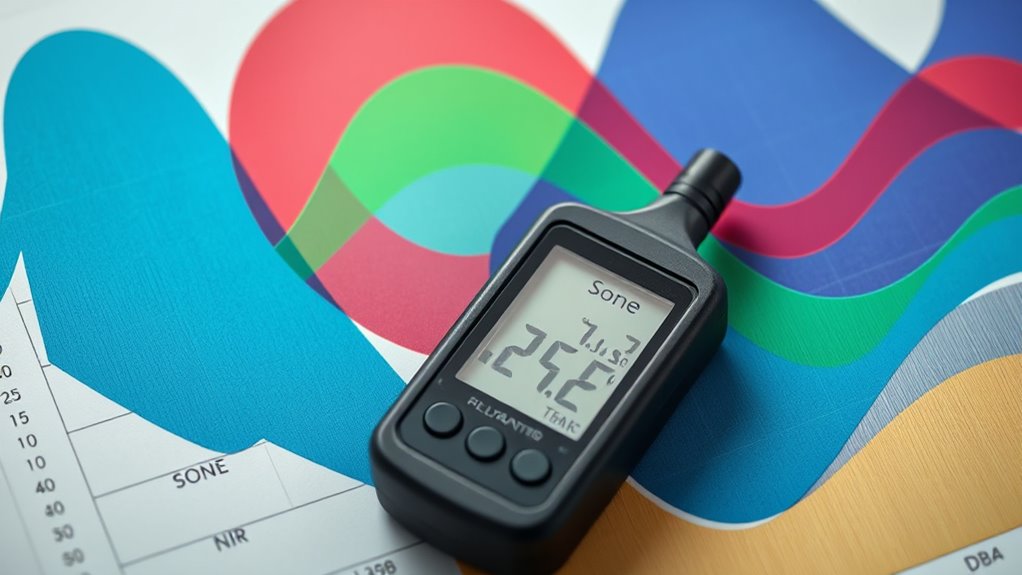
Decibel measurements, while widely used, have notable limitations that can hinder accurate assessment of noise exposure. The dB scale is logarithmic and measures sound pressure level, not perceived loudness, which means human experience can differ considerably from the readings. It also doesn’t account for the frequency content of noise, even though our hearing sensitivity varies across frequencies. Frequency-dependent perception means that two sounds with identical decibel levels can be perceived very differently. Single measurements capture only momentary sound levels and miss fluctuations over time, making them unreliable for dynamic environments. Background noise can skew readings unless properly corrected. Additionally, decibels ignore psychoacoustic factors like annoyance or discomfort, which are essential for understanding real-world noise impacts. These limitations highlight that decibel measurements alone can’t fully capture the complexity of noise exposure and its effects. Regularly monitoring air quality indicators can provide a more comprehensive understanding of environmental noise and its impact on health.
Understanding Loudness With Sones
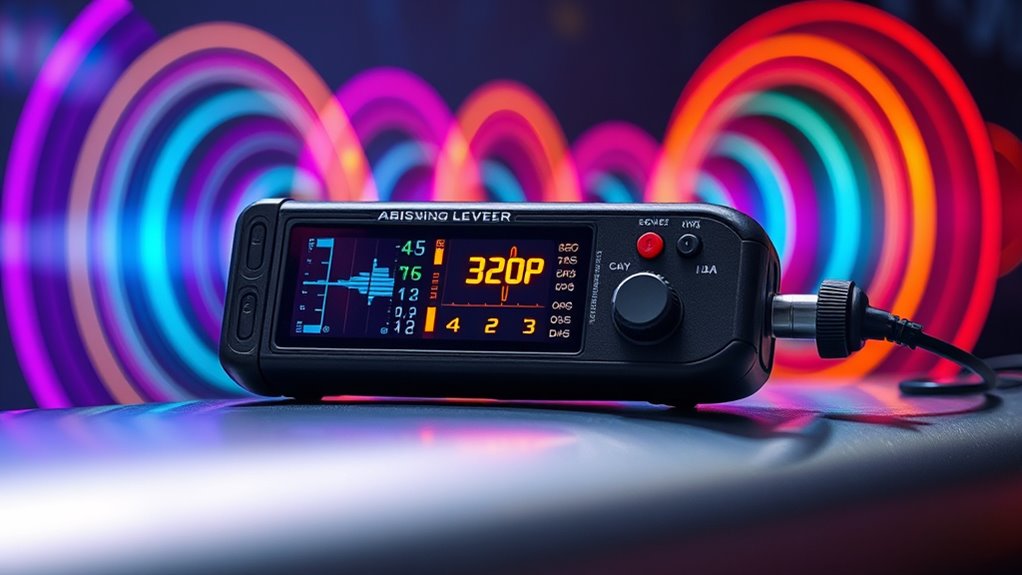
Understanding loudness with sones is essential because it reflects how humans perceive sound, unlike the physical measurements of decibels. Sones measure perceived loudness, providing a more intuitive gauge of how loud a sound feels. One sone equals the loudness of a 1,000 Hz tone at 40 dB above hearing threshold. The scale is linear: doubling sones doubles perceived loudness—2 sones feels twice as loud as 1 sone. Unlike decibels, which are logarithmic, sones align with human perception, making it easier to compare sounds. For example, 4 sones are perceived as four times as loud as 1 sone. This scale helps evaluate everyday noises like appliances, offering practical insight into how loud sounds truly seem to us.
The Role of Dba Weighting in Sound Measurement

dBA weighting plays a crucial role in sound measurement because it adjusts raw sound levels to better match human hearing sensitivity. It emphasizes frequencies between 250 and 5,000 Hz, where our ears are most sensitive, while reducing the impact of very low and high frequencies. This creates a measurement, expressed as A-weighted decibels (dB(A)), that reflects perceived loudness more accurately. You measure sound levels with microphones that capture air pressure variations across frequencies, then apply correction factors to each band. These weighted bands are combined logarithmically to produce an overall dBA level. This method aligns measurement with how humans perceive sound, making it essential for environmental noise assessments, occupational health, and regulatory standards. It simplifies comparing sounds with different frequency contents based on human auditory response. Additionally, understanding frequency weighting helps in selecting appropriate measurement techniques for various acoustic environments. Furthermore, advancements in sound measurement technology have improved the precision and reliability of these assessments across different settings.
Exploring Noise Rating (NR) Curves
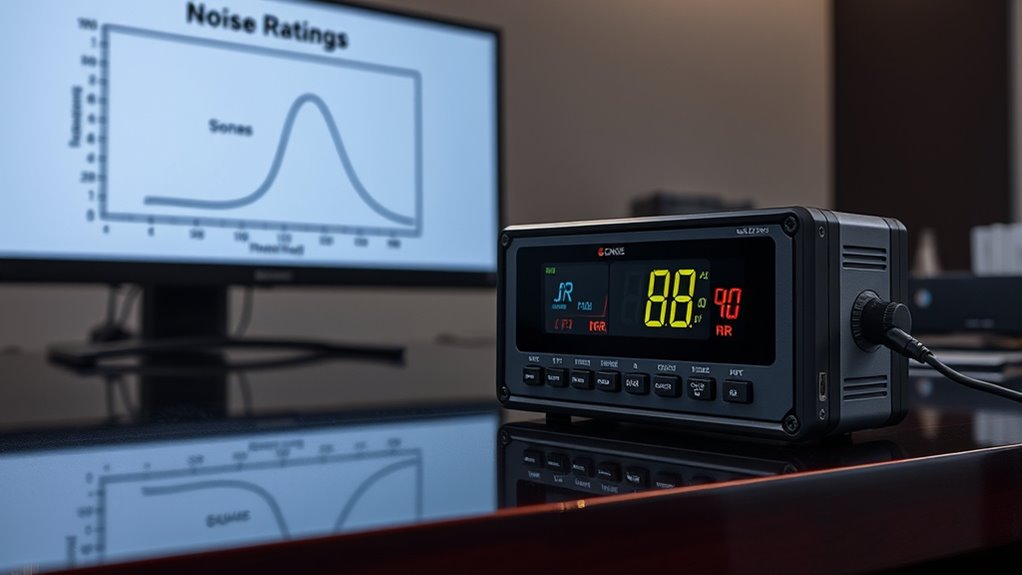
Noise Rating (NR) curves offer a practical way to evaluate and compare noise sources by analyzing their frequency content across octave bands. You measure noise in specific frequency ranges, typically from 63 Hz to 8 kHz, and compare these levels to standardized curves. The NR rating is the lowest curve where measured levels stay below or equal to the limits at all frequencies. This single number summarizes complex spectral data, indicating how loud and intrusive a noise source is. Higher NR values mean more severe noise environments. NR curves are widely used in Europe to set indoor acoustic standards, especially for building services and HVAC noise. They help you determine acceptable noise levels, guiding design choices and ensuring occupant comfort in various indoor spaces. Additionally, understanding the spectral content can assist in identifying specific noise issues, such as those caused by equipment or environmental factors like Aloe Vera Plant Issues. Recognizing the spectral signatures of different noise sources can also aid in noise mitigation efforts, leading to more comfortable indoor environments.
Psychoacoustic Parameters Shaping Sound Perception
Your perception of sound varies with loudness, which depends on how your ears interpret different frequencies, not just the raw sound pressure. Temporal fluctuations and amplitude modulations also shape how you experience the texture and harshness of sounds. Understanding these psychoacoustic parameters helps explain why some noises are more annoying or easier to identify than others. Additionally, colorful presentation can influence how sounds are perceived, especially in environments with visual stimuli that complement auditory input. Recognizing how perception of loudness is affected by various psychoacoustic factors can further enhance our understanding of sound quality and human response.
Perceived Loudness Variability
Have you ever noticed that different people perceive loudness levels differently, even when listening to the same sound? This variability stems from neural and individual differences in auditory processing. Perceived loudness increases almost linearly with sound intensity, but normal-hearing listeners can rate a 30 dB range as equally loud, indicating significant perceptual differences. These differences aren’t explained by hearing thresholds, age, or experience but are linked to neural activation variations in the auditory cortex, shown via fMRI. Psychoacoustic parameters like roughness, fluctuation strength, and tonality help quantify these subjective perceptions. Fluctuation strength, for example, measures slow amplitude modulations that influence loudness perception, which can be masked by background noise. These parameters shape how we interpret sound beyond physical measurements, revealing complex neural coding mechanisms. Additionally, vibrational energy plays a role in how sounds are perceived, aligning with the neural activation patterns associated with auditory processing. Recent research also suggests that individual differences in auditory perception are influenced by neural plasticity and auditory training, further affecting perceived loudness.
Frequency Sensitivity Effects
The human auditory system doesn’t respond equally across all frequencies; instead, it shows heightened sensitivity within the 2 kHz to 5 kHz range due to specialized cochlear and neural tuning. This sensitivity influences how you perceive loudness and sound quality, leading to frequency-dependent weighting curves like A-weighting that de-emphasize less sensitive low and high frequencies. Your ear’s physical structure, including the shape of the outer ear and the cochlear basilar membrane, separates frequencies spatially, affecting perception. Additionally, this frequency sensitivity plays a crucial role in how sound levels are measured and perceived in various environments. Recognizing that ear anatomy impacts sound perception can help in designing more accurate acoustic measurement methods.
Temporal Sound Fluctuations
Frequency sensitivity influences how we perceive not only the loudness and quality of sounds but also their temporal characteristics. Fluctuation strength measures slow amplitude modulations, peaking around 4 Hz, similar to speech syllabic rates. Increasing modulation depth and sound pressure level makes sounds seem more dynamic or wavering. Temporal masking patterns, which are low-pass, shape fluctuation perception and are affected by background noise, reducing modulation depth and impairing speech clarity—especially in noisy environments like cars. Models estimate fluctuation strength based on modulation frequency and depth, helping to characterize temporal auditory sensations beyond loudness. These parameters fluctuate during sound events, influencing speech intelligibility and sound quality. Additionally, understanding the auditory perception of these fluctuations aids in developing better hearing aids and audio processing algorithms. Recognizing the role of frequency-dependent sensitivity is crucial for designing effective auditory devices and improving sound quality assessment. Time-dependent analyses reveal how transient or sustained sounds change perception, vital for sound design and noise control.
Techniques for Frequency Analysis in Acoustic Measurements

To analyze acoustic signals effectively, you need to understand various spectrum analysis methods, microphone types, and signal processing techniques. Each approach offers different insights into frequency content, transient behaviors, and noise reduction. Mastering these tools helps you obtain accurate, detailed measurements in diverse acoustic environments. Additionally, considering sound quality metrics beyond basic decibel levels can provide a more comprehensive assessment of acoustic performance.
Spectrum Analysis Methods
Spectrum analysis methods are essential tools for understanding the frequency content of acoustic signals. You can use Fast Fourier Transform (FFT) to quickly decompose signals into their spectral components, revealing dominant frequencies and harmonics. However, FFT assumes stationarity over the analysis window, limiting time resolution. To analyze non-stationary signals, you might apply the Short-Time Fourier Transform (STFT), which processes overlapping segments to produce spectrograms that show how frequencies change over time. For transient or rapidly varying signals, wavelet transforms offer superior time-frequency localization by decomposing signals into scaled and shifted wavelets. Additionally, Power Spectral Density (PSD) estimates how power distributes across frequencies, aiding noise and resonance analysis. Real-time spectrum analyzers visualize these dynamics live, providing immediate insights into acoustic environments. Understanding these methods allows for more precise interpretation of complex acoustic data, especially in environments where sound characteristics fluctuate rapidly.
Microphone Types and Use
Different types of measurement microphones are designed to capture acoustic signals accurately across various environments and applications. Your choice depends on the specific field and conditions. Pressure-field microphones excel in cavity or surface measurements, offering flat frequency responses. Random incidence microphones respond uniformly to sound from multiple angles, ideal for reverberant spaces. Free-field microphones are calibrated for anechoic conditions, focusing on direct sound. Proper selection guarantees your measurements remain unbiased and precise. Additionally, understanding the importance of environment-specific calibration ensures that the measurements are accurate and reliable. To obtain the most accurate results, it is essential to consider the appropriate calibration procedures tailored to each microphone type and setting.
Signal Processing Techniques
Have you ever wondered how acoustic signals are analyzed to reveal their frequency content and transient behaviors? Time-frequency analysis provides a clear view by combining spectrograms, which display how frequencies evolve over time. This method offers simultaneous insight into spectral and temporal aspects, helping you identify transient events and frequency shifts. Techniques like octave band filters and FFT dissect signals into their constituent frequencies, mimicking human hearing and enabling detailed spectral analysis. Advanced methods such as Sparse Bayesian Learning improve resolution by separating close signals and reducing noise artifacts. These approaches allow you to evaluate both frequency response and transient behavior, essential for acoustic characterization, noise control, and sound quality assessment. Implementing these techniques delivers an extensive understanding of acoustic signals beyond simple amplitude measurements. Additionally, understanding vetted product reviews can guide the selection of appropriate measurement tools and accessories for accurate analysis. Incorporating signal processing techniques into your workflow enhances your ability to interpret complex acoustic data effectively.
Applying Psychoacoustic Metrics in Real-World Environments

Applying psychoacoustic metrics in real-world environments involves translating subjective human perceptions into measurable data that can inform sound design and regulation. You use these metrics—like loudness, sharpness, roughness, and fluctuation strength—to evaluate how sounds impact comfort and annoyance in urban, industrial, and consumer settings. This helps you design quieter products, optimize HVAC systems, and set effective noise limits. You can also calibrate measurements against human subjective responses through controlled testing, such as in NASA’s Exterior Effects Room. By applying psychoacoustic metrics, you ensure that sound levels are aligned with human perception rather than relying solely on physical measurements. This process ultimately leads to more comfortable and less intrusive acoustic environments. Incorporating meditation techniques can further enhance understanding of sound perception and improve acoustic comfort by promoting mental clarity and emotional regulation. Additionally, understanding the side effects of juice detox can inform strategies for managing stress and enhancing overall well-being, which can indirectly influence how individuals perceive environmental noise.
Integrating Multiple Metrics for Comprehensive Sound Evaluation
To evaluate sound quality exhaustively, you need to combine multiple psychoacoustic metrics rather than relying solely on loudness measurements. By integrating models like ISO532B and Zwicker-Fastl, you capture nuances in stationary and non-stationary sounds. Sharpness and its temporal variation reveal spectral and timbral details, while attributes like roughness and fluctuation strength add depth. Frame-based spectral and temporal decomposition ensures accurate analysis of both transient and steady sounds. Combining these over 180 metrics creates a thorough sound profile. Additionally, applying weighting filters (A-, B-, C-, Z-) and time weightings (Fast, Slow, Impulse) aligns measurements with human hearing. This multi-metric approach enhances sound environment assessments, balancing clarity and perceptual relevance.
| Metric Type | Focus |
|---|---|
| Loudness | Overall perceived volume |
| Sharpness | Spectral and timbral qualities |
| Fluctuation | Temporal variations |
| Spectral | Frequency content analysis |
Frequently Asked Questions
How Do Psychoacoustic Metrics Improve Sound Quality Assessments?
You improve sound quality assessments by using psychoacoustic metrics because they align more closely with how humans perceive sound. Instead of relying solely on decibel levels, these metrics, like loudness, sharpness, roughness, and fluctuation strength, capture perceived intensity, tonal quality, harshness, and modulations. This helps you design sounds that are more pleasant or less annoying, leading to better user acceptance and more accurate evaluations of noise and audio quality.
Can Sones Accurately Reflect Perceived Loudness Across Different Environments?
You might think sones are perfect, but they don’t fully capture perceived loudness across different environments. They work well for steady sounds but struggle with fluctuating or impulsive noises. Environmental factors like reverberation, background noise, and spatial effects influence perception beyond what sones measure. So, while useful, sones alone can’t reliably reflect how loudness feels in every setting, especially in complex or dynamic acoustic environments.
Why Is Dba Preferred Over Raw Decibel Measurements in Noise Regulation?
You prefer dBA over raw decibel measurements in noise regulation because it better reflects how humans perceive loudness. It accounts for the ear’s sensitivity to different frequencies, making it more accurate for evaluating potential hearing damage and annoyance. Using dBA helps you set realistic noise limits, ensures compliance, and protects health, unlike raw dB, which can overestimate noise impact by including inaudible or less impactful sounds.
How Do NR Curves Account for Subjective Noise Annoyance Levels?
Did you know that noise with prominent low-frequency tones can be perceived as twice as annoying? NR curves account for subjective annoyance by emphasizing frequency content, especially low and tonal sounds, which are more disturbing. They incorporate psychoacoustic data and community tolerance levels, adjusting for how humans perceive loudness. This helps predict annoyance more accurately than simple decibel measures, reflecting real-world reactions to various noise characteristics.
What Are the Limitations of Using Frequency Analysis Techniques in Complex Sounds?
You find that frequency analysis techniques struggle with complex sounds because overlapping bands blur individual components, making it hard to identify specific frequencies. Broader filters at higher frequencies increase this problem, especially for hearing-impaired listeners. Neural responses are selective and limited, further complicating analysis. Plus, traditional methods don’t fully capture the nonlinear interactions and open-system effects of real-world acoustics, reducing the accuracy of frequency-based insights.
Conclusion
Now that you’ve explored beyond decibels, you realize there’s more to sound measurement than meets the ear. Will you start using sones, NR, or dBA weighting to truly understand loudness? Or will you stick with traditional methods and miss the subtle nuances shaping perception? The choice is yours—delving into these psychoacoustic metrics could transform how you evaluate environments. Are you ready to unseal a deeper understanding of sound? The next step awaits.