Harmonics from switching power supplies in appliances occur because their high-frequency switching creates non-sinusoidal currents that distort the electrical waveform. These harmonic currents, especially at odd multiples like 3rd and 5th, can reduce power quality, increase system stress, and cause overheating or equipment failures. To manage these issues, standards and mitigation techniques like filters and proper grounding are used. Exploring more can help you understand how to reduce these harmonic effects effectively.
Key Takeaways
- Switching power supplies draw non-sinusoidal, pulsed currents that generate harmonic distortion in the power system.
- Rapid transistor switching in these supplies produces harmonic currents at multiples of the mains frequency.
- Harmonics from switching power supplies can cause voltage distortion, power factor reduction, and electromagnetic interference.
- The extent of harmonic generation depends on the design and switching techniques used in the power supply.
- Standards like IEC 61000-3-2 set limits to control harmonic emissions from appliances with switching power supplies.

Generac Guardian 22kW Home Standby Generator with 200 Amp Transfer Switch - Automatic Whole House Backup Power for Storms, Emergencies, and Outages, WiFi Enabled, Runs on Natural Gas or Liquid Propane
Remote Monitoring Anywhere: With Generac 7043 22kW Mobile Link Wi-Fi connectivity, effortlessly track generator performance from anywhere. Stay...
As an affiliate, we earn on qualifying purchases.
Understanding Harmonics in Modern Electronic Devices
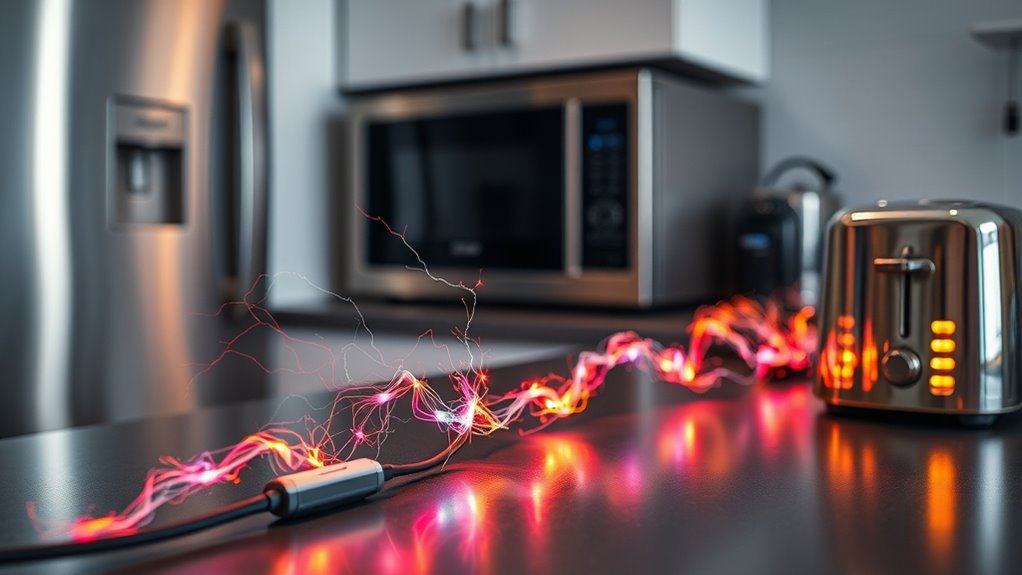
Harmonics in modern electronic devices are a result of nonlinear power consumption that distorts the ideal sine wave of electrical systems. These distortions occur because many electronic loads, like switch-mode power supplies and variable frequency drives, draw current in a non-sinusoidal way. Harmonics are multiples of the fundamental frequency (50 or 60 Hz), creating waveforms that deviate from perfect sine waves. Total Harmonic Distortion (THD) measures these distortions as a percentage, indicating how much harmonic content exists compared to the main power frequency. Even though ideal systems aim for zero THD, modern devices naturally introduce some harmonic current. Monitoring THD helps identify power quality issues, which can cause equipment overheating, malfunction, or reduced lifespan. Understanding these harmonic sources is essential for maintaining reliable and efficient electrical systems. Harmonic currents can flow back into the grid, affecting other connected devices and leading to broader power quality problems. Additionally, recognizing the sources of harmonics aids in designing better filtering and mitigation strategies to improve overall power quality, especially as the adoption of power electronics continues to grow.

Generac Guardian 24kW Home Standby Generator - Automatic Whole House Backup Power for Storms, Emergencies, and Outages, WiFi Enabled, Runs on Natural Gas or Liquid Propane, Quiet Operation
Remote Monitoring Anywhere: With Generac 7209 24kW Mobile Link Wi-Fi connectivity, effortlessly track generator performance from anywhere. Stay...
As an affiliate, we earn on qualifying purchases.
How Switching Power Supplies Generate Harmonic Currents
Switching power supplies generate harmonic currents through rapid on/off switching of transistors at high frequencies. These pulses create non-sinusoidal waveforms rich in harmonics, especially when combined with nonlinear load behavior. As a result, the distorted waveforms propagate through your system, affecting power quality and equipment performance. This process can be analyzed and mitigated through harmonic analysis, which is essential for maintaining optimal system operation. Moreover, advances in AI security contribute to developing more sophisticated monitoring tools for identifying and reducing harmonic distortions in power systems.
Rapid Switching Operations
Have you ever wondered how power supplies efficiently regulate voltage while inadvertently causing disturbances in the power system? Rapid switching operations are at the heart of this process. These supplies turn their switches on and off at high speeds to control output voltage and current. This fast switching creates a non-sinusoidal, pulsed current draw from the AC supply, generating harmonic currents at multiples of the mains frequency, such as 3rd, 5th, and 7th harmonics. The abrupt changes in current produce transient harmonics and steady-state harmonic distortion. Because the current waveform isn’t sinusoidal, it distorts the original power signal, causing power quality issues. These rapid switching actions, though essential for regulation, lead to high-frequency harmonic components that affect the entire electrical system. Cost and Budgeting considerations can influence the choice of power supply designs, affecting the extent of harmonic generation and mitigation options. Additionally, implementing harmonic mitigation techniques can help reduce the adverse effects on the power network.
Pulsed Current Waveforms
When power supplies perform rapid switching to regulate voltage, they produce pulsed current waveforms that differ markedly from smooth sinusoidal signals. These waveforms are periodic, rectangular or flat-topped, instead of sinusoidal, caused by the switching action converting AC to pulsed DC. The abrupt on/off transitions generate harmonics, affecting power quality. Switching transistors transfer energy during specific intervals, shaping pulse timing and amplitude. Variations like pulse skipping or frequency modulation alter the spectral content further.
| Waveform Type | Effect on Harmonics | Typical Shape |
|---|---|---|
| Rectangular | Introduces harmonic peaks | Flat-topped pulse |
| Pulse Skipping | Alters harmonic spectra | Irregular pulses |
| PFM Mode | Spreads harmonic energy | Modulated pulses |
Non-Linear Load Effects
The binary switching states of switching power supplies (SMPS) create non-linear current draws that deviate from sine waves. Because their high-power transistors turn on and off rapidly, the current waveform becomes distorted and no longer follows the smooth sinusoidal shape. This non-linearity causes the currents to pulse or chop, generating sharp, steep edges that produce harmonic frequencies. These harmonics, especially the 3rd, 5th, and higher odd orders, flow back into the power system, distorting both current and voltage waveforms. As a result, the power factor drops, and the electrical system experiences additional stress, overheating, and potential malfunction. The non-linear behavior of SMPS not only affects power quality but also increases the risk of resonance and equipment failures in the distribution network. Understanding harmonic distortion is essential for diagnosing and mitigating power quality issues caused by switching power supplies. Additionally, implementing power quality mitigation techniques like filters can significantly reduce these harmonic effects and protect sensitive equipment.

Generac Guardian 10kW Home Standby Generator with 100 Amp Transfer Switch - Automatic Whole House Backup Power for Storms, Emergencies, and Outages, WiFi Enabled, Runs on Natural Gas or Liquid Propane
Remote Monitoring Anywhere: With Generac 7172 10kW Mobile Link Wi-Fi connectivity, effortlessly track generator performance from anywhere. Stay...
As an affiliate, we earn on qualifying purchases.
Common Harmonic Frequencies in Household Appliances
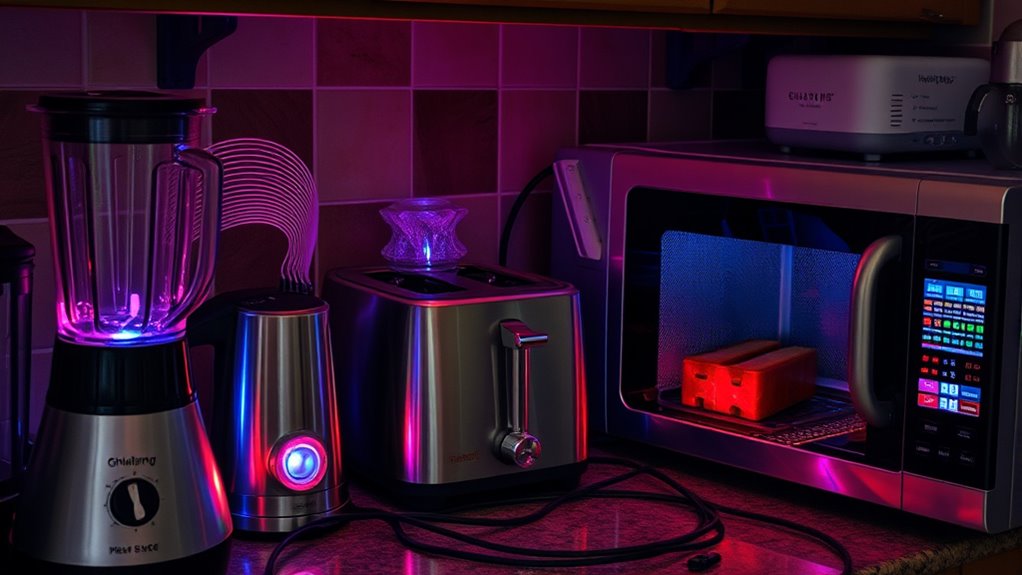
Household appliances with switching power supplies generate harmonic frequencies mainly at odd multiples of the fundamental 60 Hz power line frequency. You’ll find significant harmonics at the 3rd, 5th, 7th, 11th, 13th, 17th, and 19th orders, caused by their high-frequency switching. These harmonics distort the waveform, mainly due to non-linear loads like rectifiers. Appliances such as computers, TVs, and electronic lighting produce harmonics mostly at 3rd and 5th frequencies, while motor-driven devices like refrigerators and HVAC systems emit lower-order harmonics around the 5th and 7th. Microwave ovens and devices with inductive components also contribute to harmonic distortion. Although higher-order harmonics above the 19th are less common, they can still occur. Detecting these harmonics helps assess their impact on power quality and appliance performance. Additionally, understanding creative practice can inspire innovative solutions for mitigating harmonic distortions in electrical systems. Recognizing the harmonic frequencies generated by various appliances is essential for designing effective filters and improving overall power system reliability.

Honeywell 14kW Home Standby Generator
PrecisionPower Technology delivers best-in-class power quality with less than 5 percent total harmonic distortion for clean, smooth operation...
As an affiliate, we earn on qualifying purchases.
Impact of Harmonics on Power Quality and Equipment Reliability
Harmonics considerably affect power quality by causing equipment overheating, reducing reliability, and increasing maintenance costs. When harmonic currents flow through motors, transformers, and cables, they generate extra heat that accelerates insulation breakdown and component wear. This not only shortens the lifespan of equipment but also contributes to increased operational costs. This results in shortened equipment lifespan, unexpected failures, and frequent repairs. Overheated neutral conductors in three-phase systems, especially from triplen harmonics, may require oversized wires, raising costs. Harmonics also cause energy losses, lowering overall system efficiency and increasing electricity bills. Sensitive electronics, such as communication systems and control devices, can malfunction or become unstable due to voltage distortions and electromagnetic interference. Additionally, harmonics induce mechanical stress in motors, causing vibrations, noise, and uneven torque, which further diminishes operational reliability and accelerates equipment degradation. Recognizing power quality issues is essential for maintaining efficient and reliable electrical systems in modern appliances.
Measuring and Analyzing Harmonic Distortions
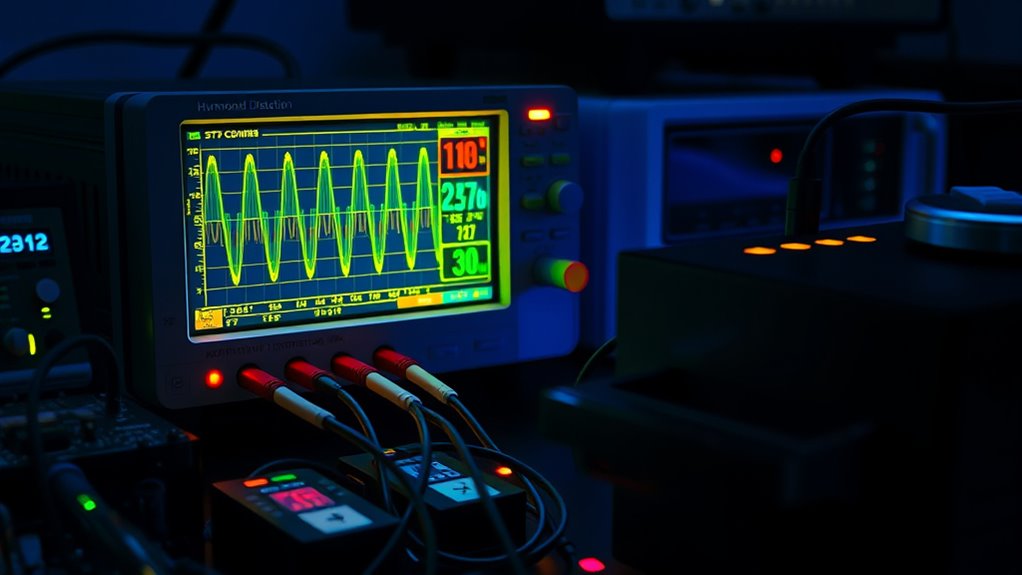
To accurately measure harmonic distortions, you need to understand various techniques like using FFT-based harmonic meters or spectrum analyzers. These tools help quantify metrics such as total harmonic distortion (THD) and identify individual harmonic components. Analyzing the harmonic spectrum enables you to assess power quality and pinpoint sources of distortion effectively. Understanding Honda Tuning principles can also provide insights into how electrical components in appliances are designed to minimize harmonic emissions. Additionally, familiarity with power quality standards can guide you in maintaining compliant and efficient electrical systems.
Harmonic Measurement Techniques
Measuring and analyzing harmonic distortions in power supplies requires precise techniques that can decompose complex signals into their constituent frequencies. The most common method is the Fast Fourier Transform (FFT), which converts time-domain signals into the frequency domain, accurately identifying harmonic components. High-resolution analyzers can measure amplitudes and phases up to the 50th harmonic, offering detailed spectral insight. To guarantee accurate results, sampling windows typically span 10 cycles for 50 Hz systems or 12 cycles for 60 Hz systems. Advanced systems utilize digital processing on specialized hardware like DSPs, FPGAs, or ARM cores, enabling real-time analysis with smoothing and classification. The table below summarizes key measurement parameters:
| Parameter | Description | Typical Range |
|---|---|---|
| Harmonic order | Frequency multiples of fundamental | 1–50 |
| Total Harmonic Distortion | Overall percentage of harmonic distortion | <5% to >20% |
| Phase angle | Relationship between voltage and current harmonics | 0°–180° |
| Amplitude spectrum | Magnitude of each harmonic component | Varies based on source |
| Power flow analysis | Direction and magnitude of harmonic currents | System-dependent |
Additionally, understanding the impact of harmonic distortion on power quality is crucial for designing effective mitigation strategies harmonic mitigation techniques. Proper measurement methods are essential for accurate assessment and effective power quality management.
Harmonic Distortion Metrics
Have you ever wondered how engineers quantify specific distortions within a power system? Harmonic distortion metrics help you understand how non-linear loads, like switching power supplies, affect waveform quality. The most common is Total Harmonic Distortion (THD), which compares harmonic voltages or currents to the fundamental, expressed as a percentage. Separate metrics, THDv and THDi, provide insights into voltage and current distortions, respectively. For targeted analysis, Individual Harmonic Distortion (IHD) reveals the strength of specific harmonics, guiding mitigation efforts. These metrics help you identify whether equipment is operating within safe limits or risking damage. Monitoring THD levels enables proactive maintenance, ensuring power quality and preventing failures. Understanding these metrics power system design empowers you to make informed decisions about power system design and protection. Measuring and analyzing harmonic distortions can reveal subtle waveform deviations that may precede equipment failure, allowing for early intervention.
Spectrum Analysis Methods
Spectrum analysis methods are essential for accurately measuring and understanding harmonic distortions in electrical systems. You’ll use tools like power quality analyzers to capture the amplitude, phase, and frequency of harmonic components. Spectrum analyzers, especially in RF applications, help measure harmonic distortion by analyzing the power of each harmonic relative to the fundamental. In zero span mode, you can focus on specific harmonic frequencies for detailed analysis. Setting correct frequency and amplitude parameters ensures precise measurements. When testing a device under test (DUT), replacing the load with the DUT allows you to detect harmonic emissions accurately. Visualizing harmonic spectra through charts aids in identifying problematic harmonic orders. Comparing your data against standards like IEC 61000-3-3 helps determine if emissions are within acceptable limits, guiding mitigation strategies. Regular analysis can also reveal unwanted harmonic emissions, enabling you to implement effective filtering solutions.
Standards and Regulations for Harmonic Compliance
Ensuring harmonic compliance in power supplies requires adherence to a complex set of standards and regulations that vary across regions. These standards, like IEC 61000-3-2 and IEEE 519-2022, set limits on harmonic emissions and manage power quality. Regional differences mean you must navigate diverse requirements in the US, Europe, and Canada, which can be challenging but are essential for safety and grid stability. Falling short can lead to penalties, costly redesigns, and compromised equipment reliability. Hyundai Tuning techniques can be employed to optimize power systems and ensure compliance.
Meeting regional standards like IEC 61000-3-2 and IEEE 519-2022 is vital for safe, compliant power supply design.
- Feel the urgency of meeting strict standards to protect your equipment and the grid.
- Recognize the importance of compliance in avoiding penalties and ensuring safety.
- Understand that continuous monitoring and updates are crucial for ongoing success.
Strategies for Mitigating Harmonic Effects in Appliances
To effectively reduce harmonic effects in appliances, engineers employ a variety of filtering and control techniques. Passive filters with capacitors, inductors, and resistors target specific harmonic frequencies but can be bulky and costly, with resonance risks. Harmonic traps, using tuned resonance circuits, redirect or absorb harmonics in targeted scenarios. Active harmonic filters utilize power electronics to dynamically detect and cancel harmonics, offering adaptive responses to load changes. Line reactors and DC link chokes integrated with devices like VFDs help reduce high-order harmonics by adding inductive reactance. Advanced harmonic conditioning units combine filtering and power conditioning to suppress multiple harmonic orders, improving overall system efficiency. Programmable logic controllers and control algorithms enable real-time, adaptive mitigation, ensuring better power quality and minimizing equipment stress. Incorporating HEPA filtration techniques in the design of power supplies can further enhance the reduction of airborne electrical noise and improve overall system reliability.
The Role of Neutral Conductors and Grounding in Harmonic Management
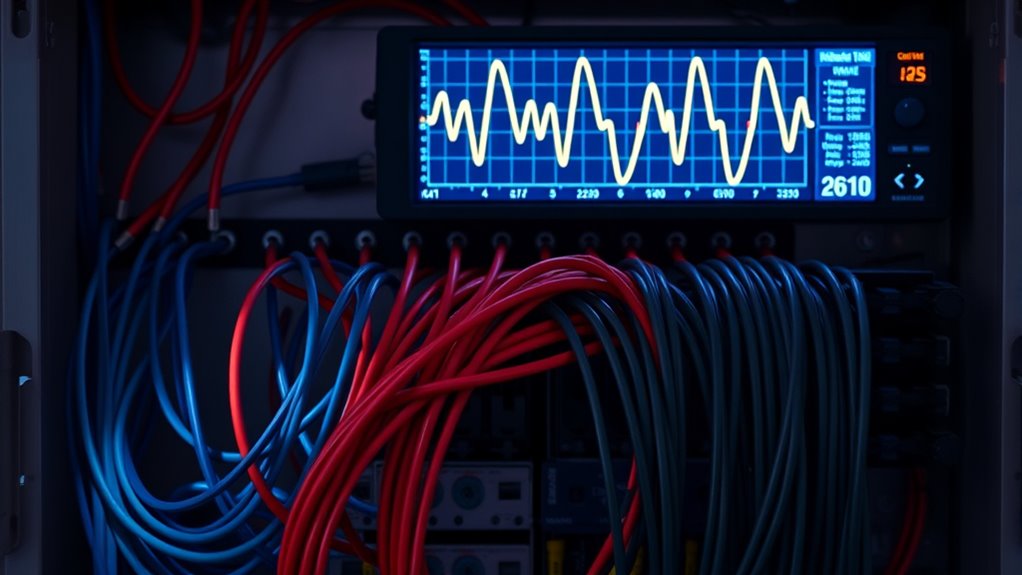
Have you ever considered how triplen harmonics—those multiples of three—affect neutral conductors and grounding systems? These harmonics add arithmetically, causing neutral currents to sometimes reach 170% of phase currents. This overload increases the risk of overheating, fires, and equipment failure. Grounding systems can carry harmonic currents that interfere with proper fault clearing, reducing safety. Harmonic resonance with capacitors can further damage equipment and compromise grounding effectiveness. Additionally, understanding crochet styles for locs can inspire creative ways to visualize complex electrical concepts.
Future Trends in Reducing Harmonics in Electronic Appliance Design
Advancements in electronic appliance design are increasingly focusing on integrating harmonic mitigation strategies early in the development process. You’ll see more use of active harmonic filters (AHFs), which dynamically monitor and eliminate harmonics by injecting compensating currents, adapting to load changes in real time. Although AHFs cost more initially, their higher precision makes them ideal for sensitive applications, ensuring better power quality. Incorporating harmonic mitigation techniques during design, like component selection and system integration, helps reduce harmonic distortion from the start, meeting standards such as IEEE 519 and IEC 61000. Future systems will likely feature adaptable designs that incorporate advanced technologies, including power supplies with low total harmonic distortion (THD). Transformer innovations, like harmonic-neutralizing and phase-shifting transformers, will also play a crucial role in enhancing overall power quality and system reliability. Harmonic mitigation strategies are also being integrated into the design process to proactively address potential issues before deployment.
Frequently Asked Questions
How Can Consumers Identify Harmonic Issues in Their Home Appliances?
You can spot harmonic issues by watching for signs like frequent circuit breaker trips, overheating motors, or unusual buzzing sounds in your appliances. Use a clamp meter or a plug-in power meter with harmonic detection to monitor for abnormal current patterns. If you notice erratic operation or performance issues, it’s best to get a professional power quality assessment. Being aware of electronic devices like LED lights and power supplies helps you identify potential sources.
What Are the Most Effective Passive Filters for Reducing Harmonic Distortion?
Think of passive filters as the guardians of power quality. Single-tuned filters target specific harmonics with precision, while double-tuned and LCL filters broaden the scope, tackling multiple harmonic frequencies. You should choose filters that match your system’s harmonic profile, ensuring proper placement and tuning. These filters effectively reduce distortion by up to 80%, improving power factor and device longevity, making your appliances run smoother and safer.
How Do Harmonic Currents Affect the Lifespan of Household Wiring?
Harmonic currents shorten your household wiring’s lifespan by causing excess heat, which accelerates insulation aging and weakens conductors. They generate hotspots, increase electrical losses, and cause vibration that loosens connections. Over time, this leads to insulation breakdown, higher risk of faults, and reduced durability of wiring and connected devices. Continuous exposure to harmonics forces your wiring system to work harder, ultimately resulting in earlier replacements and potential safety hazards.
Are There Cost-Effective Ways to Improve Power Quality Related to Harmonics?
Yes, you can improve power quality cost-effectively by installing passive or hybrid harmonic filters at nonlinear load points. Passive filters absorb specific harmonics, reducing distortion without high costs. Hybrid filters combine passive components with active technology for better flexibility. Additionally, proper load management, reactive power optimization, and strategic capacitor placement help minimize harmonics efficiently, ensuring better power quality without significant investment.
What Future Innovations Are Expected to Minimize Harmonic Generation in Electronics?
Future innovations will revolutionize how you minimize harmonic generation. You’ll see smarter control algorithms embedded in PLCs, dynamically adjusting switching behaviors to cut distortions. Advanced PFC circuits will reshape input currents, and innovative filter designs will suppress high-frequency harmonics more efficiently. Materials and energy management techniques will further reduce internal losses and harmonic emissions. Together, these breakthroughs promise cleaner power, improved efficiency, and a smarter, more sustainable approach to electronic device design.
Conclusion
Think of harmonics as hidden ripples in a pond—they may seem small, but they can disturb the entire surface. By understanding how switching power supplies generate these currents and implementing effective mitigation strategies, you can keep your electrical system smooth and reliable. Staying compliant with standards and embracing future innovations will help you navigate this complex landscape, ensuring your appliances operate harmoniously without disturbing the overall power environment.