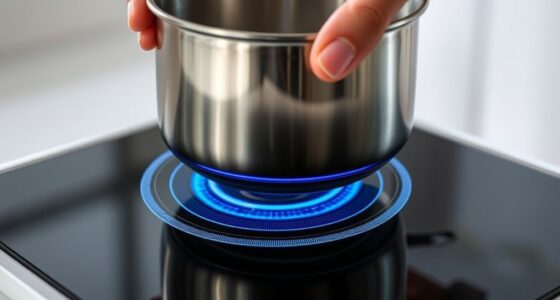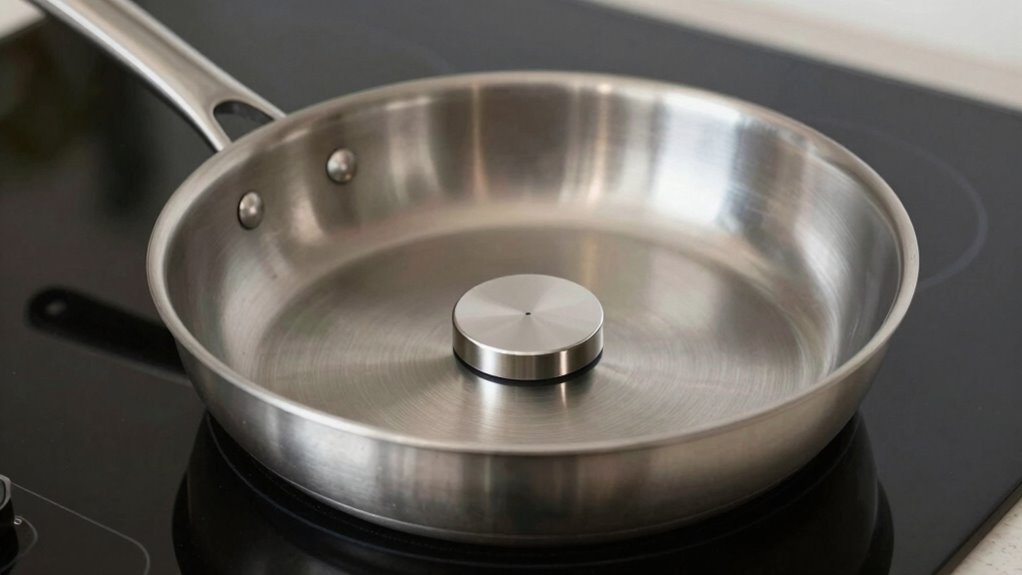

To check if your ceramic or glass cookware is compatible with an induction cooktop, start with a simple magnet test. Use a strong magnet and place it on the bottom of your cookware. If the magnet sticks firmly, your cookware likely contains ferromagnetic material and is suitable for induction. If not, it won’t work efficiently. Want to make certain your cookware is truly compatible? Keep exploring for helpful tips and tricks.
Key Takeaways
- Use a strong magnet to test if it sticks firmly to the bottom of the cookware.
- A strong magnetic attraction indicates likely compatibility with induction cooktops.
- Not all ceramic or glass cookware is suitable; verify with the magnet first.
- Glass cookware generally lacks ferromagnetic materials and won’t work on induction.
- Perform the magnet test before purchasing or using cookware for safe, efficient induction cooking.
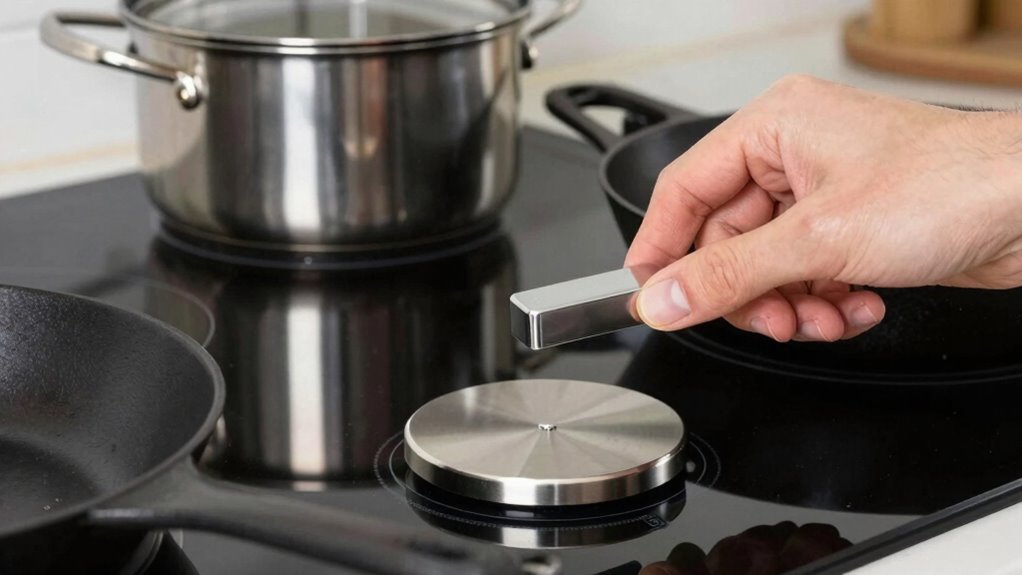
Induction cookware compatibility is vital to guarantee your stovetop heats efficiently and safely. If you’re new to induction cooking, one of the first steps you should take is performing a simple magnet test. This test helps determine whether your existing cookware will work on an induction cooktop. Not all cookware is compatible, so it’s important to verify before investing in new pots and pans.
Perform a magnet test to check if your ceramic or glass cookware is compatible with induction stoves.
When testing, grab a strong magnet—preferably one that sticks firmly to metal. Place the magnet on the bottom of your ceramic cookware or glass cookware. If the magnet sticks well and holds firm, then your cookware is likely induction-compatible. If it doesn’t, your ceramic or glass cookware won’t work directly on an induction stove, because these materials are typically non-magnetic. Keep in mind that some ceramic cookware with layered bases or magnetic stainless steel inserts might pass the magnet test, so check those carefully.
Many people assume that glass cookware, such as glass baking dishes or tempered glass pots, can be used on induction stoves, but that’s not the case. Glass cookware doesn’t contain ferromagnetic materials, so it won’t generate heat on its own. Even if a piece of glass cookware is heavy and looks durable, it won’t work unless it has a magnetic bottom or an induction-compatible layer. Ceramic cookware, especially those with metallic or magnetic bases, can sometimes be compatible, but not all ceramic pots are designed for induction. Always perform the magnet test to be sure.
Remember, performing the magnet test is quick and easy. Just hold the magnet against the bottom of your cookware and see if it sticks strongly. If it does, you’re good to go; if not, you might need to look for induction-specific cookware. Some brands now offer ceramic and glass cookware with magnetic bases, so don’t dismiss these types outright. Instead, verify their compatibility through the magnet test first.
Additionally, understanding the importance of induction-compatible cookware can help you avoid unnecessary expenses and ensure your stove heats efficiently. Ultimately, understanding whether your ceramic or glass cookware is induction-compatible saves you time, money, and frustration. It guarantees your stove heats efficiently and prevents damage to your cookware or cooktop. Whether you’re upgrading your kitchen or just trying to make the most of what you already own, performing this simple test is a vital first step. It helps you identify which pieces will perform well and which ones need replacing, so you can enjoy safe, effective, and energy-efficient induction cooking.
Frequently Asked Questions
Can Non-Metallic Cookware Work With Induction Stoves?
Non-metallic cookware generally won’t work with induction stoves because they don’t meet magnetic requirements. Induction cooking relies on magnetic materials, like cast iron or stainless steel, to generate heat. Material considerations are vital; if your cookware isn’t magnetic, it won’t activate the stove’s induction field. To check, do the magnet test—if a magnet sticks, your cookware should work. Otherwise, you’ll need to choose compatible, magnetic cookware for your induction stove.
Do All Stainless Steel Pots Work on Induction Cooktops?
Like a knight seeking a true sword, you wonder if all stainless steel pots work on induction cooktops. Not all do, because stainless steel’s magnetic properties vary. To check, perform a magnet test—if a magnet sticks, your stainless steel cookware should work. Remember, cookware with poor magnetic properties won’t heat efficiently, so verify your stainless steel pot is compatible before cooking.
How Do I Test if My Cookware Is Induction Compatible?
To test if your cookware is induction compatible, check its magnetic properties with a magnet. If the magnet sticks firmly, your cookware likely works on induction cooktops. For alternative materials like aluminum or glass, which aren’t magnetic, you’ll need to use a different method or opt for magnetic-compatible options. This quick test helps you determine compatibility without guesswork, saving you time and ensuring efficient cooking.
Will Aluminum or Copper Cookware Work With Induction?
Aluminum and copper cookware generally won’t work with induction stoves because of their magnetic properties. To determine if your cookware is compatible, perform a simple material testing method: hold a magnet to the bottom. If it sticks firmly, your cookware has the right magnetic properties. If it doesn’t, it likely won’t work with induction. Always test your cookware’s magnetic properties before cooking to guarantee compatibility.
Are Cast Iron Pans Suitable for Induction Cooking?
Yes, cast iron pans are suitable for induction cooking because they have strong magnetic properties, making them compatible. To verify, you should perform a compatibility testing by using a magnet; if it sticks firmly, your cast iron cookware works with induction. This simple test ensures you’re using the right cookware for efficient heating and safe cooking on your induction stove.
Conclusion
Think of the magnet test as your key to unlocking induction’s magic. When the magnet sticks, it’s a symbol of harmony—a bond between your cookware and the stove’s energy. Without it, your pots and pans remain silent, unable to dance to the induction’s rhythm. So, trust this simple test; it’s your gateway to seamless cooking. Embrace the magnet’s message, and let your cookware and stove unite in perfect symphony.