Complete the kit


Get home appliances delivered free with Prime
- Fast, free delivery on millions of items
- Prime Video, Amazon Music and more included
- Member-only deals all year
Key Takeaways
- Inverter technology dominates the top rankings, offering up to 40% energy savings compared to traditional on/off compressors found in budget models.
- Dual-hose portable units like the Midea Duo and Whynter ARC-1230WN close the efficiency gap with window units, making them viable for renters.
- LG and Midea lead in app ecosystem reliability, whereas lesser-known brands often suffer from connection drops and limited third-party integration.
- U-shaped window designs provide quieter operation and better room sealing compared to traditional box-style units, a key differentiator for bedroom use.
- Smart features are most valuable when paired with energy monitoring; models that only offer remote on/off functions lack the data needed for true cost savings.
| LG 10,000 BTU Smart Dual Inverter Window Air Conditioner |  | Best Overall | Cooling capacity: 10,000 BTU | Coverage: Up to 450 square feet | Voltage: 115V | VIEW LATEST PRICE | See Our Full Breakdown |
| Midea 10,000 BTU Smart Inverter Window Air Conditioner, 115V, for Rooms up to 450 Sq. Ft. |  | Best for Quiet Operation | Cooling capacity: 10,000 BTU | Coverage: Up to 450 square feet | Voltage: 115V | VIEW LATEST PRICE | See Our Full Breakdown |
| Comfort Zone 8,000 BTU Smart Wi-Fi Window Air Conditioner |  | Best for Automatic Temperature Management | Cooling capacity: 8,000 BTU | Coverage: Up to 350 square feet | Noise level: 59 dB | VIEW LATEST PRICE | See Our Full Breakdown |
| LG 6,000 BTU Smart Window Air Conditioner, Wi-Fi, Remote Control, White (LW6024RSMX) |  | Best for Small Rooms | Cooling capacity: 6,000 BTU | Recommended room area: Up to 250 square feet | Voltage: 115V | VIEW LATEST PRICE | See Our Full Breakdown |
| Hisense 10,000 BTU Window Air Conditioner with Wi-Fi Smart App Control |  | Best for Flexible Local Controls | Cooling capacity: 10,000 BTU | Coverage: Up to 450 square feet | Voltage: 115V | VIEW LATEST PRICE | See Our Full Breakdown |
| Windmill 5,000 BTU Lite Window Air Conditioner |  | Best for Small Rooms | Cooling capacity: 5,000 BTU | Recommended area: Up to 150 sq ft | Noise level: 51 dB | VIEW LATEST PRICE | See Our Full Breakdown |
| LG LW1522FVSM 14,000 BTU Dual Inverter Window Air Conditioner with Wi-Fi |  | Best for Large Rooms | Cooling capacity: 14,000 BTU | Coverage area: Up to 700 sq ft | Noise level: As low as 44 dB in sleep mode | VIEW LATEST PRICE | See Our Full Breakdown |
| Whynter ARC-1230WN Dual-Hose Smart Portable Air Conditioner, 14,000 BTU |  | Best Portable Smart Pick | Cooling power: 14,000 BTU | Coverage area: 600 sq ft | Type: Dual-hose portable air conditioner | VIEW LATEST PRICE | See Our Full Breakdown |
| Hisense UltraSlim 12,000 BTU Inverter Window Air Conditioner with Wi-Fi Smart App Control |  | Best for Quiet Cooling | Cooling power: 12,000 BTU | Coverage area: Up to 550 sq ft | Noise level: 35 dB | VIEW LATEST PRICE | See Our Full Breakdown |
| LG LW1022FVSM 10,000 BTU Dual Inverter Window Air Conditioner |  | Best Mid-Size Smart Window Unit | Cooling capacity: 10,000 BTU | Coverage area: 450 sq ft | Noise level: As low as 44 dB in sleep mode | VIEW LATEST PRICE | See Our Full Breakdown |
| GE 14,000 BTU Smart Window Air Conditioner with Wi-Fi and App Control |  | Best for High-Ceiling Rooms | Cooling Power: 14,000 BTU | Coverage Area: Up to 700 sq ft | Noise Level: 63 dB | VIEW LATEST PRICE | See Our Full Breakdown |
| Alphaappliance 10,000 BTU Portable Smart Air Conditioner with Heating |  | Best Budget Portable Hybrid | Cooling Capacity: 10,000 BTU | Coverage Area: Up to 450 sq ft | Noise Level: Below 46 dB | VIEW LATEST PRICE | See Our Full Breakdown |
| Midea Duo 14,000 BTU Portable Air Conditioner with Heat | 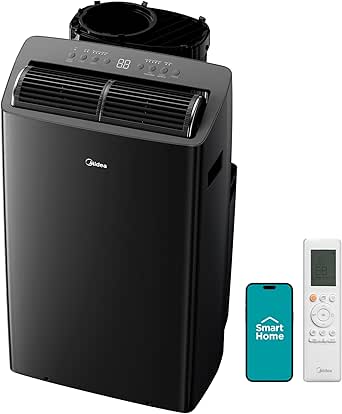 | Best Premium Portable | Cooling Power: 14,000 BTU (12,000 SACC) | Coverage Area: Up to 550 sq. ft. | Noise Level: 42 dB | VIEW LATEST PRICE | See Our Full Breakdown |
| Midea 12,000 BTU U-Shaped Window Air Conditioner |  | Best for Window Access | Cooling power: 12,000 BTU | Coverage area: 550 square feet | Noise level: 32 dBA | VIEW LATEST PRICE | See Our Full Breakdown |
| Midea U-Shaped Smart Inverter Window Air Conditioner, 12,000 BTU |  | Best Overall Smart Window Unit | Cooling Capacity: 12,000 BTU | Coverage Area: Up to 550 sq. ft. | Noise Level: As low as 32 dBA | VIEW LATEST PRICE | See Our Full Breakdown |
| smart air conditioner | Noise level | Cooling capacity | Coverage area |
|---|---|---|---|
| LG 10,000 BTU Smart Dual Inver | — | 10,000 BTU | — |
| Midea 10,000 BTU Smart Inverte | As low as 41 dB | 10,000 BTU | — |
| Comfort Zone 8,000 BTU Smart W | 59 dB | 8,000 BTU | — |
| LG 6,000 BTU Smart Window Air | 52 dB | 6,000 BTU | — |
| Hisense 10,000 BTU Window Air | 53 dB | 10,000 BTU | — |
| Windmill 5,000 BTU Lite Window | 51 dB | 5,000 BTU | — |
| LG LW1522FVSM 14,000 BTU Dual | As low as 44 dB in sleep mode | 14,000 BTU | Up to 700 sq ft |
| Whynter ARC-1230WN Dual-Hose S | 42.5 dB | — | 600 sq ft |
| Hisense UltraSlim 12,000 BTU I | 35 dB | — | Up to 550 sq ft |
| LG LW1022FVSM 10,000 BTU Dual | As low as 44 dB in sleep mode | 10,000 BTU | 450 sq ft |
| GE 14,000 BTU Smart Window Air | 63 dB | — | Up to 700 sq ft |
| Alphaappliance 10,000 BTU Port | Below 46 dB | 10,000 BTU | Up to 450 sq ft |
| Midea Duo 14,000 BTU Portable | 42 dB | — | Up to 550 sq. ft. |
| Midea 12,000 BTU U-Shaped Wind | 32 dBA | — | 550 square feet |
| Midea U-Shaped Smart Inverter | As low as 32 dBA | 12,000 BTU | Up to 550 sq. ft. |
More Details on Our Top Picks
LG 10,000 BTU Smart Dual Inverter Window Air Conditioner
For a medium-size room, I’d put the LG 10,000 BTU Dual Inverter first because it combines 450-square-foot coverage with app and voice control, quiet sleep-mode operation, and four-way airflow. Its 44 dB sleep mode is a useful distinction from the Midea 10,000 BTU Smart Inverter, which is rated as low as 41 dB but doesn’t list the same four-way deflection feature. LG also specifies efficiency up to 25% above the Energy Star certification requirement, making this a strong fit for buyers who expect long cooling sessions. The tradeoff is physical: at 63 pounds, it is a substantial window unit, and the opening must be at least 22 inches wide and 13 inches high. I’d choose another model if easier installation matters more than LG’s feature mix.
Pros:- Covers rooms up to 450 square feet with 10,000 BTU cooling.
- Sleep mode operates as quietly as 44 dB.
- Works with LG ThinQ, Alexa, and Google Assistant.
- Four-way air deflection and a washable filter support flexible airflow and routine upkeep.
Cons:- At 63 pounds, installation may be awkward without help.
- Requires a window opening at least 22 inches wide and 13 inches high.
Best for: People cooling a bedroom or living room up to 450 square feet who want app and voice control, adjustable airflow, and a defined quiet sleep setting.
Not ideal for: Anyone installing the unit alone or with a narrow window; its 63-pound weight and minimum opening dimensions can make setup difficult.
- Cooling capacity:10,000 BTU
- Coverage:Up to 450 square feet
- Voltage:115V
- Sleep-mode noise:As low as 44 dB
- Smart controls:LG ThinQ, Amazon Alexa, and Google Assistant
- Air deflection:Four-way
- Filter:Removable and washable
- Weight:63 pounds
- Window opening:22–36 inches wide; 13 inches high
Our verdict“Choose this LG for feature-rich, quiet cooling across a medium-size room if you have help for its heavy window installation.”
Midea 10,000 BTU Smart Inverter Window Air Conditioner, 115V, for Rooms up to 450 Sq. Ft.
The Midea makes a persuasive case for buyers who prioritize a quieter room: its listed noise level reaches 41 dB, lower than the LG 10,000 BTU Dual Inverter’s 44 dB sleep-mode figure. It also pairs inverter operation with eco mode, app and voice controls, and a washable filter, so everyday control does not depend on standing beside the unit. Auto, cool, dry, and fan modes give it more listed operating choices than the Hisense 10,000 BTU Window Air Conditioner, which lists cooling, fan, and dehumidifier modes. Both cover up to 450 square feet, though Midea’s product data does not specify four-way air direction. It remains a window-only choice, and its room-size limit makes it a poor match for larger open spaces.
Pros:- Listed noise level as low as 41 dB.
- Inverter technology and eco mode support energy-conscious operation.
- App, voice, remote, and panel controls provide several ways to adjust settings.
- Includes a washable filter and installation kit.
Cons:- Cooling coverage is limited to rooms up to 450 square feet.
- Requires a suitable standard window and does not offer a portable placement option.
Best for: Light sleepers and remote workers cooling rooms up to 450 square feet who want inverter operation, app access, and several operating modes.
Not ideal for: People cooling a large open-plan area or anyone unable to use a standard window installation.
- Cooling capacity:10,000 BTU
- Coverage:Up to 450 square feet
- Voltage:115V
- Noise level:As low as 41 dB
- Inverter:Yes
- Controls:App, voice, remote, and button panel
- Modes:Auto, cool, dry, fan, and eco
- Timer:24 hours
- Filter:Washable
Our verdict“Pick the Midea over the LG 10,000 BTU model if its lower listed noise level is your priority and your room fits its coverage limit.”
Comfort Zone 8,000 BTU Smart Wi-Fi Window Air Conditioner
The Comfort Zone is the smaller-capacity pick for rooms where 10,000 BTU would be more than needed: it is rated for up to 350 square feet, compared with 450 square feet for the LG and Midea 10,000 BTU models. Its standout detail is seven temperature sensors supporting Auto mode, which can make automatic operation more responsive to room conditions. Wi-Fi app and remote control, plus Eco and Sleep modes, add useful control without stepping up to a larger unit. The compromise is clear in the data: it is not an inverter model and is listed at 59 dB, louder than the Midea’s 41 dB rating and the LG’s 44 dB sleep-mode figure. I’d favor it for a modest room and skip it where quiet operation is a priority.
Pros:- Seven temperature sensors support automatic operation.
- Wi-Fi app and remote control cover everyday adjustments.
- Eco and Sleep modes offer alternatives to continuous standard cooling.
- Washable antimicrobial filter includes a 500-hour reminder.
Cons:- Listed noise level is 59 dB, higher than the Midea and LG 10,000 BTU options.
- Non-inverter design lacks the inverter feature offered by those larger models.
- Coverage tops out at 350 square feet.
Best for: Renters or homeowners cooling a bedroom or office up to 350 square feet who want Wi-Fi control and sensor-guided Auto mode.
Not ideal for: People with rooms larger than 350 square feet or buyers seeking especially quiet operation or inverter technology.
- Cooling capacity:8,000 BTU
- Coverage:Up to 350 square feet
- Noise level:59 dB
- Modes:Cool, dry, fan, and auto
- Fan speeds:4
- Controls:Wi-Fi app and remote
- Temperature sensors:7
- Filter:Washable antimicrobial filter with 500-hour reminder
- Inverter:No
Our verdict“Choose the Comfort Zone for sensor-guided smart cooling in a smaller room, but select the Midea or LG if lower listed noise matters more.”
LG 6,000 BTU Smart Window Air Conditioner, Wi-Fi, Remote Control, White (LW6024RSMX)
For a compact bedroom or office, I’d choose the LG LW6024RSMX over the 8,000 BTU Comfort Zone when the room is closer to 250 square feet and a smaller unit is the better fit. It brings smart control through LG ThinQ, Alexa, and Google Assistant, plus a remote, a 24-hour timer, and auto-restart after a power interruption. Its 37-pound weight is notably below the 63-pound LG 10,000 BTU model, which may make handling less demanding, though installation still depends on a compatible double-hung window. The tradeoffs are modest capacity and just two cooling and fan speeds; it also lacks an inverter. I’d skip it for larger rooms, where the Comfort Zone’s 350-square-foot rating offers more headroom.
Pros:- Smart control works through LG ThinQ, Alexa, and Google Assistant.
- At 37 pounds, it is lighter than the LG 10,000 BTU model.
- Auto-restart and a 24-hour timer add useful scheduling and recovery features.
- Washable filter includes a cleaning reminder.
Cons:- Designed for rooms up to 250 square feet, less coverage than the Comfort Zone 8,000 BTU model.
- Only two cooling and fan speeds.
- Does not use inverter technology and requires a compatible double-hung window.
Best for: People cooling a small bedroom, nursery, or home office up to 250 square feet who want smart controls and a lighter unit to handle.
Not ideal for: Households with rooms above 250 square feet or windows that are not compatible with its double-hung installation requirements.
- Cooling capacity:6,000 BTU
- Recommended room area:Up to 250 square feet
- Voltage:115V
- Wattage:540W
- Noise level:52 dB
- Smart controls:LG ThinQ, Amazon Alexa, and Google Assistant
- Cooling and fan speeds:2
- Weight:37 pounds
- Window installation:Double-hung window; 21–35 inches wide
Our verdict“Choose this LG for a small room and smart-home control; move up to the Comfort Zone if you need coverage beyond 250 square feet.”
Hisense 10,000 BTU Window Air Conditioner with Wi-Fi Smart App Control
The Hisense is a straightforward smart window option for buyers who want app access but still prefer physical controls close at hand. Its ConnectLife Wi-Fi app sits alongside a touch panel and remote, while cooling, fan, and dehumidifier modes cover the basic jobs for a room up to 450 square feet. Four-way air direction can help send airflow where it is needed, a feature not listed for the Midea 10,000 BTU Smart Inverter. The tradeoff is that Hisense lists 53 dB, above Midea’s 41 dB and the LG 10,000 BTU model’s 44 dB sleep-mode figure; it also does not list inverter technology or a timer. At 50.7 pounds, it is lighter than that LG, but still a sizable window installation.
Pros:- ConnectLife app, remote, and touch panel provide multiple control methods.
- Cooling, fan, and dehumidifier modes handle different room needs.
- Four-way air direction helps direct airflow around the room.
- Washable mesh filter simplifies routine maintenance.
Cons:- Listed noise level is 53 dB, higher than the Midea and LG 10,000 BTU alternatives.
- Product data does not list inverter technology or a timer.
- At 50.7 pounds, it may still be difficult to install without help.
Best for: People cooling a room up to 450 square feet who want smart app access, a physical panel and remote, and a dehumidifier mode.
Not ideal for: Light sleepers seeking the lowest listed noise or buyers who want inverter operation and a stated timer feature.
- Cooling capacity:10,000 BTU
- Coverage:Up to 450 square feet
- Voltage:115V
- Wattage:870W
- Noise level:53 dB
- Modes:Cooling, fan, and dehumidifier
- Controls:ConnectLife Wi-Fi app, remote, and touch panel
- Air direction:Four-way
- Weight:50.7 pounds
Our verdict“Choose the Hisense for its mix of app and physical controls plus four-way airflow, but favor the Midea if quieter operation and inverter technology are higher priorities.”
Windmill 5,000 BTU Lite Window Air Conditioner
For a bedroom, office, or other compact space, I’d favor the Windmill 5,000 BTU Lite over larger smart units that would be more machine than the room needs. It is rated for up to 150 square feet, with app and voice control for changing settings without walking over to the unit. The washable filter and three cooling modes also keep routine upkeep and basic comfort adjustments straightforward. Compared with the LG LW1022FVSM, this Windmill gives up broad-room capacity and inverter technology, but its smaller cooling range may suit a single room better. Its main compromises are its limited coverage and narrow window compatibility: it fits standard single- or double-hung windows only, with specific opening dimensions. I’d skip it for open-plan areas or anyone needing flexible installation options.
Pros:- App and voice controls support remote adjustments.
- Three modes and three fan speeds give useful basic control.
- Washable filter can be cleaned and reused.
- Installation kit is included for compatible windows.
Cons:- Rated for rooms up to just 150 square feet.
- Fits only standard single- and double-hung windows within the listed dimensions.
Best for: People who want app- or voice-controlled cooling in a bedroom, home office, or other room no larger than 150 square feet.
Not ideal for: Buyers cooling a large or connected living space, or anyone with a window outside the listed single- or double-hung size range.
- Cooling capacity:5,000 BTU
- Recommended area:Up to 150 sq ft
- Noise level:51 dB
- Controls:App and voice control
- Modes and fan speeds:Cool, eco, fan; 3 fan speeds
- Window compatibility:Single- and double-hung; 14.5 in minimum height, 23–34 in width
- Dimensions:14.8 × 17.8 × 15.1 in (D × W × H)
- Power:115 V; 460 W
Our verdict“Choose the Windmill for smart cooling in a small room, but pick a higher-capacity model such as the LG LW1022FVSM for a larger space.”
LG LW1522FVSM 14,000 BTU Dual Inverter Window Air Conditioner with Wi-Fi
When a single unit needs to handle a large room, the LG LW1522FVSM offers the broadest stated coverage in this batch: up to 700 square feet. Its dual-inverter compressor and Wi-Fi controls make it a more feature-rich choice than the small-room Windmill, while the ThinQ app, voice assistant support, and included remote give buyers several ways to manage cooling. Sleep-mode noise is listed as low as 44 dB, and the slide-out washable filter makes cleaning less of a chore. That extra capacity comes with practical costs: at 85 pounds, installation can be awkward, and it needs a double-hung window at least 27 inches wide and 16 inches high. Compared with the Hisense UltraSlim, LG covers more area but is heavier and has a higher listed sleep-mode noise level.
Pros:- Rated for spaces up to 700 square feet.
- Dual-inverter compressor supports variable operation.
- ThinQ app, compatible voice assistants, and remote offer several control options.
- Washable slide-out filter and filter reminder support routine maintenance.
Cons:- At 85 pounds, it can be difficult to lift and install.
- Requires a double-hung window 27–39 inches wide and 16 inches high.
- Its large capacity may be excessive for smaller rooms.
Best for: Households cooling a large room up to 700 square feet that want Wi-Fi, voice control, and a remote in one window unit.
Not ideal for: People installing an air conditioner alone, buyers with narrower windows, or anyone cooling a small room that does not need this much capacity.
- Cooling capacity:14,000 BTU
- Coverage area:Up to 700 sq ft
- Noise level:As low as 44 dB in sleep mode
- Connectivity:Wi-Fi, LG ThinQ app, Google Assistant and Amazon Alexa compatibility
- Compressor:Dual inverter
- Window fit:27–39 in wide × 16 in high
- Dimensions and weight:22.32 × 23.62 × 15 in (D × W × H); 85 lb
- Power:115 V; 1,260 W
Our verdict“Pick the LG LW1522FVSM for a large room and connected controls if your window and installation setup can handle its size and weight.”
Whynter ARC-1230WN Dual-Hose Smart Portable Air Conditioner, 14,000 BTU
The Whynter ARC-1230WN is the clearest choice here for buyers who cannot or do not want to install a window unit. Its dual-hose portable design is intended to keep conditioned air indoors, while Wi-Fi and voice control add remote operation that the window-mounted Hisense UltraSlim cannot provide in a portable format. It also combines cooling with dehumidifying and fan modes, plus a washable filter, sleep mode, timer, and auto-drain function. The listed 42.5 dB noise level is appealing, though the unit’s portability has limits: it weighs 77.3 pounds, so moving it between rooms is no small task. The window opening also needs to meet a listed minimum height and width of 47 inches. I’d choose it for flexible placement, not effortless mobility.
Pros:- Dual-hose design helps keep conditioned air indoors.
- Wi-Fi app and voice control support remote adjustments.
- Cooling, dehumidifying, and fan modes cover more than temperature control.
- Auto-drain, washable filter, timer, and sleep mode support day-to-day use.
Cons:- Weighs 77.3 pounds, which limits easy room-to-room movement.
- Window installation calls for an opening with a listed minimum height and width of 47 inches.
- A portable unit still needs window access for its hoses.
Best for: Renters or homeowners who need a smart air conditioner that can be installed through a window and moved without mounting a window unit.
Not ideal for: Anyone who needs a lightweight unit to move often, or whose window cannot accommodate the stated 47-inch minimum opening dimensions.
- Cooling power:14,000 BTU
- Coverage area:600 sq ft
- Type:Dual-hose portable air conditioner
- Noise level:42.5 dB
- Controls:Digital display, remote, Wi-Fi app, and voice control
- Modes:Cool, dehumidify, and fan
- Dimensions and weight:16.75 × 19.5 × 32.5 in; 77.3 lb
- Dehumidifier capacity:87 pints
Our verdict“Choose the Whynter if portable placement matters more than light weight, and consider the Hisense UltraSlim if a fixed window installation is acceptable.”
Hisense UltraSlim 12,000 BTU Inverter Window Air Conditioner with Wi-Fi Smart App Control
The Hisense UltraSlim stands apart for its listed 35 dB noise level, making it the quiet-focused pick among these window models. Its inverter compressor is designed to support steady cooling, and ConnectLife Wi-Fi control adds scheduling and remote mode changes for buyers who want to manage a room from their phone. Rated for up to 550 square feet, it sits between the compact Windmill and the larger LG LW1522FVSM in stated coverage. That middle ground may suit a spacious bedroom or living area without stepping up to LG’s 700-square-foot model. The tradeoffs are installation and connectivity: at 63.9 pounds, lifting it into place may take help, and full use of its smart features depends on Wi-Fi. The supplied details do not list window-fit dimensions, so check compatibility before buying.
Pros:- Listed 35 dB noise level is lower than the other window models in this batch.
- Inverter compressor is designed for stable cooling.
- ConnectLife app supports remote control, scheduling, and mode changes.
- Washable mesh filter and included easy-install bracket simplify upkeep and setup.
Cons:- Weighs 63.9 pounds, which can make installation challenging.
- Full smart-feature use depends on Wi-Fi connectivity.
- Window-fit dimensions are not included in the supplied specifications.
Best for: Buyers prioritizing low-noise operation and app scheduling in a room up to 550 square feet, with a suitable window and reliable Wi-Fi.
Not ideal for: People who need offline smart control, want a lightweight DIY installation, or need confirmed window-fit dimensions before purchase.
- Cooling power:12,000 BTU
- Coverage area:Up to 550 sq ft
- Noise level:35 dB
- Compressor:Inverter
- Connectivity:Wi-Fi; ConnectLife app
- Modes:Cooling, fan, and dehumidifier
- Dimensions and weight:20.5 × 20.3 × 14.6 in (D × W × H); 63.9 lb
- Power:115 V; 1,120 W
Our verdict“Choose the Hisense UltraSlim for quiet, connected cooling in a medium-to-large room, provided you can confirm the fit and manage its installation weight.”
LG LW1022FVSM 10,000 BTU Dual Inverter Window Air Conditioner
For a medium-sized room, the LG LW1022FVSM balances smart controls and capacity without going as large as the 14,000 BTU LG LW1522FVSM. Its 10,000 BTU rating is intended for spaces up to 450 square feet, and the dual-inverter compressor, ThinQ app, and Alexa and Google Assistant compatibility make it a connected alternative to the smaller Windmill. Sleep-mode noise is listed as low as 44 dB, while the washable filter and reminder help keep maintenance visible. LG also lists energy savings of up to 35% compared with standard ENERGY STAR requirements; that claim is a useful point of comparison, not a guarantee for every room or usage pattern. The drawbacks are installation weight and fit: it weighs 62.8 pounds and requires a compatible double-hung window.
Pros:- Dual-inverter compressor supports efficient, variable cooling.
- LG ThinQ app and Alexa or Google Assistant compatibility add connected control.
- Sleep-mode noise is listed as low as 44 dB.
- Washable filter and filter reminder make routine maintenance easier to track.
Cons:- At 62.8 pounds, installation may require assistance.
- Fits double-hung windows only, with a stated width range of 22–36 inches.
- Less suitable for larger spaces than the 14,000 BTU LG LW1522FVSM.
Best for: People cooling a bedroom or living room up to 450 square feet who want inverter operation and app or voice control.
Not ideal for: Buyers with small rooms, incompatible windows, or no help available to lift a 62.8-pound unit during installation.
- Cooling capacity:10,000 BTU
- Coverage area:450 sq ft
- Noise level:As low as 44 dB in sleep mode
- Compressor:Dual inverter
- Connectivity:Wi-Fi, LG ThinQ app, Alexa, and Google Assistant
- Window fit:Double-hung; 22–36 in wide
- Dimensions and weight:26.97 × 19.57 × 12.36 in (D × W × H); 62.8 lb
- Power:115 V; 970 W
Our verdict“Choose this LG for connected, inverter-based cooling in a medium room; step up to the LW1522FVSM for substantially larger coverage.”
GE 14,000 BTU Smart Window Air Conditioner with Wi-Fi and App Control
This unit stands out for its generous vertical clearance, fitting windows as tall as 14.56 inches. While the Midea U-Shaped models offer quieter operation, they often require stricter height minimums. The GE is Energy Star certified, helping manage electricity costs in larger spaces up to 700 square feet. It connects seamlessly with the SmartHQ app, though the interface is less polished than Midea’s MSmartHome. The EZ Mount kit simplifies installation for standard double-hung windows, making it a reliable workhorse for those who prioritize raw cooling capacity over silence.Pros:- Fits windows up to 14.56 inches high
- Energy Star certified for efficiency
- Includes EZ Mount installation kit
- Compatible with Alexa and Google Assistant
Cons:- Loud operation at 63 dB
- Uses older R-410A refrigerant
- Limited to double-hung window types
Best for: Owners of large bedrooms or living areas with tall windows who need high BTU output.
Not ideal for: Light sleepers, as the 63 dB noise level is significantly louder than inverter competitors.
- Cooling Power:14,000 BTU
- Coverage Area:Up to 700 sq ft
- Noise Level:63 dB
- Refrigerant:R-410A
- Window Height Fit:14.563″
- Control Methods:App, Voice, Remote
Our verdict“Choose this for high-capacity cooling in tall-window setups where noise is a secondary concern.”
Alphaappliance 10,000 BTU Portable Smart Air Conditioner with Heating
This model offers a rare combination of heating and cooling in a portable form factor, making it versatile for year-round use. Unlike the Midea Duo, which is heavier and pricier, this unit is lighter at 39.7 lbs and easier to store. It operates quietly below 46 dB, which is impressive for a portable. However, its coverage is limited to 450 sq ft, significantly less than the 700 sq ft handled by the GE window unit. It relies on the Tuya app, which is functional but less intuitive than dedicated brand ecosystems.Pros:- Combines heating and cooling modes
- Lightweight and easy to move with wheels
- Quiet operation under 46 dB
- Compatible with major voice assistants
Cons:- Limited cooling coverage (450 sq ft)
- Tuya app interface is less refined
- Standard portable hose setup reduces efficiency
Best for: Renters or users needing both heat and cool in small rooms without permanent installation.
Not ideal for: Large open-plan spaces, as it struggles to cool areas beyond 450 square feet.
- Cooling Capacity:10,000 BTU
- Coverage Area:Up to 450 sq ft
- Noise Level:Below 46 dB
- Weight:39.7 lb
- Modes:Cooling, heating, fan, dehumidifier
- Controls:Tuya app, Alexa, Google Assistant
Our verdict“A practical choice for renters who need basic smart control and dual-season utility in compact spaces.”
Midea Duo 14,000 BTU Portable Air Conditioner with Heat
This unit redefines portable efficiency with its dual hose-in-hose design, which prevents hot air recirculation—a common flaw in standard portables like the Alphaappliance. The inverter compressor cuts energy use by over 40%, while the 42 dB noise level rivals many window units. It is heavy at 77.2 lbs, making it difficult to move frequently compared to lighter models. The smart features are robust, supporting both Alexa and Google Assistant seamlessly. For those who cannot install a window unit but want near-window performance, this is the superior portable option.Pros:- Dual hose-in-hose design for high efficiency
- Ultra-quiet operation at 42 dB
- Inverter technology saves significant energy
- Includes heating capability
Cons:- Heavy at 77.2 lbs
- Remote batteries not included
- Heating range limited to 41°F-86°F
Best for: Users who need high-performance portable cooling without permanent window modifications.
Not ideal for: Those who need to move the unit between rooms often, due to its heavy 77 lb weight.
- Cooling Power:14,000 BTU (12,000 SACC)
- Coverage Area:Up to 550 sq. ft.
- Noise Level:42 dB
- Weight:77.2 lbs
- Design:Dual hose-in-hose
- Compatibility:Alexa, Google Assistant
Our verdict“The definitive choice for premium portable cooling, offering window-unit efficiency in a movable form.”
Midea 12,000 BTU U-Shaped Window Air Conditioner
The U-shaped design is the headline feature here, allowing the window to slide open even while the AC is installed. This is a major advantage over traditional boxy units like the GE 14,000 BTU, which seal the window completely. It operates extremely quietly at 32 dBA thanks to inverter technology. The quick-snap bracket simplifies installation, though it requires specific window dimensions. While slightly lighter than the Midea U-Shaped Inverter (B0F23C9DQX), the performance is nearly identical, making it a solid choice for those who value fresh air access alongside smart cooling.Pros:- U-shaped design allows window to open
- Very quiet operation at 32 dBA
- Inverter technology saves energy
- Includes quick-snap installation bracket
Cons:- Specific window dimension requirements
- Less BTU power than the GE 14k model
- Warranty details can vary by retailer
Best for: Homeowners who want to keep their windows open for fresh air or views.
Not ideal for: Users with non-standard window sizes that do not fit the specific U-shape requirements.
- Cooling power:12,000 BTU
- Coverage area:550 square feet
- Noise level:32 dBA
- Energy savings:Over 37%
- Refrigerant:R-32
- Weight:56.9 pounds
Our verdict“Ideal for those who refuse to sacrifice window access for smart cooling performance.”
Midea U-Shaped Smart Inverter Window Air Conditioner, 12,000 BTU
This model refines the U-shaped concept with a 90-day warranty focus on authorized channels and a robust MSmartHome app. Compared to the GE 14,000 BTU, it is significantly quieter (32 dBA vs 63 dB) and more energy-efficient due to the inverter. The R-32 refrigerant is modern and eco-friendlier than the R-410A found in older units. It balances cooling power with smart features perfectly. The anti-theft lock adds security, though it can be annoying if you frequently open the window. It is the most balanced option for most smart-home buyers.Pros:- Inverter system for quiet 32 dBA operation
- U-shaped design preserves window view
- Modern R-32 refrigerant
- Secure anti-theft window lock
Cons:- Strict window height minimum (13.75 in)
- Anti-theft lock can hinder frequent window opening
- 90-day warranty is shorter than competitors
Best for: Smart home enthusiasts who want quiet, efficient, and secure window cooling.
Not ideal for: Users who need more than 12,000 BTUs or have windows shorter than 13.75 inches.
- Cooling Capacity:12,000 BTU
- Coverage Area:Up to 550 sq. ft.
- Noise Level:As low as 32 dBA
- Refrigerant:R-32
- Window Height Fit:Minimum 13.75 in
- Controls:MSmartHome app, Alexa, Google Assistant
Our verdict“The top pick for most buyers seeking a blend of quiet operation, smart integration, and modern efficiency.”
How We Picked
I evaluated these units based on energy efficiency ratios (EER/CEER), the stability of their companion apps, and real-world noise levels. A smart AC is only as good as its connectivity, so I prioritized models with consistent Wi-Fi performance and robust integration with major platforms like Alexa and Google Home. I also weighed cooling speed against power consumption, giving preference to inverter compressors that modulate power rather than cycling on and off.
Beyond specs, I considered ease of installation and maintenance. Window units were judged on their sealing kits and mounting security, while portable models were assessed for hose setup complexity and drainage requirements. This ranking favors long-term usability and energy savings over initial purchase price, reflecting the higher upfront cost of smart technology as an investment in lower utility bills.
Factors to Consider When Choosing Best Smart Air Conditioners
Selecting a smart air conditioner involves more than just matching BTU ratings to room size. The integration of smart technology changes how you interact with the unit daily, from scheduling to energy monitoring. Here are the critical factors to weigh before buying.Inverter vs. Traditional Compressors
The compressor type is the single biggest factor in operating cost. Inverter compressors adjust their speed to maintain a set temperature, avoiding the massive energy spikes of traditional on/off cycles. While traditional units may have a lower sticker price, they consume significantly more electricity over a season. If you plan to run the AC for more than a few hours a day, an inverter model pays for itself through reduced utility bills. Traditional compressors are only suitable for occasional use in guest rooms or home offices.
App Ecosystem and Integration
Not all smart features are created equal. I looked for units that offer more than just a digital remote control. The best models provide energy usage data, allowing you to see exactly how much each degree of cooling costs. Check for compatibility with your existing smart home hub. If you use Alexa, ensure the brand has a certified skill. Some cheaper brands use proprietary apps that are buggy or lack third-party integration, limiting their usefulness in a connected home.
Noise Levels and Sleep Modes
Smart features allow for granular control of fan speeds, which is critical for bedrooms. Look for units with a sleep mode that gradually adjusts temperature and lowers fan noise. Inverter models generally operate quieter than traditional ones because they do not blast at full power upon startup. For light sleepers, a decibel rating below 50dB on low settings is recommended. Window units with U-shaped designs often provide better sound insulation than standard box styles.
Installation and Portability
Consider your living situation. If you rent, a portable unit is often the only option, but dual-hose models are far more efficient than single-hose versions. Single-hose units create negative pressure, pulling hot air from outside into the room. Window units offer better efficiency but require secure installation. U-shaped window ACs are gaining popularity because they sit flush with the window, reducing vibration noise and improving the seal against heat leakage.
Maintenance and Filter Access
Smart monitoring can alert you when filters need cleaning, but physical access matters. Washable filters save money on replacements, but check how easy they are to remove. Some portable units require frequent draining of condensate water, though newer models feature self-evaporation technology that eliminates this chore. Regular maintenance is vital for efficiency; a clogged filter can increase energy consumption by up to 15%. Choose a model with a front-access filter panel for easier upkeep.
Frequently Asked Questions
Do smart air conditioners actually save money on electricity?
Yes, but primarily through behavioral changes and efficient compressor technology. Smart units allow you to set schedules and geofencing, ensuring the AC is off when you are not home. More importantly, the inverter compressors found in top-tier smart models use up to 40% less energy than traditional units by avoiding startup surges. Over a few years, these savings often offset the higher initial purchase price.Can I use a smart air conditioner without Wi-Fi?
Most smart air conditioners function as standard AC units without an internet connection. You can still use the physical buttons or the included infrared remote control to adjust settings. However, you lose access to app-based features like scheduling, energy monitoring, and voice control. If your Wi-Fi goes down, the unit will continue to cool, but it will not respond to commands from your phone or smart speaker.What is the difference between single-hose and dual-hose portable ACs?
Single-hose units pull air from the room, cool it, and exhaust the heat outside, creating negative pressure that draws warm air in from cracks and vents. Dual-hose units pull air from outside for the cooling process and exhaust it separately, preventing negative pressure. This makes dual-hose models significantly more efficient and faster at cooling, which is why they are recommended for larger spaces or hotter climates despite their higher cost.How do I determine the right BTU size for my room?
BTU ratings must match room square footage, but other factors matter too. Rooms with high ceilings, large windows, or exposure to direct sunlight need higher BTU ratings. Conversely, shaded rooms or those with good insulation need less. A general rule is 20 BTUs per square foot, but you should increase this by 10% for sunny rooms and decrease it by 10% for shaded ones. Oversizing can lead to short cycling, which reduces dehumidification efficiency.Are U-shaped window air conditioners worth the extra cost?
For most users, yes. U-shaped designs allow the window to close partially or fully behind the unit, improving security and insulation. They also tend to operate more quietly because the compressor is isolated from the window frame, reducing vibration noise. If you are sensitive to noise or live in a high-rise where window security is a concern, the premium for a U-shaped model is justified by the improved comfort and usability.Conclusion
To summarize, the LG 10,000 BTU Smart Dual Inverter is the best overall choice for most households, combining quiet inverter efficiency with a stable smart home integration. For renters or those who cannot install a window unit, the Midea Duo 14,000 BTU Portable offers the best performance in a portable form factor. Budget-conscious buyers should look at the Hisense 10,000 BTU for solid basics, while those seeking premium features should consider the LG LW1522FVSM for larger spaces. Choose based on your specific installation constraints and how much you value detailed energy monitoring over simple remote control.