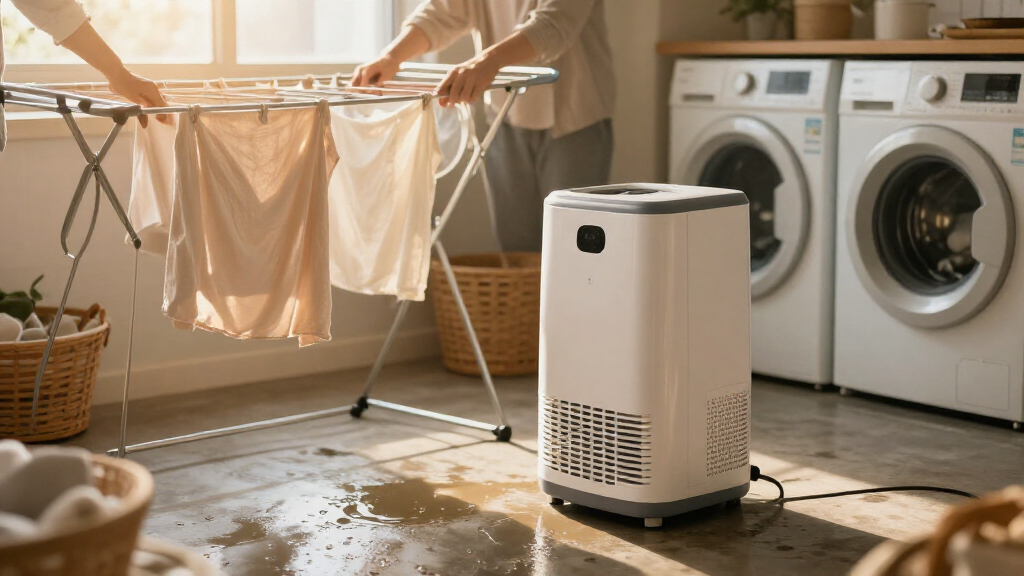
When laundry dries indoors, the right dehumidifier can help manage the moisture that builds up around drying racks and in utility rooms. My strongest all-around options are the DREO 75-Pint Smart Dehumidifier for high-capacity drying with app controls, the 80-Pint Dehumidifier for flexible airflow and straightforward hose drainage, and the KNKA 34-Pint for a quieter, smaller-scale laundry routine. They solve different problems: high moisture output, broad room coverage, and manageable everyday operation.

Get home appliances delivered free with Prime
- Fast, free delivery on millions of items
- Prime Video, Amazon Music and more included
- Member-only deals all year
I ranked these five by how well their stated capacity, drainage, controls, and noise suit laundry use—not by room coverage alone. A large tank still needs attention, and a continuous drain is only useful if the hose can reach a suitable outlet. The ALORAIR commercial unit is the specialist choice when powered pumping and sustained moisture removal matter more than easy moving; the UKOKE is a quieter compact alternative, though its small tank makes hose drainage particularly useful.
Complete the kit


Key Takeaways
- DREO is my high-capacity smart pick: it combines a 75-pint daily rating, a 7-liter tank, an included drain hose, and app scheduling, but its 33-pound body is not the easiest to carry.
- The 80-Pint model suits large laundry areas: its 1.72-gallon tank, included hose option, adjustable outlet, and wheels offer flexibility, while the tank still needs frequent attention during heavy drying.
- KNKA is the quieter home-scale option: its stated 37 dB noise level and 34-pint capacity suit regular laundry, though the included hose is only 3.28 feet long.
- ALORAIR is built around drainage access: its pump can lift condensate up to 14.7 feet through a 19.6-foot hose, but 64.3 pounds and one fan speed make it less convenient in a shared room.
- Drainage can matter as much as capacity: for laundry that runs for hours, a hose or pump can reduce tank-emptying interruptions; without a drain point, compare tank size and full-tank shutoff behavior.
| DREO 75-Pint Smart Dehumidifier for Rooms up to 4,500 Sq Ft |  | Best Overall for High-Volume Laundry | Dehumidification capacity: 75 pints per day | Recommended floor area: Up to 4,500 sq ft | Tank capacity: 7 liters (1.85 gallons) | VIEW LATEST PRICE | See Our Full Breakdown |
| 80-Pint Dehumidifier for Spaces up to 4,500 Sq. Ft. with Drain Hose |  | Best for Large Laundry Rooms | Dehumidification capacity: Up to 80 pints per day | Coverage area: Up to 4,500 sq ft | Tank capacity: 1.72 gallons | VIEW LATEST PRICE | See Our Full Breakdown |
| KNKA 34-Pint Dehumidifier for Rooms up to 2,500 Sq. Ft. |  | Best Quieter Home-Scale Pick | Dehumidification capacity: 34 pints per day | Coverage area: Up to 2,500 sq ft | Tank capacity: 0.79 gallons (3 liters) | VIEW LATEST PRICE | See Our Full Breakdown |
| ALORAIR Commercial Dehumidifier with Pump, 180 PPD |  | Best for Pumped Drainage and Damp Utility Spaces | Capacity: 180 pints per day at saturation; 85 PPD at AHAM | Coverage area: Up to 2,300 sq ft | Airflow: 210 CFM | VIEW LATEST PRICE | See Our Full Breakdown |
| UKOKE 1750 Sq. Ft. Dehumidifier with Auto Drain |  | Best Compact, Quiet-Mode Option | Coverage area: 1,750 sq ft | Dehumidification capacity: Up to 34 pints per day under stated high-temperature, high-humidity conditions | Tank capacity: 0.53 gallons | VIEW LATEST PRICE | See Our Full Breakdown |
| dehumidifiers for laundry | Weight | Dehumidification capacity | Tank capacity | Noise |
|---|---|---|---|---|
| DREO 75-Pint Smart Dehumidifie | 33 lb | 75 pints per day | 7 liters (1.85 gallons) | 41 dB at lowest fan speed |
| 80-Pint Dehumidifier for Space | 30 lb | Up to 80 pints per day | 1.72 gallons | 40 dB |
| KNKA 34-Pint Dehumidifier for | 8 kg | 34 pints per day | 0.79 gallons (3 liters) | 37 dB |
| ALORAIR Commercial Dehumidifie | 64.3 lb | — | — | — |
| UKOKE 1750 Sq. Ft. Dehumidifie | 20 pounds listed | Up to 34 pints per day under stated high-temperature, high-humidity conditions | 0.53 gallons | 38 dB on low speed |
More Details on Our Top Picks
DREO 75-Pint Smart Dehumidifier for Rooms up to 4,500 Sq Ft
I put the DREO first because it balances substantial stated moisture capacity with useful drainage and controls for repeated laundry days. Its 75-pint daily rating is well above the 34-pint UKOKE and KNKA models, so it is the more compelling choice when several loads dry indoors or a laundry area opens into a larger damp space. The included hose supports continuous drainage, while the 7-liter tank gives you a reservoir when a floor drain or other suitable outlet is not available.
The app sets humidity targets and schedules, monitors energy use, and provides filter reminders. That is a more connected approach than the simpler controls on the 80-Pint model or UKOKE. Sleep mode and a stated lowest fan speed of 41 dB may make it easier to place near living areas, although noise figures are not directly comparable across every fan setting. Auto defrost, auto shutoff, a water sensor, and a child lock add practical safeguards for longer runs.
The compromise is physical handling. At 33 pounds, it is heavier than the UKOKE and KNKA, and the tank still needs regular emptying if you do not attach the hose. I would choose it over the commercial ALORAIR for a home that benefits from app scheduling and quieter-room features, but not where a built-in pump must send water upward. Its 75-pint figure is also not a guarantee of that output in every home condition.
Pros:- 75-pint daily capacity rating and stated coverage up to 4,500 square feet.
- App controls include humidity targets, schedules, energy monitoring, and filter reminders.
- Included drain hose and 7-liter tank allow continuous or reservoir drainage.
- Sleep mode, auto defrost, water sensing, and child lock support unattended operation.
Cons:- At 33 pounds, it is less convenient to carry between floors than the lighter UKOKE.
- The 7-liter tank still requires regular emptying without continuous drainage.
- The stated capacity depends on operating conditions and should not be read as a guaranteed household result.
Best for: Households drying multiple loads indoors that want high stated capacity, app scheduling, and an included continuous-drain hose.
Not ideal for: Anyone who needs a built-in condensate pump for upward drainage, wants a very light unit, or cannot use a drain hose and prefers a much larger reservoir.
- Dehumidification capacity:75 pints per day
- Recommended floor area:Up to 4,500 sq ft
- Tank capacity:7 liters (1.85 gallons)
- Drainage:Included hose or tank
- Noise:41 dB at lowest fan speed
- Weight:33 lb
- Controls:App humidity targets, schedules, and energy monitoring
- Warranty:12-month limited warranty
Our verdict“I recommend the DREO as the most balanced high-capacity laundry pick when app control and hose drainage matter more than light weight.”
80-Pint Dehumidifier for Spaces up to 4,500 Sq. Ft. with Drain Hose
This 80-pint model takes the lead when a laundry setup needs high stated capacity with simple physical controls. Its rating is higher than the DREO’s 75 pints per day, and its 4,500-square-foot coverage claim places it in the large-room category. For an open utility area, a basement laundry zone, or clothes drying alongside other sources of dampness, that capacity headroom may be attractive. As with the DREO, the rating should be read in light of operating conditions rather than as a promise of identical performance in every room.
Its useful distinction is flexible airflow: the outlet adjusts through 90 degrees, and the unit offers humidity settings from 30% to 80%, sleep mode, and a 24-hour timer. The included drain hose can reduce tank interruptions, while four swivel wheels make floor-level movement easier than lifting the 33-pound DREO or 64.3-pound ALORAIR. At a stated 40 dB, it is close to DREO’s lowest-speed figure, though the specifications do not establish a like-for-like noise test.
There is no app control listed, so I would choose the DREO instead if scheduling and energy monitoring from a phone are priorities. The 1.72-gallon tank is a reasonable backup, not a set-and-forget solution for prolonged drying. Compared with KNKA and UKOKE, this unit is designed for a substantially larger moisture load, but it is heavier and may be excessive for one small room. The washable filter makes routine upkeep more straightforward.
Pros:- 80-pint daily rating and stated coverage up to 4,500 square feet.
- Tank drainage or included hose supports different laundry-room layouts.
- Adjustable 90-degree air outlet, sleep mode, and 24-hour timer add operating flexibility.
- Four swivel wheels and a washable filter simplify movement and maintenance.
Cons:- The 1.72-gallon tank needs emptying when the hose is not used.
- At 30 pounds, it may be awkward to lift between floors.
- No app controls are listed, unlike the DREO.
Best for: People drying laundry in a large room or open basement who want high capacity, adjustable airflow, wheels, and a hose option.
Not ideal for: Small laundry areas, buyers who want app-based monitoring, or anyone who must carry a dehumidifier up and down stairs often.
- Dehumidification capacity:Up to 80 pints per day
- Coverage area:Up to 4,500 sq ft
- Tank capacity:1.72 gallons
- Drainage:Tank with automatic shutoff or included hose
- Noise:40 dB
- Weight:30 lb
- Humidity settings:30%–80%
- Additional features:Sleep mode, 24-hour timer, auto defrost, washable filter
Our verdict“I would choose this model over the DREO for a large laundry space where adjustable airflow and straightforward hose drainage matter more than connected controls.”
KNKA 34-Pint Dehumidifier for Rooms up to 2,500 Sq. Ft.
KNKA is my choice for a more modest laundry routine: one or two loads drying indoors, a dedicated room, and a preference for a quieter stated operating level rather than a commercial-scale machine. Its 34-pint daily rating matches UKOKE’s stated capacity, while the listed 37 dB noise level is lower than UKOKE’s 38 dB low-speed figure. Those numbers offer a useful reference, but the products’ test conditions and settings may differ, so I would not treat the one-decibel gap as a decisive real-world difference.
The unit has Auto, Dry, and adjustable humidity modes, plus a range from 30% to 80% RH. An included 3.28-foot hose gives it a continuous-drain option, and a 0.79-gallon tank is larger than UKOKE’s 0.53-gallon reservoir. Wheels, a handle, a washable filter, sleep mode, and a full-tank alert help it fit ordinary home use. Compared with the more connected DREO, KNKA gives up app features and high output in exchange for a simpler, smaller-capacity role.
The short hose is its main practical limitation: it may not reach a drain without positioning the unit close by or sourcing a suitable longer route. The tank is still modest for extended drying, and the manual calls for keeping the unit upright and letting it stand for 24 hours after delivery before use. That pause may affect buyers who want to put it straight to work. I would pick it over UKOKE when the larger reservoir and lower listed noise level appeal, but UKOKE offers an auto-drain feature in its supplied description and weighs less.
Pros:- Stated 37 dB noise level and sleep mode suit a home environment.
- 0.79-gallon tank is larger than UKOKE’s 0.53-gallon tank.
- Auto, Dry, and adjustable humidity modes support different laundry routines.
- Wheels, handle, washable filter, full-tank alert, and hose support practical use.
Cons:- The included hose is only 3.28 feet long.
- Its 34-pint rating is below the DREO and 80-Pint models.
- Manual guidance calls for an upright 24-hour rest after delivery before use.
Best for: Homeowners who dry a moderate amount of laundry in a dedicated room and value a quieter listed noise level, wheels, and adjustable humidity settings.
Not ideal for: Large laundry loads, buyers needing app scheduling, or rooms where the included short hose cannot reach a suitable drain.
- Dehumidification capacity:34 pints per day
- Coverage area:Up to 2,500 sq ft
- Tank capacity:0.79 gallons (3 liters)
- Drain hose:Included, 3.28 ft (1 m)
- Noise:37 dB
- Weight:8 kg
- Humidity range:30%–80% RH
- Modes:Auto, Dry, and Setting
Our verdict“I recommend KNKA for regular home laundry in a moderate-sized room when quieter listed operation and a larger tank than UKOKE matter more than high output.”
ALORAIR Commercial Dehumidifier with Pump, 180 PPD
ALORAIR is the specialist on this list, not my default recommendation for a household laundry room. Its strongest laundry-related feature is a built-in condensate pump with a 19.6-foot hose and up to 14.7 feet of vertical lift. That setup can solve a drainage problem the DREO, KNKA, UKOKE, and 80-Pint model do not address with a built-in pump: water can be routed upward to a suitable outlet rather than relying on gravity. The continuous operating mode and restart after power loss also suit longer, less supervised runs.
The capacity figures need careful reading. ALORAIR lists 180 pints per day at saturation conditions but also 85 PPD at AHAM, so its saturation rating should not be compared directly with the other products’ headline numbers. It is specified for areas up to 2,300 square feet, has 210 CFM airflow, and operates at up to 104°F. For a damp basement laundry area or confined utility space with a difficult drain route, those commercial-oriented details may be more relevant than a domestic app or sleep mode.
The drawbacks are substantial for everyday home placement. At 64.3 pounds, it is far heavier than every other pick, and it has only one fan speed. Its 646-watt rating also makes it a more demanding machine than the 195-watt UKOKE on the supplied figures, though actual energy use depends on operating conditions and runtime. I would choose it over the DREO only when pump lift and commercial-style drainage are central requirements. For a bedroom-adjacent laundry room, KNKA or the 80-Pint unit is easier to live with.
Pros:- Built-in pump and 19.6-foot hose support drainage up to 14.7 feet vertically.
- Automatic defrost, adjustable humidity control, and power-loss restart support ongoing operation.
- Commercial-style housing has carrying handles for placement in confined spaces.
- Lists both saturation and AHAM capacity figures, helping distinguish test conditions.
Cons:- At 64.3 pounds, it is much heavier than the other home-oriented picks.
- One fan speed offers less flexibility than DREO, KNKA, or UKOKE.
- Its 646-watt rating is considerably higher than UKOKE’s listed 195 watts.
Best for: Owners of damp basements, crawl spaces, or utility rooms who need pumped drainage to a higher outlet and expect long continuous operation.
Not ideal for: Buyers seeking a light, quiet, multi-speed household unit or a dehumidifier that is easy to move between rooms.
- Capacity:180 pints per day at saturation; 85 PPD at AHAM
- Coverage area:Up to 2,300 sq ft
- Airflow:210 CFM
- Pump and hose:Built-in pump; 19.6-foot hose; up to 14.7-foot vertical lift
- Weight:64.3 lb
- Wattage:646 watts
- Operating mode:Continuous
- Warranty:6-year limited warranty
Our verdict“I would reserve ALORAIR for laundry or utility spaces where its pump and vertical lift solve a real drainage constraint.”
UKOKE 1750 Sq. Ft. Dehumidifier with Auto Drain
UKOKE earns its place as a compact, lower-capacity option for laundry that dries in a smaller room rather than a whole basement. Its stated 34-pint daily capacity matches KNKA’s, and its 1,750-square-foot coverage claim is more restrained than the 2,500-square-foot KNKA and 4,500-square-foot DREO or 80-Pint model. It weighs 20 pounds, making it easier to reposition than those larger home units. Three modes—automated, ultra-quiet, and continuous—give it a useful range for a laundry room that also serves another purpose.
The supplied description lists 38 dB on low speed, close to KNKA’s 37 dB figure. UKOKE also offers adjustable humidity control, a digital display, child lock, automatic shutoff, and auto drain. Those safeguards and simple operating modes make the unit approachable, though the listing does not give the same app-based scheduling or energy monitoring as DREO. Compared with KNKA, its standout is the stated auto-drain feature and lighter weight; KNKA counters with a larger 0.79-gallon tank and a slightly lower listed noise figure.
The 0.53-gallon tank is the key tradeoff. Without drainage, it may need frequent emptying during sustained laundry drying, so the auto-drain option matters more here than on models with larger reservoirs. There is also a specification inconsistency: the supplied dimensions and weight differ from figures elsewhere in the product description. I would check the current listing and physical fit before buying. UKOKE makes more sense than the 80-Pint unit for a smaller room and easier relocation, but it is not my choice for several wet loads or a large damp area.
Pros:- 20-pound listed weight makes it easier to move than the larger DREO and commercial ALORAIR.
- Three modes include automated, ultra-quiet, and continuous operation.
- Auto drain, adjustable humidity, automatic shutoff, and child lock support convenient use.
- Low-speed noise is listed at 38 dB.
Cons:- The 0.53-gallon tank may need frequent emptying if auto drainage is not used.
- Its 34-pint rating is a step below the higher-capacity DREO and 80-Pint models.
- Listed dimensions and weight conflict with figures elsewhere in the product description.
Best for: People who need a lighter dehumidifier for a smaller laundry room and can use its auto-drain option or keep up with a small tank.
Not ideal for: Large or heavily used laundry areas, buyers who need a large water reservoir, or anyone relying on exact dimensions without verifying the current product listing.
- Coverage area:1,750 sq ft
- Dehumidification capacity:Up to 34 pints per day under stated high-temperature, high-humidity conditions
- Tank capacity:0.53 gallons
- Modes:Automated, ultra-quiet, continuous
- Noise:38 dB on low speed
- Wattage:195 watts
- Weight:20 pounds listed
- Features:Adjustable humidity, auto drain, automatic shutoff, digital display, child lock
Our verdict“I recommend UKOKE for a smaller laundry room where lighter handling and auto drainage outweigh the small tank and listing inconsistencies.”
How We Picked
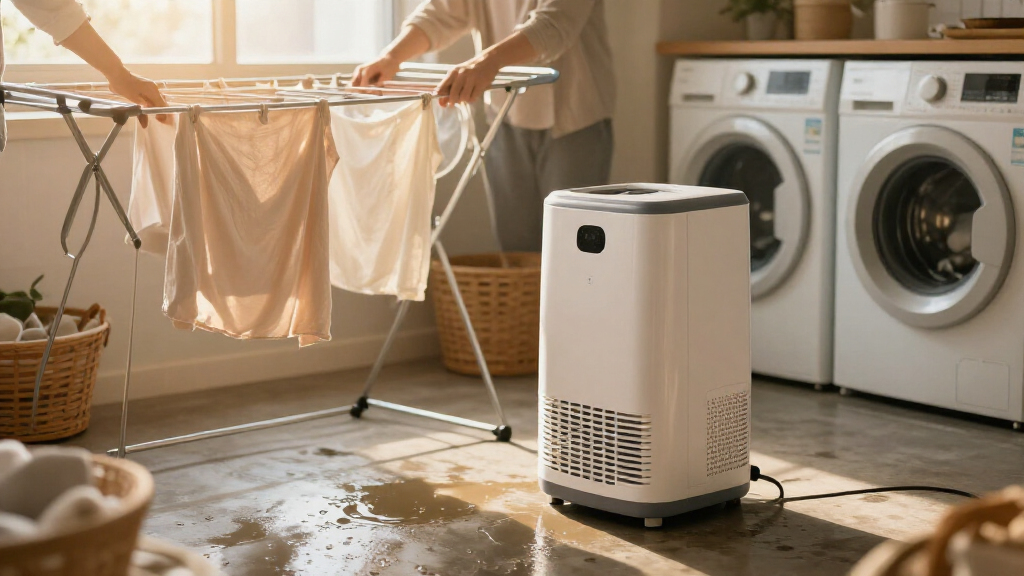
I compared these options through the specific demands of drying laundry indoors: extracting moisture from the surrounding air, running long enough to make a difference, and disposing of collected water without adding a chore every few hours. Daily pint figures are useful for comparing stated capacity, but the conditions behind them matter. ALORAIR lists both a saturation figure and an AHAM figure, while the other supplied descriptions do not provide matching test conditions. I treat the numbers as manufacturer-stated ratings rather than a direct performance contest.
Drainage received particular weight. A small reservoir may be fine for a short cycle, but wet clothes can release moisture over many hours. I looked at tank volume, whether a hose is included, and whether a pump can move water upward or across a longer route. I also considered whether the unit shuts off when its reservoir fills. A hose is helpful only when its outlet can drain reliably, so my ranking does not treat continuous drainage as a universal solution.
Noise, controls, and placement shape whether a machine fits into a home laundry routine. Where the supplied specifications state a noise level, I use it as a comparison point, not a promise that every room or fan setting will sound the same. Wheels, handles, dimensions, weight, sleep settings, humidity control, and scheduling can make a unit easier to live with. I gave extra credit to features that remove practical friction, while noting drawbacks such as small tanks, heavy bodies, limited fan choices, or short hoses.
Finally, I separated home-use units from the commercial pump model rather than pretending they serve identical buyers. A laundry room in a family home does not automatically need commercial capacity; a damp, confined space with a high drainage point may. Every pick earns its place by serving a distinct use case, and each review names the tradeoff I would weigh before choosing it.
Factors to Consider When Choosing Best Dehumidifiers For Laundry
For laundry, I would start with the room and drainage route, then decide how much capacity and convenience you need. A dehumidifier cannot make wet clothing dry instantly, but it can collect moisture from the room air as clothes release it. That makes steady operation and reliable water removal central to choosing, alongside fan noise and placement.
Match stated capacity to the laundry load
The five models span a wide range: UKOKE and KNKA each list 34 pints per day, DREO lists 75, the 80-Pint model lists up to 80, and ALORAIR gives 180 pints at saturation but 85 PPD at AHAM. These figures are not all presented under the same conditions. I use them to understand the intended scale, not to claim a precise head-to-head result. A small room with occasional drying may not benefit from a commercial unit, while multiple loads and a damp basement can justify looking beyond a 34-pint model. Coverage-area claims are also not a substitute for considering how much moisture enters the room.
Plan drainage before choosing a tank
Indoor laundry can keep a dehumidifier running for hours, so a tank may fill while clothes are still drying. The UKOKE’s 0.53-gallon reservoir is the smallest listed and makes its auto-drain option especially relevant. KNKA offers 0.79 gallons and a short included hose; DREO has a 7-liter tank and hose, while the 80-Pint model combines a 1.72-gallon tank with a hose option. ALORAIR is different: its built-in pump and long hose can move water upward. Before buying, check that a hose can reach a drain, has an appropriate route, and can discharge safely. If it cannot, compare tank size and automatic shutoff rather than assuming continuous drainage will be practical.
Treat noise figures as a guide, not a guarantee
KNKA lists 37 dB, UKOKE specifies 38 dB on low speed, the 80-Pint model lists 40 dB, and DREO lists 41 dB at its lowest fan speed. These published figures may use different methods and do not describe every setting. They can still help narrow the field for a laundry room beside a bedroom or living area. Sleep or ultra-quiet modes may matter when a unit runs through the evening, but they can involve different fan behavior. ALORAIR’s supplied specifications do not list a noise figure and give it only one fan speed, so I would favor it for a separate utility area rather than shared living space.
Think about where the unit will sit
Air needs to circulate around the machine, and the hose needs a workable route. UKOKE is listed at 20 pounds, KNKA at 8 kg, the 80-Pint model at 30 pounds, DREO at 33 pounds, and ALORAIR at 64.3 pounds. Wheels can help reposition a unit on the same floor, but they do not make a heavy model easy to carry up stairs. Check dimensions and clearance in a narrow laundry closet. UKOKE’s supplied size and weight details conflict with other figures in its description, so confirm the current listing before relying on a precise fit.
Choose controls that fit your routine
Humidity settings let you choose a target rather than run continuously without a plan. DREO adds app scheduling and energy monitoring, which may help when laundry follows a regular weekly pattern. The 80-Pint model has a 24-hour timer and adjustable outlet, while KNKA and UKOKE offer multiple modes and humidity controls. ALORAIR prioritizes continuous operation, automatic defrost, and restart after power loss. I would pay for connected controls only if remote monitoring or scheduled runs are useful; for a machine that stays in one room, physical controls and automatic shutoff may be enough.
Read capacity and energy details in context
Wattage alone does not tell you the total energy a laundry routine will use; operating time and conditions matter. The supplied figures list UKOKE at 195 watts and ALORAIR at 646 watts, but comparable wattage details are not supplied for every model. DREO lists ENERGY STAR 2025 certification, and the 80-Pint model is described as Energy Star certified. I would use certification as one selection point, then look at the actual room, run schedule, and drainage needs rather than assuming a larger capacity always means lower energy use.
Keep realistic expectations about drying
A dehumidifier collects moisture from room air; it does not replace airflow or solve every cause of dampness. Leave space around the unit and clothes rack, follow the manufacturer’s setup instructions, and use a safe drain route if running continuously. KNKA’s manual guidance says to keep the unit upright and let it stand for 24 hours after delivery before use. That is a model-specific instruction, and I would follow the manual for whichever dehumidifier I choose. Persistent dampness may also call for checking ventilation, leaks, or other sources of moisture.
Frequently Asked Questions
What size dehumidifier do I need for drying laundry indoors?
I would match the machine to both the room and the amount of laundry rather than choosing by floor-area claim alone. For occasional drying in a smaller room, the 34-pint KNKA or UKOKE may be enough to compare; repeated loads or a larger damp area make the higher stated capacities of DREO or the 80-Pint model more relevant. ALORAIR is a commercial-style option for a drainage or moisture problem that calls for its pump. Remember that the capacity ratings are not all supplied under matching test conditions.
Is a drain hose better than a water tank for laundry use?
A hose can reduce interruptions when the dehumidifier runs for hours, but it only helps if it can reach a safe, suitable drain. A tank is easier to use when there is no drain nearby, though it must be emptied when full. UKOKE’s small 0.53-gallon tank makes auto drainage particularly useful; the 80-Pint model has a larger 1.72-gallon reservoir, and ALORAIR’s pump can move water upward. Consider the room layout before treating a hose as an advantage.
Can I run a dehumidifier overnight while clothes dry?
These models list features such as automatic shutoff, sleep modes, auto defrost, or continuous operation, but I would follow the specific manufacturer’s safety and placement instructions. Keep the machine on a stable surface, leave room for airflow, and route any hose so water can drain without kinks or spills. A full-tank shutoff can prevent continued operation after the reservoir fills, but it does not remove the need to check the tank if you are not using a hose. Noise and fan settings also matter when the laundry area is near bedrooms.
Which pick is best for a laundry room without a floor drain?
If there is no floor drain, the tank becomes more important unless a hose can reach another suitable outlet. The 80-Pint model has the largest listed tank among the household options here at 1.72 gallons; DREO provides 7 liters, while KNKA holds 0.79 gallons and UKOKE only 0.53 gallons. ALORAIR’s pump can route condensate upward, but it still needs an appropriate discharge point. I would choose based on how often you can empty the tank and whether a safe alternate drain route exists.
Should I buy a commercial dehumidifier for a home laundry room?
Usually, I would not start with a commercial model unless the room has a demanding moisture problem or a specific drainage obstacle. ALORAIR’s pump and vertical lift are useful when a normal gravity-fed hose cannot reach the drain, but its 64.3-pound weight, single fan speed, and 646-watt rating make it a specialized choice. For most household laundry routines, DREO, the 80-Pint model, KNKA, or UKOKE offers a more home-oriented mix of capacity, handling, and controls.
Conclusion
For repeated loads and a need for app scheduling, I would choose the DREO 75-Pint; its combination of capacity, hose drainage, and connected controls makes it my most balanced high-output pick. A large laundry room that needs adjustable airflow and a straightforward hose option points to the 80-Pint model. For a regular but moderate home routine, KNKA offers a quieter listed noise figure and a larger tank than UKOKE, while UKOKE suits buyers who want a lighter unit and can make use of auto drainage. Choose ALORAIR when its built-in pump and vertical lift solve a real drainage problem—not simply because its saturation capacity is the largest headline figure. Across all five, I would decide on the drain route first, then weigh moisture load, room placement, and how much manual tank emptying fits your routine.
Black Friday Picks

Philips Hue Amarant Outdoor Smart Light Bar, Black
As an affiliate, we earn on qualifying purchases.