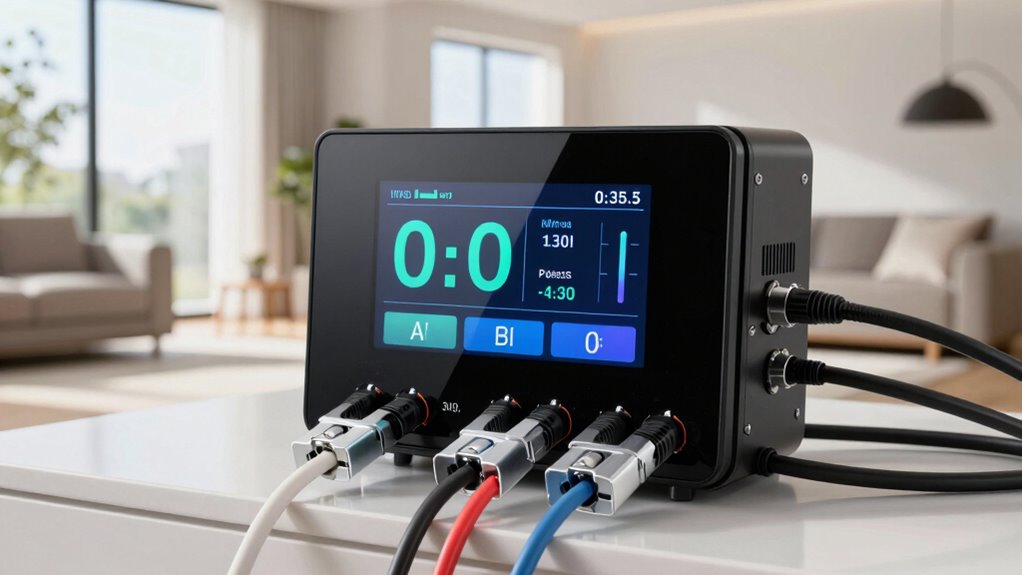

When searching for a whole house energy monitor with clamps, the goal is to get accurate, real-time insights into your home’s power usage. The Smart Home Energy Monitor with 3 80A Clamps EdgeAnt stands out for its precise tracking and user-friendly WiFi interface, making it a reliable overall choice. Meanwhile, the Emporia Vue 3 Home Energy Monitor excels for solar integration and detailed analytics, perfect for energy-conscious households. However, tradeoffs often involve balancing features like complexity against ease of setup or cost. Continue reading to see how these options compare and find the best fit for your needs.

Get home appliances delivered free with Prime
- Fast, free delivery on millions of items
- Prime Video, Amazon Music and more included
- Member-only deals all year
Complete the kit


Key Takeaways
- The most accurate monitors tend to use multiple clamps and support real-time tracking for comprehensive energy insights.
- Compatibility with smart home platforms like Home Assistant or APIs adds significant value for advanced users.
- Higher-priced options often include more sensors, better data granularity, and integration features, but may be overkill for simple needs.
- Ease of installation varies widely; some models require professional setup, while others are DIY-friendly.
- Consider the total sensor capacity—more clamps or circuit sensors mean better coverage but at a higher cost and complexity.
| Smart Home Energy Monitor with 3 80A Clamps EdgeAnt, Real-Time Accurate Energy Consumption Tracking, WiFi |  | Best Overall | Current Clamps: 3 x 80A | Connectivity: 2.4 GHz WiFi | Measurement Accuracy: ±2% | VIEW ON AMAZON | See Our Full Breakdown |
| Smart WiFi Energy Monitor with 3 x 80A Clamp for Home Power Tracking |  | Best for Remote Control and Compatibility | Sensors: 3 x 80A clamp sensors | Compatibility: Single-phase, split phase, 3-wire, 3-phase, 4-wire Wye systems | Connectivity: WiFi 2.4 GHz | VIEW ON AMAZON | See Our Full Breakdown |
| Refoss Smart Home Energy Monitor with Open API, Home Assistant, No Cloud |  | Best for Privacy and Custom Automation | Model: EM16P | Main Circuit Sensors: 2 (2–200A each) | Branch Sensors: 16 (1–60A each) | VIEW ON AMAZON | See Our Full Breakdown |
| Eyedro Smart Home Energy Monitor 200A WiFi/Ethernet |  | Best for Off-Grid and Solar Users | Current Rating: 200A | Connectivity: WiFi 2.4 GHz, Ethernet | Sensors Included: Two 200A sensors | VIEW ON AMAZON | See Our Full Breakdown |
| Smart Home Energy Monitor 2×80A, Dual-Channel WiFi Electricity Usage Tracker with App Control |  | Best for Basic Household Monitoring | Power Source: Corded Electric | Minimum Operating Voltage: 110 volts | Measurement Type: Ammeter | VIEW ON AMAZON | See Our Full Breakdown |
| Smart Home Energy Monitor with 16 50A Circuit Sensors |  | Best Overall Whole House Energy Monitor with Clamps | Sensors: 16 50A circuit sensors | Supports: Single-phase up to 240VAC, split-phase 120/240VAC, three-phase up to 415Y/240VAC | Connectivity: Wi-Fi 2.4G/5G, RJ45 wired | VIEW ON AMAZON | See Our Full Breakdown |
| Emporia Vue 3 Home Energy Monitor – Real-Time Electricity Usage and Solar Monitoring |  | Best for Solar and Mobile Insights | Certification: UL Listed | System Support: Single phase, split phase, 2-wire, 3-wire, 3-phase, 4-wire Wye | Sensors: Sixteen 50A branch sensors | VIEW ON AMAZON | See Our Full Breakdown |
| WiFi Home Energy Monitor with 3 80A CT Clamps |  | Best Compact, Easy-to-Use Circuit Monitor | Model: PW03 | Color: White | Item Weight: 13.4 ounces | VIEW ON AMAZON | See Our Full Breakdown |
| Smart Home Energy Monitor with 16 50A Circuit Sensors, Real-Time Power & Cost Tracking, Compatible with Home Assistant |  | Best for Customization and Privacy-Conscious Users | Sensors: 16 50A sensors | Supported Voltages: Single-phase to three-phase systems | Connectivity: 2.4GHz Wi-Fi, MQTT support | VIEW ON AMAZON | See Our Full Breakdown |
| whole house energy monitor with clamp | Connectivity |
|---|---|
| Smart Home Energy Monitor with | 2.4 GHz WiFi |
| Smart WiFi Energy Monitor with | WiFi 2.4 GHz |
| Refoss Smart Home Energy Monit | WiFi, Open API, MQTT |
| Eyedro Smart Home Energy Monit | WiFi 2.4 GHz, Ethernet |
| Smart Home Energy Monitor 2×80 | — |
| Smart Home Energy Monitor with | Wi-Fi 2.4G/5G, RJ45 wired |
| Emporia Vue 3 Home Energy Moni | 2.4 GHz Wi-Fi |
| WiFi Home Energy Monitor with | — |
| Smart Home Energy Monitor with | 2.4GHz Wi-Fi, MQTT support |
More Details on Our Top Picks
Smart Home Energy Monitor with 3 80A Clamps EdgeAnt, Real-Time Accurate Energy Consumption Tracking, WiFi
This model stands out for its combination of accuracy, ease of use, and solar integration. Compared with the Eyedro, it offers more precise measurements within ±2%, which benefits users focused on detailed energy analysis. Its support for bidirectional measurement makes it a strong choice for homes with solar panels. However, it excludes Delta systems and requires a stable WiFi connection, which could be limiting in some setups. The installation process is straightforward for most single-phase systems, making it suitable for typical homeowners seeking an all-in-one solution. The main tradeoff is that it doesn’t support more complex multi-phase systems, which might be a concern for larger or more advanced installations.
Pros:- Highly accurate measurements (±2%) for precise energy monitoring
- Supports bidirectional measurement for solar energy tracking
- Easy to install in most standard home electrical panels
- Real-time data accessible via smartphone app
Cons:- Does not support Delta or advanced multi-phase systems
- Requires stable WiFi connection for optimal performance
Best for: Homeowners with single-phase or split-phase systems wanting accurate, real-time energy tracking and solar integration.
Not ideal for: Homes with Delta or complex multi-phase systems, or users with unreliable WiFi connections.
- Current Clamps:3 x 80A
- Connectivity:2.4 GHz WiFi
- Measurement Accuracy:±2%
- Compatibility:Single-phase, split-phase, 2-wire, 2-phase, 3-wire Wye systems
- Data Export:Hourly, daily, monthly
Our verdict“This monitor is best suited for homeowners seeking accurate, real-time energy data with solar support in simple electrical setups.”
Smart WiFi Energy Monitor with 3 x 80A Clamp for Home Power Tracking
This pick makes sense for users who want easy installation and integration with a variety of electrical systems, thanks to its professional clamp sensors and broad compatibility. Unlike the EdgeAnt, it emphasizes remote energy management through the SmartLife app, making it ideal for those who prefer controlling and monitoring from anywhere. Its ability to support three-phase and four-wire systems broadens its use but requires professional installation for safety, which could be a barrier for DIY enthusiasts. Customer reviews highlight a moderate satisfaction level, reflecting some concerns about complexity and reliability. The tradeoff here is that it’s limited to 80A per clamp, which could be insufficient for high-power appliances or larger homes.
Pros:- Supports various electrical configurations, including three-phase systems
- Easy to install with clamp-on sensors
- Remote monitoring and control via the SmartLife app
- Suitable for multiple home types and electrical setups
Cons:- Requires professional installation for safety and compliance
- Limited to 80A sensors per clamp, restricting high-load measurements
- Moderate customer satisfaction rating suggests potential reliability issues
Best for: Tech-savvy homeowners wanting flexible system compatibility and remote monitoring via a user-friendly app.
Not ideal for: Users looking for a plug-and-play, no-install solution or with high-power circuits exceeding 80A per clamp.
- Sensors:3 x 80A clamp sensors
- Compatibility:Single-phase, split phase, 3-wire, 3-phase, 4-wire Wye systems
- Connectivity:WiFi 2.4 GHz
- App:SmartLife
- Weight:1.3 pounds
- Dimensions:2.3 x 3.5 x 4.69 inches
Our verdict“This device offers flexible system compatibility and remote control, ideal for users comfortable with professional setup seeking versatility.”
Refoss Smart Home Energy Monitor with Open API, Home Assistant, No Cloud
The Refoss EM16P scores for those wanting full control over their energy data with no reliance on cloud services. Its local API and integration with platforms like Home Assistant make it distinct from the other options like the Eyedro, which depend on cloud access. It offers ±1% measurement accuracy and detailed circuit-level insights, excellent for solar homes aiming to maximize efficiency. The main tradeoff is that installation can be more technically involved, requiring some familiarity with home automation systems. Its sensor capacities (up to 200A main and 60A branches) are suitable for most residential setups but might limit use in very high-load scenarios.
Pros:- Local control with no cloud dependency for privacy
- Seamless integration with Home Assistant and OpenClaw AI
- High measurement accuracy (±1%) and detailed circuit data
- Supports solar energy maximization and detailed alerts
Cons:- Installation may require technical expertise
- Limited to circuit sensors up to 200A / 60A per branch
- Price not specified, potentially higher for advanced features
Best for: Tech-savvy homeowners and solar enthusiasts who prioritize data privacy and automation integration.
Not ideal for: Users seeking a simple plug-and-play device or with limited technical skills for installation and setup.
- Model:EM16P
- Main Circuit Sensors:2 (2–200A each)
- Branch Sensors:16 (1–60A each)
- Connectivity:WiFi, Open API, MQTT
- Accuracy:±1%
- Certification:ETL, UL 61010
Our verdict“Ideal for technically skilled users seeking detailed, private energy insights with automation flexibility.”
Eyedro Smart Home Energy Monitor 200A WiFi/Ethernet
This monitor excels for users needing comprehensive real-time insights combined with flexible connectivity, supporting WiFi and Ethernet options. Its capacity for solar, grid, and net metering makes it particularly well-suited for off-grid or solar-integrated households, unlike the more specialized modules like the EdgeAnt or Refoss. Setup can be complex, especially since it requires two devices for net metering, which might deter casual users. Its support for North American standards ensures compliance locally but limits international use. Compared to others, it offers broad compatibility and no subscription fees, but its physical and network setup might be challenging for some.
Pros:- Supports solar, grid, and net metering applications
- Flexible connectivity with WiFi and Ethernet
- No subscription fee for cloud access
- Real-time energy consumption data
Cons:- Requires two devices for net metering setup
- Setup complexity can be high for non-technical users
- Limited to North American safety standards
Best for: Homeowners with solar or off-grid systems seeking reliable, versatile energy monitoring.
Not ideal for: Users who prefer a single, simplified device or those outside North America due to standard limitations.
- Current Rating:200A
- Connectivity:WiFi 2.4 GHz, Ethernet
- Sensors Included:Two 200A sensors
- Compatibility:Solar, grid, net metering
- Standards:North American safety standards
- Includes:Ethernet cable, power adapter, access to MyEyedro cloud
Our verdict“This monitor offers flexible, comprehensive energy tracking perfect for solar or off-grid homes willing to handle a more involved setup.”
Smart Home Energy Monitor 2×80A, Dual-Channel WiFi Electricity Usage Tracker with App Control
This device makes sense for users who want simple, real-time energy monitoring with dual channels to track two circuits separately. Compared to the more advanced options like the Refoss or EdgeAnt, it offers easy setup and app control through Tuya and Smart Life, making it accessible for typical homeowners. Its dual 80A channels are suitable for most household circuits but might fall short for high-power appliances or larger homes. The main limitation is that it relies heavily on WiFi and smartphone apps, which could be a drawback for users who prefer local control or have unstable internet. This monitor balances ease of use with enough detail for everyday energy management.
Pros:- Provides real-time energy monitoring for two circuits
- Supports bi-directional energy tracking, helpful for solar setups
- Easy to install with clamp sensors
- App control via popular smart home platforms
Cons:- Limited to 80A per channel, restricting high-power appliances
- Requires WiFi and smartphone app setup
- Basic functionality may not satisfy advanced users
Best for: Homeowners seeking straightforward, real-time energy data for two circuits without complex installation or automation needs.
Not ideal for: Power users with high-load appliances exceeding 80A or those requiring advanced automation features.
- Power Source:Corded Electric
- Minimum Operating Voltage:110 volts
- Measurement Type:Ammeter
- Compatible Devices:Tuya, Amazon Alexa, Google Home
- Style:80A Dual Channel
Our verdict“This monitor offers simple, dual-channel energy tracking ideal for basic household use and solar integration.”
Smart Home Energy Monitor with 16 50A Circuit Sensors
This monitor stands out for its comprehensive support of multiple connection types and high sensor capacity, making it suitable for detailed whole-house energy management. Compared to models like the Emporia Vue 3, it offers more flexible installation options and supports three-phase systems, which is vital for larger or more complex electrical setups. However, it demands some technical know-how for setup, and its lack of remote access features limits convenience. Its clamp-on sensors simplify installation, but the interface and data access could be more user-friendly. This pick makes the most sense for homeowners who want detailed, real-time energy data across a large or complex system and are comfortable with some technical installation.
Pros:- Supports multiple connection types, including Wi-Fi and wired Ethernet
- Handles up to 16 50A circuit sensors for detailed monitoring
- Easy to install with clamp-on sensors inside circuit panels
- Supports three-phase systems for larger homes or commercial setups
Cons:- Requires some technical knowledge for proper installation
- Limited to single or multi-phase systems, not designed for simple plug-and-play use
- No dedicated mobile app or remote access features
Best for: Homeowners with multi-phase or complex electrical systems seeking detailed, real-time energy insights and safety improvements
Not ideal for: Casual users or renters who prefer plug-and-play solutions without technical setup or extensive customization
- Sensors:16 50A circuit sensors
- Supports:Single-phase up to 240VAC, split-phase 120/240VAC, three-phase up to 415Y/240VAC
- Connectivity:Wi-Fi 2.4G/5G, RJ45 wired
- Installation:Clamp-on sensors for circuit panel
- Weight:4 pounds
- Dimensions:5.75 x 2.95 x 1.1 inches
Our verdict“This monitor is ideal for tech-savvy homeowners with complex electrical systems who want detailed, real-time energy data.”
Emporia Vue 3 Home Energy Monitor – Real-Time Electricity Usage and Solar Monitoring
The Emporia Vue 3 distinguishes itself with UL certification and a focus on solar integration, making it well-suited for households with solar panels or those seeking reliable safety standards. Its detailed mobile app provides actionable insights, similar to the data-rich experience offered by the B0D6VZQBPF, but with the added benefit of monitoring solar output and net metering. While installation is straightforward, it relies solely on 2.4 GHz Wi-Fi, which could limit connectivity stability in some homes. Its data retention period is sufficient for most users, but those needing long-term historical data might find it limiting. This monitor is best for solar owners or energy-conscious households wanting comprehensive, reliable data via a user-friendly app.
Pros:- UL-certified for safety and reliability
- Supports solar and net metering for solar owners
- Provides detailed real-time energy data via mobile app
- Flexible installation options for various system configurations
Cons:- Requires 2.4 GHz Wi-Fi connection, which may cause connectivity issues
- Limited data retention for short-term intervals (7 days for 1-minute data)
- Advanced system setup might need additional sensors
Best for: Homeowners with solar installations looking for reliable, real-time energy and solar monitoring via a mobile app
Not ideal for: Users with only basic energy tracking needs or those without stable 2.4 GHz Wi-Fi connections
- Certification:UL Listed
- System Support:Single phase, split phase, 2-wire, 3-wire, 3-phase, 4-wire Wye
- Sensors:Sixteen 50A branch sensors
- Connectivity:2.4 GHz Wi-Fi
- Data Retention:7 days for 1-minute data
- Warranty:1 year
Our verdict“This monitor is perfect for solar-equipped households seeking reliable, detailed energy data through an easy-to-use mobile app.”
WiFi Home Energy Monitor with 3 80A CT Clamps
This compact WiFi-enabled monitor offers simple tracking of up to three circuits, making it suitable for small homes, workshops, or specific appliance monitoring. Its compatibility with the Smart Life or Tuya app allows for real-time voltage, current, and power data, similar to the more comprehensive models like the B0D6VZQBPF. However, its limited number of clamps restricts it to partial home monitoring rather than whole-house oversight. Installation involves wiring, which might require professional help for those unfamiliar with electrical work. The moderate customer rating suggests some users find it lacking in durability or ease of setup. This device makes sense for users needing targeted circuit monitoring without the complexity or cost of a whole-house system.
Pros:- Supports monitoring of up to three circuits simultaneously
- Real-time data access via popular Smart Life or Tuya app
- Includes temperature alerts and remote circuit control
Cons:- Installation requires electrical wiring, which may need professional help
- Limited to three circuits, not suitable for whole-house monitoring
- Customer satisfaction is moderate, indicating potential reliability issues
Best for: Homeowners or small business owners wanting simple, real-time monitoring of a few circuits or appliances
Not ideal for: Those seeking comprehensive, whole-house energy management or non-technical users uncomfortable with wiring
- Model:PW03
- Color:White
- Item Weight:13.4 ounces
- Product Dimensions:4.2 x 2.5 x 1.2 inches
- Input Voltage:AC 100–240V
- Clamps Included:3 CT clamps
- Max Relay Current:15A
Our verdict“This is a good choice for users wanting quick, targeted insights into specific circuits without the complexity of full-home monitoring.”
Smart Home Energy Monitor with 16 50A Circuit Sensors, Real-Time Power & Cost Tracking, Compatible with Home Assistant
This monitor excels in adaptability, supporting multiple phases and offering detailed real-time power and cost data via Wi-Fi and MQTT. Its ability to operate with LAN-only mode provides privacy benefits, making it suitable for shared or rental homes where data security is a concern. Compared to the Emporia Vue 3, it offers greater flexibility for advanced users who want to integrate with home automation platforms like Home Assistant. The need for MQTT setup and compatible server can be a hurdle for less technical users, and its reliance on flexible sensors means installation might be more complex. This device makes sense for those prioritizing customization, privacy, and integration into broader smart home systems.
Pros:- Supports multiple phases and detailed real-time data
- Offers LAN-only mode for privacy and MQTT support for customization
- Easy to install with clamp-on sensors and flexible access options
- Ideal for rental properties or shared living spaces
Cons:- Requires MQTT server or advanced app setup, which can be complicated
- Limited to Wi-Fi and LAN environments, not standalone or cloud-based
- Flexible sensors may need access points like busbar or specialized wiring
Best for: Energy-savvy households or renters interested in custom automation, privacy, and detailed cost tracking
Not ideal for: Less technical users or those who prefer plug-and-play solutions without setup complexity
- Sensors:16 50A sensors
- Supported Voltages:Single-phase to three-phase systems
- Connectivity:2.4GHz Wi-Fi, MQTT support
- Warranty:1 year
- Monitoring Range:Now, day, week, month, year
Our verdict“This monitor is best suited for users who want highly customizable, private energy monitoring within a smart home ecosystem.”
How We Picked
These products were selected based on their clamp capacity, measurement accuracy, user interface, connectivity options, and overall build quality. We prioritized devices that support real-time monitoring and are compatible with standard home electrical systems. Cost and ease of installation were also considered, ensuring options suit both beginners and advanced users. The ranking reflects a balance between value, feature set, and usability, highlighting options for different household sizes and technical comfort levels.Factors to Consider When Choosing Whole House Energy Monitor With Clamps
Choosing the right whole house energy monitor with clamps involves several considerations that go beyond just features. First, evaluate your home’s electrical system capacity and the number of circuits you want to monitor. Compatibility with existing smart home setups can enhance functionality, especially if you plan to integrate energy data with other devices. Ease of installation varies, so consider whether you prefer a DIY approach or professional setup. Cost is another factor—more sensors and advanced features typically come with higher price tags. Lastly, look for devices with robust data logging and reporting capabilities to help you make meaningful energy improvements over time.Clamp Capacity and Number of Circuits
The number and capacity of clamps directly influence how much of your home’s electrical system you can monitor. Larger homes or those with multiple circuits benefit from monitors that support several clamps, ensuring comprehensive coverage. Devices with fewer clamps may miss crucial data, leading to incomplete insights. Be mindful of your home’s wiring and plan accordingly to avoid overloading or compatibility issues. Investing in a monitor with sufficient clamp capacity helps future-proof your setup, especially if you expand your energy monitoring or add solar systems.
Compatibility and Integration
Many monitors now support integration with popular smart home platforms like Home Assistant, Google Home, or Alexa. Compatibility can significantly extend the monitor’s functionality, allowing you to automate energy-saving routines or view data via existing dashboards. Some devices also offer open APIs or local data access, appealing to tech-savvy users who want full control. On the flip side, incompatible systems or proprietary platforms might limit your options or increase setup complexity. Consider your current home automation ecosystem when choosing a monitor to ensure smooth integration and future expandability.
Ease of Installation
Installation difficulty varies among models, with some designed for straightforward DIY setup and others requiring professional wiring. For homeowners comfortable with electrical work, models with fewer components and clear instructions are ideal. Conversely, complex systems with many sensors or additional hardware may justify professional installation but add to upfront costs. Think about your comfort level, available tools, and whether you prefer a plug-and-play device or a more integrated approach. Proper installation is vital for accurate readings and safety, so don’t overlook the support resources offered by the manufacturer.
Data Logging and Reporting Features
Accurate, accessible data is the backbone of effective energy management. Look for monitors that log historical data, provide real-time updates, and generate useful reports. Some models offer cloud storage, while others allow local data access, which can be more secure and reliable. The frequency of data updates and the granularity of measurements also matter—higher resolution helps identify specific energy drains. Think about whether you need detailed analytics, simple dashboards, or integration with third-party apps—your choice should match your energy goals and technical expertise.
Cost vs. Features
Price points vary widely, often reflecting the number of sensors, connectivity options, and advanced features. Higher-cost models generally offer better accuracy, more sensors, and extensive integration, making them suitable for energy geeks or larger households. Cheaper options may suffice for basic monitoring but could lack detail or reliability. It’s important to weigh your budget against your goals—if you only want a general idea of your energy usage, a more affordable model may be enough. For comprehensive energy management, investing in a premium device might pay off in long-term savings and insights.
Frequently Asked Questions
Can I install a whole house energy monitor with clamps myself?
Many models are designed for DIY installation and come with detailed instructions, making it feasible for homeowners with basic electrical skills. However, working with high-voltage circuits can be dangerous, and improper installation may result in inaccurate readings or safety hazards. If you’re unsure about wiring or circuit connections, hiring a professional electrician is advisable. Proper setup ensures reliable data collection and reduces risks, so weigh your comfort level carefully before proceeding with a DIY approach.
Will a whole house energy monitor work with my solar system?
Many monitors support solar integration, allowing you to track both consumption and solar production. Devices like the Emporia Vue 3 are particularly suited for households with solar panels, providing detailed insights into energy flow and savings. Compatibility depends on the sensor types and communication protocols, so check whether the monitor supports your inverter or solar setup. Proper integration can help optimize your energy use, but ensure the monitor’s specifications match your existing solar equipment for accurate data.
How accurate are these monitors in reflecting actual energy consumption?
The accuracy of a whole house energy monitor largely depends on the quality of its clamps, sensors, and calibration. Devices with multiple clamps and high-quality hardware tend to deliver more precise readings. However, even the best monitors can have small margins of error due to wiring nuances or sensor placement. Regular calibration and proper installation mitigate inaccuracies. For critical energy management, choosing a monitor with proven accuracy specs and positive user reviews is essential.
Do I need an internet connection for these monitors to work?
Many modern monitors rely on WiFi or Ethernet for real-time data access, remote monitoring, and cloud storage. However, some models offer local-only data access, which can be preferable for privacy and reliability reasons. If remote access or integration with smart home platforms is important to you, an internet connection is usually required. Conversely, standalone models with local dashboards can operate without internet but may have limited features. Consider your connectivity preferences when selecting a monitor.
What should I consider if I want to expand my energy monitoring system later?
Think about the scalability of the system—whether it supports additional clamps or sensors for future expansion. Some monitors are modular, allowing you to add more sensors as needed, while others are fixed. Compatibility with existing home automation systems or APIs can also make expansion smoother. Budget for potentially higher costs upfront if you anticipate growing your system later. Choosing a flexible, scalable monitor ensures you won’t need to replace it entirely as your energy tracking needs evolve.
Conclusion
For most homeowners seeking an all-around effective solution, the Smart Home Energy Monitor with 3 80A Clamps EdgeAnt offers a balanced mix of accuracy, usability, and connectivity. If solar tracking and detailed analytics are priorities, the Emporia Vue 3 stands out as the best premium choice. Beginners or those with simple needs may prefer models with fewer sensors and straightforward installation, like the Refoss Smart Home Energy Monitor. For advanced users wanting full customization and local control, monitors supporting open APIs and multiple sensors provide the best value. Your choice should align with your home’s size, your technical comfort level, and your energy management goals.Fall yard work Picks
leaf blowers
As an affiliate, we earn on qualifying purchases.