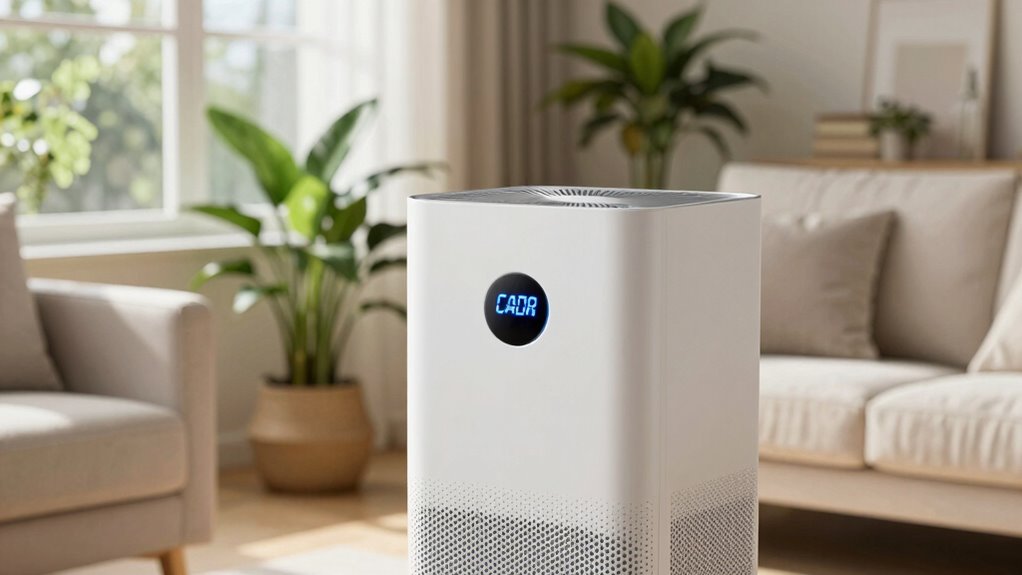

The CADR rating is the most important number when choosing an air purifier because it shows how well the device cleans the air in your space. It measures how effectively it removes pollutants like smoke, dust, and pollen, giving you a clear idea of real-world performance. Higher scores usually mean better filtration and faster results. If you want to learn more about how to pick the right model, keep exploring this topic.
Key Takeaways
- CADR ratings directly measure an air purifier’s efficiency in removing pollutants like smoke, dust, and pollen.
- Matching CADR to room size ensures effective air cleaning tailored to specific indoor spaces.
- Higher CADR often indicates better filter performance and overall air purification effectiveness.
- CADR helps compare models objectively, aiding in selecting devices suited to particular pollutants and needs.
- It is the most reliable number to assess a purifier’s real-world ability to improve indoor air quality.
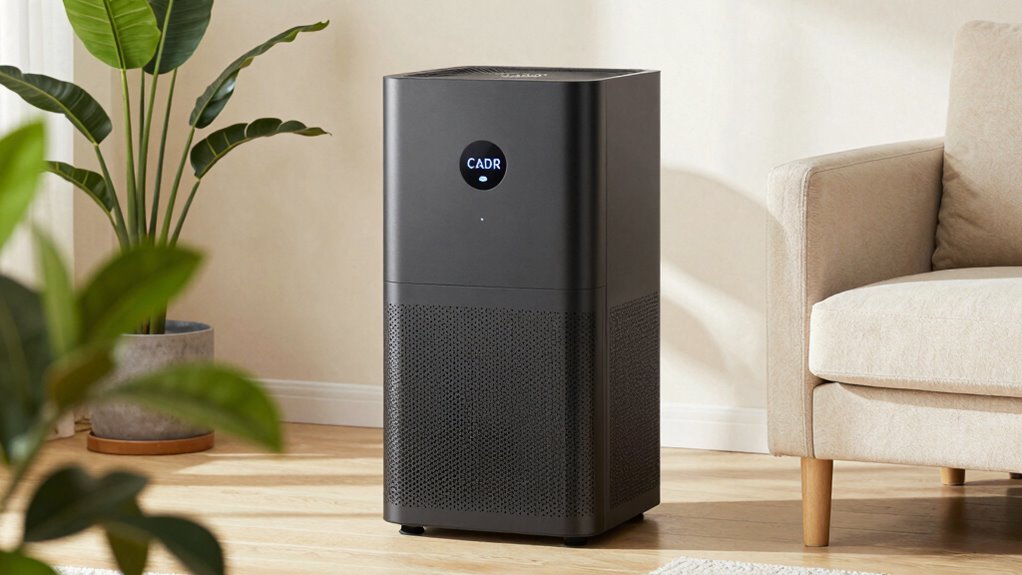
Have you ever wondered how to choose the most effective air purifier? If so, you’re not alone. With countless models and features on the market, it can be overwhelming to determine which one will truly improve your indoor air quality. That’s where understanding the CADR rating comes into play. CADR, or Clean Air Delivery Rate, is the number that helps you compare how well different air purifiers perform in removing specific pollutants like smoke, dust, and pollen. It’s the only number that really matters because it directly reflects the device’s ability to clean the air in your space efficiently.
When considering air quality, you want a purifier that can handle the size of your room and the level of pollutants present. CADR ratings give you a clear, measurable standard to assess this. Unlike other features or specifications, which can be confusing or misleading, CADR provides a straightforward way to evaluate a purifier’s real-world effectiveness. For example, a high CADR in smoke indicates the purifier can quickly remove airborne tobacco smoke, while a high CADR in dust shows it’s capable of capturing larger particles that settle on surfaces. This allows you to match the purifier’s strengths to your specific needs, whether you’re dealing with allergies, asthma, or general air cleanliness.
Filter efficiency also plays a critical role in the overall performance of an air purifier. A high CADR rating often correlates with good filter efficiency, meaning the filter can trap a significant percentage of airborne particles without quickly clogging. It’s important to choose a purifier with a filter that’s designed for your particular concerns, such as HEPA filters for allergens or activated carbon filters for odors and chemicals. But no matter how advanced the filter is, if the air purifier’s CADR isn’t high enough for your room size, it won’t deliver the results you want.
In addition, the technology used in filters can impact the overall effectiveness and longevity of the air purifier, making CADR an even more essential metric for comparison. In essence, understanding the relationship between air quality, filter efficiency, and CADR ratings helps you make smarter choices. You want a device that balances a high CADR with a filter capable of efficiently capturing pollutants without sacrificing airflow or energy efficiency. Remember, the CADR rating is a reliable benchmark that allows you to compare different models objectively, so you can select an air purifier that genuinely improves your indoor environment. When you focus on this number, you’re making an informed decision that leads to cleaner, healthier air in your home or office.

KNKA Air Purifier for Home Bedroom Large Room Up to 1,695 Ft² in 1 Hr, HEPA Air Cleaner with Washable Pre-Filter, AQI Display, ECO Mode, Sleep Mode, Pet Mode for Pets, Dust, Pollen, APH4000
𝐇𝐢𝐠𝐡 𝐂𝐀𝐃𝐑 𝐕𝐚𝐥𝐮𝐞: This air purifier provides reliable performance with a Smoke/Dust/PM2.5 CADR of 226 CFM (384 m³/h)…
As an affiliate, we earn on qualifying purchases.
As an affiliate, we earn on qualifying purchases.
Frequently Asked Questions
How Is CADR Measured for Different Pollutants?
You can measure CADR for different pollutants by testing how effectively your air purifier removes specific pollutant particles in a controlled measurement environment. During testing, the device’s ability to filter particles like dust, smoke, or pollen is evaluated, and the CADR score reflects how many particles are cleared per cubic foot of air per minute. This process guarantees you understand your purifier’s efficiency for each pollutant type.
Do Higher CADR Ratings Always Mean Better Air Quality?
Higher CADR ratings generally indicate better air purifier technology and more effective removal of pollutants, but they don’t always guarantee superior air quality. Your preferences matter—consider factors like room size, filter type, and specific pollutants you want to target. So, while a higher CADR can be a good sign, it’s crucial to match the purifier’s features with your needs for ideal results.
Can CADR Ratings Be Compared Across Different Brands?
You might find it tempting to compare CADR ratings across brands, but brand reputation and user reviews matter just as much. While higher CADR suggests better air cleaning, different brands may use varying testing standards, making direct comparisons tricky. Coincidentally, a well-reviewed brand with a solid reputation often provides more reliable performance, so don’t rely solely on numbers. Instead, consider user reviews and brand trust to make a smarter choice.
How Often Should I Check or Update My Air Purifier’s CADR?
You should check your air purifier’s CADR periodically, ideally every six months, to guarantee peak performance. Follow your maintenance schedule and pay attention to replacement indicators like filter lifespan alerts or reduced airflow. Regularly inspecting and updating your filters helps maintain high CADR ratings, ensuring cleaner air. If you notice decreased effectiveness or unusual noises, it’s time to replace filters or service your unit to keep it running efficiently.
Do CADR Ratings Consider Noise Levels and Energy Efficiency?
CADR ratings focus mainly on how effectively an air purifier cleans the air, but they don’t consider noise levels or energy efficiency. When choosing a purifier, you should check these factors separately, as a high CADR might mean louder operation or higher energy consumption. Look for models with quiet operation and good energy ratings to balance air cleaning power with comfort and cost efficiency.
KNKA Air Purifier for Home Bedroom Large Room Up to 1,695 Ft² in 1 Hr, HEPA Air Cleaner with Washable Pre-Filter, AQI Display, ECO Mode, Sleep Mode, Pet Mode for Pets, Dust, Pollen, APH4000
𝐇𝐢𝐠𝐡 𝐂𝐀𝐃𝐑 𝐕𝐚𝐥𝐮𝐞: This air purifier provides reliable performance with a Smoke/Dust/PM2.5 CADR of 226 CFM (384 m³/h)…
As an affiliate, we earn on qualifying purchases.
As an affiliate, we earn on qualifying purchases.
Conclusion
So, the next time you’re choosing an air purifier, remember that CADR ratings are what truly matter. They tell you how well the purifier cleans your air, not just what it claims. Doesn’t your home deserve the best protection possible? Don’t settle for less—choose a purifier with a high CADR rating, and breathe easier knowing you’ve made the right decision for your health. After all, isn’t clean air worth it?

AROEVE Air Purifiers for Bedroom Home, Air Purifier For Smoke Pollen Dander Hair Smell Air Cleaner with Sleep Mode Speed Control For Bedroom Office, MK01- White(Available for California)
Impressive Particle Filtration: AROEVE air purifier utilizes filter that can filter out particles such as smoke, pollen, dander,…
As an affiliate, we earn on qualifying purchases.
As an affiliate, we earn on qualifying purchases.

Air Purifiers for Home with H13 Quiet HEPA Filter Up to 1076 Ft² for Pet Hair, Odors, Pollen, Smoke, Compact Air Cleaner with 3 Speeds, Timer, Aroma Quiet 360°Intake Filter, White
Effortless Operation: Simplified control panel with intuitive design makes it easy to operate. No complicated setup—just one tap,…
As an affiliate, we earn on qualifying purchases.
As an affiliate, we earn on qualifying purchases.