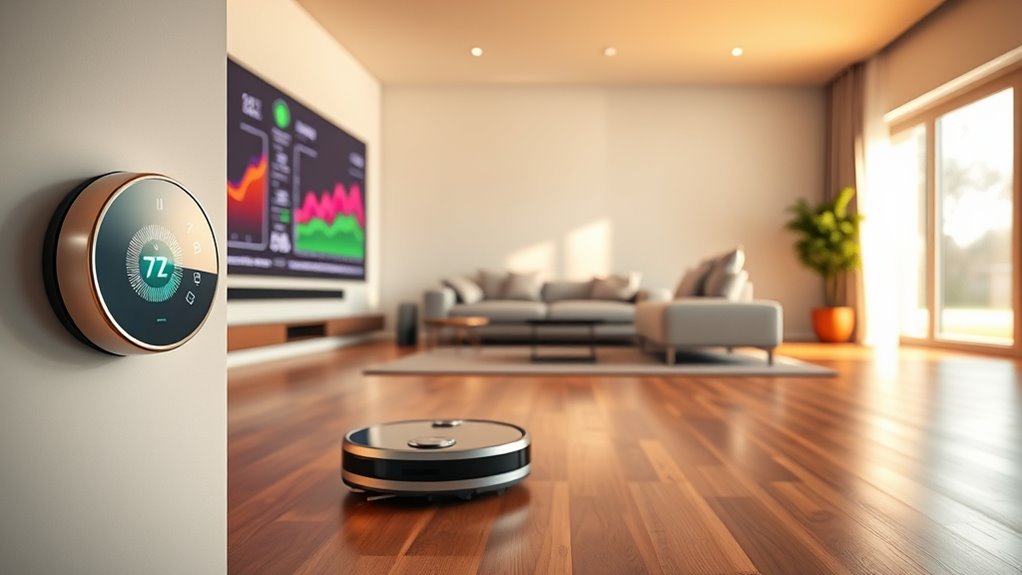

AI plays a key role in optimizing your household energy use by intelligently controlling heating, cooling, and appliances based on real-time data. It learns your routines and preferences, adjusting settings automatically for comfort and efficiency. By forecasting demand and analyzing usage patterns, AI helps you save energy and reduce costs. If you want to discover how these technologies work together to create a smarter, more sustainable home, keep exploring the details behind this innovation.

Get home appliances delivered free with Prime
- Fast, free delivery on millions of items
- Prime Video, Amazon Music and more included
- Member-only deals all year
Key Takeaways
- AI learns household routines to automatically adjust heating and cooling for comfort and energy efficiency.
- Energy monitoring tools provide real-time data, enabling AI to identify usage patterns and inefficiencies.
- AI analyzes energy data to optimize appliance operation and reduce waste through smarter scheduling.
- Predictive algorithms forecast future energy needs, allowing preemptive adjustments and load management.
- Overall, AI enhances energy management by automating decisions, reducing costs, and supporting sustainable living.
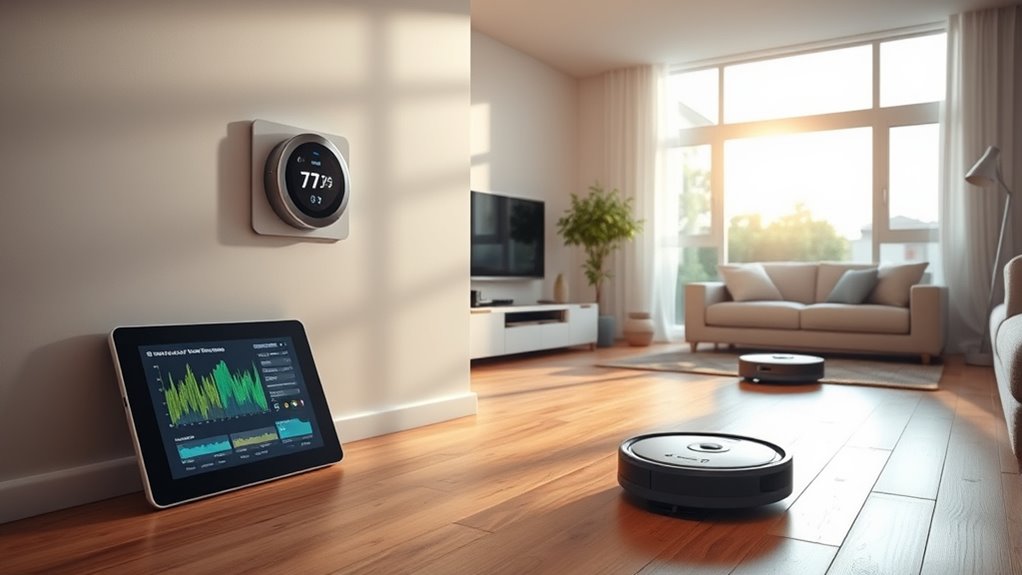
Artificial Intelligence is transforming how households manage energy, making it easier for you to save money and reduce your environmental impact. One of the most significant advancements is the integration of smart thermostats, which leverage AI to optimize your home’s heating and cooling systems. These devices learn your daily routines, preferences, and even your schedule, adjusting temperature settings automatically to ensure comfort while minimizing energy waste. Instead of manually setting the thermostat every day, AI-powered smart thermostats analyze data from your habits and adjust accordingly, saving you money on energy bills without sacrificing comfort.
AI-powered smart thermostats learn your routines to save energy and money effortlessly.
Energy monitoring tools are another game-changer, giving you real-time insights into your household’s energy consumption. With AI-driven energy monitoring systems, you can track how much electricity your appliances use and identify patterns or inefficiencies. These systems often come with user-friendly apps or dashboards that provide detailed breakdowns, helping you pinpoint which devices are consuming the most power. When you know where your energy is going, you can make smarter decisions about usage, like turning off unused appliances or scheduling high-energy tasks during off-peak hours. This not only cuts costs but also reduces your carbon footprint.
Combining smart thermostats with energy monitoring creates a powerful synergy. AI analyzes the data from your energy monitoring system to refine heating and cooling schedules, ensuring your home stays comfortable while consuming the least amount of energy possible. For instance, if your energy monitoring indicates that certain rooms are seldom used, your smart thermostat can adjust temperature settings accordingly, avoiding unnecessary heating or cooling in those areas. This dynamic approach maximizes efficiency and minimizes waste, all while you go about your daily routine.
Furthermore, AI can predict future energy needs based on weather forecasts, occupancy patterns, and historical data. This predictive capability allows your household systems to prepare in advance, further optimizing energy use. If a cold front is approaching, your smart thermostat can preheat your home beforehand, reducing the need for sudden, energy-intensive adjustments. These intelligent systems also adapt over time, learning from your habits and refining their algorithms to become even more efficient.
AI smart thermostat for energy savings
As an affiliate, we earn on qualifying purchases.
As an affiliate, we earn on qualifying purchases.
Frequently Asked Questions
How Does AI Predict Future Household Energy Needs?
You can see how AI predicts your future household energy needs through smart grid systems that analyze your usage patterns. By applying predictive analytics, AI learns when you typically use the most energy and anticipates future demands. It continuously monitors real-time data, adjusts for weather changes, and forecasts your energy consumption, helping optimize your energy use efficiently and prevent waste before it happens.
Can AI Adapt to Seasonal Energy Consumption Changes?
Yes, AI can adapt to seasonal energy changes using adaptive algorithms. While your energy needs fluctuate with seasons, AI continuously learns from your usage patterns and adjusts accordingly. This dynamic process guarantees efficient energy consumption year-round, whether it’s heating in winter or cooling in summer. By staying responsive to these variations, AI helps you save energy and money, making your household smarter and more sustainable without manual intervention.
What Are Privacy Concerns With AI Monitoring Energy Use?
You might be concerned about privacy when AI monitors your energy use. The main issues are data security and user privacy, since AI systems collect detailed information about your habits. If data isn’t properly protected, it could be accessed or misused. To safeguard your privacy, guarantee your AI provider uses robust security measures and transparent data policies, so your personal energy patterns stay confidential and secure.
How Affordable Are Ai-Powered Energy Management Systems?
AI-powered energy management systems are becoming increasingly affordable, especially when you compare costs to traditional energy solutions. The affordability factors include installation expenses, technology advancements, and potential energy savings. While upfront costs vary, many systems offer cost comparison benefits over time through reduced energy bills. Overall, these systems are more accessible now, making it easier for you to adopt smarter energy solutions without breaking the bank.
Do AI Systems Require Professional Installation or Maintenance?
AI systems generally don’t require professional installation or maintenance if they come with user-friendly AI hardware and clear installation procedures. Many smart energy management devices are designed for easy setup, allowing you to connect and configure them yourself. However, for complex setups or troubleshooting, consulting a professional might be helpful. Regular updates and monitoring can usually be handled by you, keeping the system optimized without extensive expertise.
Conclusion
By now, you can see how AI transforms your home energy use. With smart algorithms, you could reduce your energy bills by up to 30%, making a real difference. AI’s ability to learn your habits and optimize energy consumption means you’ll save money and help the environment. Embracing this technology isn’t just smart — it’s essential for a sustainable future. So, why not harness AI to make your household more efficient today?
Cold & flu season Picks
humidifiers
As an affiliate, we earn on qualifying purchases.